
What Happens When You Bust in Blackjack and How to Avoid It
The bust is the only way you can lose a blackjack hand before the dealer plays. Draw a card that pushes your total past 21 and your bet is gone, immediately, unconditionally, regardless of what the dealer holds. The dealer could bust on the very next draw and it does not matter. Your hand was dead before they started. This asymmetry is one of the key mathematical disadvantages players face: you draw first, and you lose first if you go over. Understanding bust probability is how you decide when drawing a card is worth the risk and when it is not.
What a Bust Is and Why It Matters
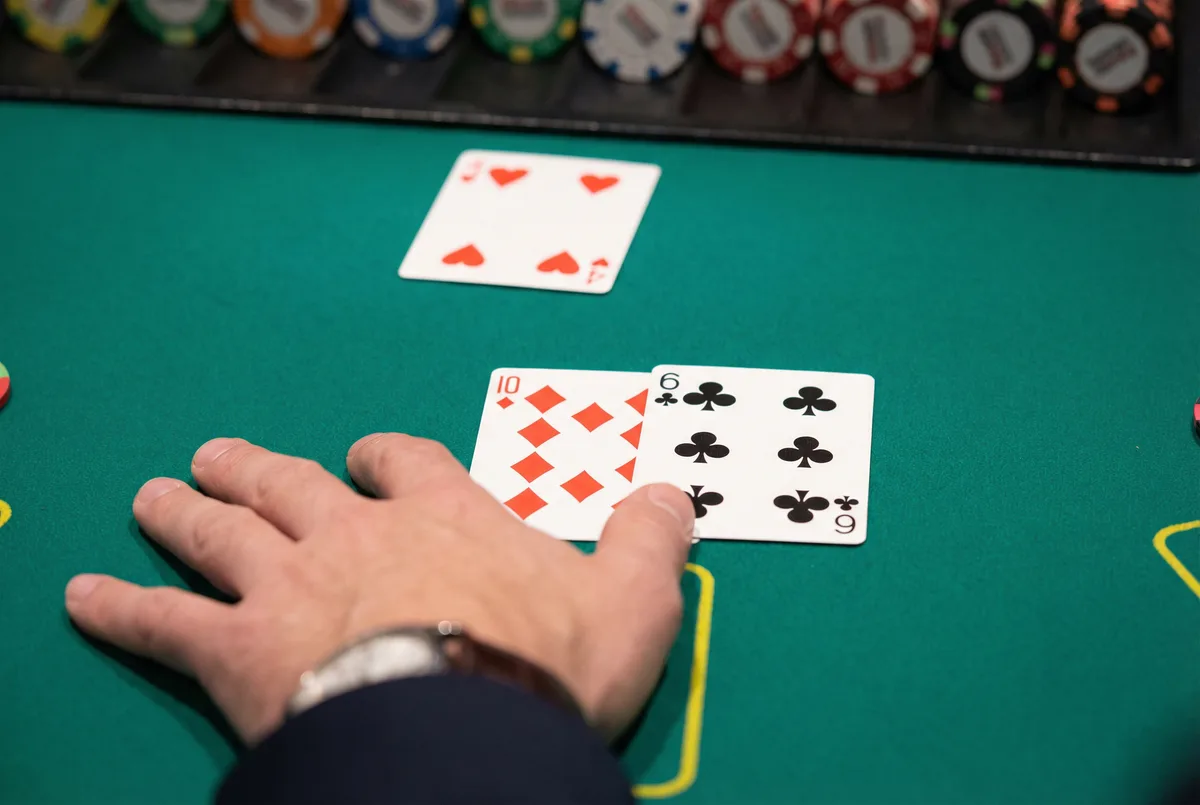
A bust occurs when the total value of your hand exceeds 21. There is no partial loss, no reduced payout, and no second chance. The dealer sweeps your chips before drawing their own cards. This creates what poker players call an asymmetric loss condition: your draw risk is resolved before the dealer’s draw risk begins. You can both bust in the same round, but only your loss counts.
The bust rule is the primary source of the casino’s blackjack house edge in blackjack. Players draw to their hands under uncertainty while the dealer draws with perfect information about whether they need to draw at all (their total is visible once the hole card is revealed). Because players resolve their hands first, the dealer wins all player busts even on hands where the dealer would have busted anyway. Across millions of hands, this creates a persistent edge for the house that no amount of intuition can overcome.
Dealer Shows
Your Hand
You hold hard 16 against a dealer 10 upcard. You know the dealer has a 35% chance of busting. Do you stand and hope they bust, or hit to avoid losing to a dealer 20?
Hard 16 against a dealer 10 is a hit in basic strategy. Standing on 16 wins only when the dealer busts (approximately 23%). Hitting 16 gives you roughly 26% survival outcomes where you improve. The expected loss from standing is slightly higher than from hitting. The math favors the draw even though it feels wrong.
The reason hard 16 against a dealer 10 requires a hit despite the high personal bust risk comes back to the asymmetry above. Standing on 16 pins your only win condition on the dealer busting. Hitting 16 creates additional win paths: drawing an Ace through 5 improves your hand to 17-21 without busting. Those improvement cards make up approximately 38% of a standard deck. The expected value calculation over thousands of hands favors hitting, even accounting for the 62% bust probability of the 16 itself.
What Is the Bust Probabilities for Every Stiff Hand Total?
Every stiff hand (12 through 16) carries a different bust probability when you draw: hard 12 busts 31% of the time on the next card, rising to 62% for hard 16 and 69% for hard 17. The probability is calculated by counting how many cards in a full deck would push you past 21, divided by the remaining deck size. Understanding these numbers prevents the common mistake of treating all stiff hands as equally dangerous.
Hard 12 busts on a 10-value card only, since any card from Ace through 9 keeps you at 13-21. With 16 cards of value 10 in a 52-card deck, hard 12 has a 30.8% bust probability on the next draw. Hard 13 busts on a 9 or 10, so the bust probability rises to 38.5%. Hard 14 busts on 8, 9, or 10: 46.2%. Hard 15 busts on 7, 8, 9, or 10: 53.8%. Hard 16 busts on 6, 7, 8, 9, or 10: 61.5%. Hard 17 busts on anything except Ace: 69.2%.
⚠ Alert
Never Stand on Hard 11 or Below
Hard 11 and below cannot bust on a single draw. There is no card in the deck that will push a total of 11 past 21. Standing on these hands is always wrong, you are giving up a free card that can only improve your position. Basic strategy never stands on hard totals below 12.
The bust probability jump between 12 and 16 is linear and steep. This is why blackjack basic strategy distinguishes sharply between how you play each stiff total. Hard 12 against a dealer 4, 5, or 6 is a stand because the dealer’s bust probability (40-42%) exceeds the 30.8% risk you take drawing. Hard 16 against those same weak dealer cards is also a stand, but the logic is more forceful: you have a 61.5% chance of busting yourself, while the dealer has a 40%+ chance of busting without your help. You are protecting a bad hand by not drawing, not expecting to win outright.
When to Accept the Bust Risk?
Basic strategy answers the when-to-draw question with dealer-upcard logic: against weak upcards (2–6), standing forces the dealer to take the bust risk; against strong upcards (7–Ace), hitting stiff hands gives better expected value than standing. When the dealer shows a weak upcard (2 through 6), their mandatory drawing rule creates a natural bust probability of 28-42%. In those situations, standing on stiff hands forces the dealer to take the bust risk. You play defensively and let the algorithm work against the house. When the dealer shows a strong upcard (7 through Ace), their bust probability drops to 17-23%. Standing on 16 or 15 now leaves you too far behind. Drawing is necessary even at high personal bust risk, because the alternative, losing to a dealer 17-21, is almost certain.
The critical insight is that the bust risk is always shared. You and the dealer both have hands that can bust. Basic strategy is simply a framework for choosing when to take your share of that risk and when to force the dealer to take it instead. Playing scared on every stiff hand, always standing to avoid busting, actually increases your losses because it leaves you losing every time the dealer makes 17 or above without busting, which they do approximately 77% of the time.
Advantages
- Drawing on stiff hands vs dealer strong card: creates additional win paths
- Accepting bust risk on hard 16 vs 10: lowest expected loss of available options
- Hitting hard 12 vs dealer 2: correct when bust probability (30.8%) is lower than dealer win probability (72%)
Disadvantages
- Drawing on stiff hands vs dealer weak card: unnecessary when dealer bust rate is 40%+
- Standing on hard 17+: always correct, no draw option improves expected value
- Taking insurance to protect against bust losing to dealer natural: insurance is a losing side bet regardless
Why a Soft Hand Bust on the First Draw: The Answer?
A soft hand contains an Ace counted as 11 and is immune to busting on the first draw because the Ace automatically reverts to 1 if the next card would push the total above 21. Soft hands are immune to busting on the first draw because the Ace can revert to 1 if the next card would push you past 21. Soft 18 (Ace-7) drawing a 5 does not give you 23. It gives you Ace-7-5 counted as Ace + 7 + 5 = 13 (hard). The Ace flips to 1 automatically, preserving the hand. This means any soft hand can absorb one draw without busting.
This property makes soft hands much more aggressive doubling candidates than hard hands. Soft 18 against a dealer 5 is a double-down play in blackjack basic strategy specifically because you cannot bust on the double card. The worst outcome is that you take a card that hard-converts the Ace, leaving you with a stiff total that then needs managing. But at least you got a free double of your money before that happened.
Understanding the soft hand immunity to first-draw busts also prevents a common overreaction. Players sometimes stand on soft 18 (a very good hand) when they should be drawing or doubling. They fear any card. But unless you are doubling or the upcard makes drawing correct by blackjack basic strategy, the fear is misplaced, the Ace is always protecting you on the first card. Only after the Ace flips to 1 does the hand become vulnerable to busting on a subsequent draw.
How to Use Bust Probability as a Decision Tool
You do not need to memorize exact bust probabilities to play correctly. You need to memorize the blackjack basic blackjack strategy chart, which encodes those probabilities into simple hit/stand instructions. But understanding the underlying bust math helps you trust the chart when instinct tells you not to. When the chart says hit hard 16 against a dealer 10 and your gut says stand, knowing that standing wins only 23% of the time while hitting wins approximately 26% of the time overrides the gut feeling.
The players who lose most to busts are not the ones who draw too often. They are the ones who draw incorrectly, hitting stiff hands against weak dealer upcards, or standing on hands where drawing is mathematically required. Bust management in blackjack is not about avoiding draws. It is about drawing only when the expected value of drawing exceeds the expected value of standing, and standing when the dealer’s own bust risk makes your hand defensible as-is.
The bust is the game’s most immediate punishment, but it is not random. It follows precise probability rules. Track your bust decisions in real time at a live table, specifically whether you busted on hands where blackjack basic strategy called for a hit or on hands where you deviated. You will find that correct strategy busts are inevitable but acceptable; deviation busts are expensive and avoidable. Every draw at the table uses real money, so decide before you sit what your session limit is and hold it whether the busts come early or late.
Frequently Asked Questions
Your hand ends immediately and your bet is forfeited. The dealer does not need to play their hand to collect, your bust is a loss the moment you exceed 21, even if the dealer would have busted afterward. This asymmetry is a fundamental source of the casino house edge.
Hard 12 busts on the next draw approximately 31% of the time. Hard 13: 38%. Hard 14: 46%. Hard 15: 54%. Hard 16: 62%. Hard 17: 69%. These probabilities determine when basic strategy recommends standing (when dealer bust risk exceeds your draw risk) versus hitting (when drawing improves your expected value).
A soft hand (containing an Ace counted as 11) cannot bust on the first draw because the Ace automatically reverts to 1 if the next card would push you past 21. Only after the Ace flips to 1, making the hand 'hard,' can subsequent draws cause a bust.
Before you test these plays at a real table, run them through our free blackjack simulator practice unlimited hands at zero cost until every move becomes automatic.
Calculate Your Exact Risk on Every Stiff Hand
The calculator shows expected value for every hit/stand decision against every dealer upcard.
Blackjack Academy is an educational resource. All strategy is based on mathematical expectation. Always play within your means.
Learn More
Continue your education with these related lessons.

How Online Live Dealer Blackjack Compares to Playing in a Casino
Live dealer blackjack and casino blackjack share real cards and real rules, but they differ in pace, atmosphere, and house…
Major Differences in Skill Between Blackjack and Poker
Most people assume poker requires more skill than blackjack. The reality is more complicated. Both games reward skill at the…
Why the Dealer Removes a Burn Card Before Starting the Round
The burn card looks like a ritual with no purpose. It has a precise security and procedural function that every…