
The Truth About the Original Black Jack Bonus Legend
- What the Original Black Jack Bonus Actually Was
- Why the Original Black Jack Bonus Disappear After Nevada Legalized Gambling?
- How 3:2 Become the Professional Benchmark Every Serious Player Requires?
- Why the 3:2 Natural Payout Still Carry the Ghost of That Original Bonus?
- What the Original Bonus Legend Means at a Modern Table
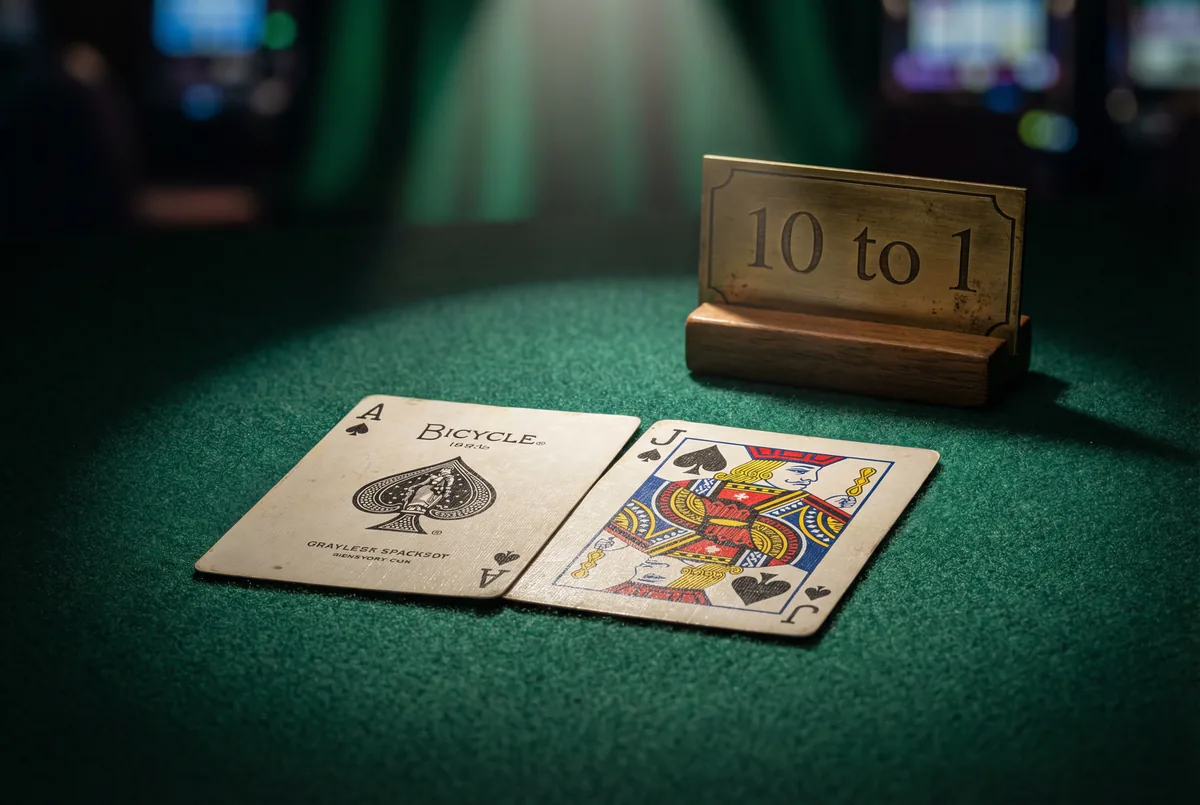
There are exactly two numbers I check before I sit at any blackjack table. The first is 3:2. If the table does not pay 3:2 on a natural, I do not sit. That standard exists because of something that happened over a century ago: gambling houses offered a 10:1 bonus for a specific two-card hand, an Ace of spades with a black Jack. That promotion named the game and then disappeared. What replaced it, the 3:2 payout for any natural, became the line that separates good tables from exploitative ones. Understanding the original bonus explains why 3:2 is non-negotiable and why 6:5 tables represent the same promotional logic turned against you.

Common Myth
“The blackjack bonus is a modern casino promotion.”
The History
The original black jack bonus is how the game got its name. Early 20th-century gambling houses paid 10:1 for an Ace of spades plus a black Jack. That bonus was discontinued after Nevada regulated casinos in 1931, replaced by the 3:2 standard for any natural. The word blackjack survived the bonus that created it.
What the Original Black Jack Bonus Actually Was
The original bonus required two specific cards: the Ace of spades and either the Jack of spades or the Jack of clubs. Both cards had to be black-suited. The hand was visually distinctive and statistically rare: in a single standard 52-card deck, there are exactly 2 qualifying Jacks and 1 qualifying Ace, making the combination appear roughly once every 1,300 hands in single-deck play. That rarity made the 10:1 payout mathematically dramatic and commercially effective at drawing attention to twenty-one tables in competitive gambling establishments.
The bonus was not universal. Different gambling houses applied different rules and different payout multiples. Some establishments paid 10:1, others paid lower enhanced odds. Some required both cards to be black, others expanded the qualifying hand. There was no standardized casino regulation before Nevada legalized gambling in 1931, so promotional rules varied from town to town and often changed with ownership. The name blackjack became attached to the entire game during this period of promotional competition, not from any single official rule change.
Original bonus payout
Ace of spades + black Jack
Why the Original Black Jack Bonus Disappear After Nevada Legalized Gambling?
Nevada’s legalization of casino gambling in 1931 introduced regulatory frameworks that standardized table game rules, making a 10:1 payout for a specific two-card hand mathematically untenable at the volumes a licensed casino floor generates. A 10:1 payout for a specific two-card hand was mathematically untenable at the volumes of play a regulated casino floor generates. At 10:1 odds on a hand appearing roughly once in 1,300 hands, the bonus cost was small per session but significant across thousands of players per day. Operators reduced the qualifying combinations and then eliminated the specific-suit requirement entirely, replacing the original bonus with a flat 3:2 payout for any Ace plus any 10-value card on the opening deal.
The 3:2 standard that emerged from this rationalization is the rule that professional players require before sitting at any table. At a $25 table, a natural pays $37.50 under 3:2 and $30.00 under 6:5. Naturals occur approximately once every 21 hands, so over 80 hands at $25, the 6:5 rule costs you $27.80 extra compared to a 3:2 table. The original 10:1 bonus was replaced by something better for players than what many modern casinos now offer.
| Rule Era | Payout | $25 Bet Pays | Notes |
|---|---|---|---|
| Original bonus (pre-1931) | 10:1 | ||
| Post-legalization standard | 3:2 | ||
| Modern trap tables | 6:5 | ||
| Even money | 1:1 |
How 3:2 Become the Professional Benchmark Every Serious Player Requires?
The 3:2 payout for any natural became the standard Vegas rule through the 1940s and 1950s, when Baldwin and colleagues published the first mathematically correct blackjack basic strategy and all blackjack house edge calculations assumed 3:2 as the baseline. When Baldwin and colleagues published the first optimal strategy in 1956, and when Thorp published Beat the Dealer in 1962, the 3:2 payout was the assumed baseline. Every blackjack house edge calculation in those foundational works assumed 3:2. The 0.5% blackjack house edge with perfect blackjack basic strategy in a 6-deck game assumes 3:2. At 6:5, that number rises to approximately 1.9% before any other rule differences are applied.
The 3:2 rule is also the threshold at which blackjack becomes the best bet on a standard casino floor. Baccarat runs between 1.06% and 1.24%. European roulette runs 2.7%. Craps pass line runs 1.41%. Blackjack at 3:2 with blackjack basic strategy at 0.5% is structurally superior to every other widely available table game. The 6:5 rule eliminates that advantage and makes blackjack no better than craps.
Why the 3:2 Natural Payout Still Carry the Ghost of That Original Bonus?
The 3:2 payout for any natural blackjack is a direct structural descendant of the 10:1 specific-hand bonus that created the game’s name: both rules express the same underlying casino decision to pay a premium for the best two-card combination in the game. The 10:1 specific-hand bonus paid dramatically more for a rare qualifying hand. The 3:2 standard pays moderately more for any qualifying natural. The mechanism is identical. Only the ratio and the qualifying definition changed.
This lineage matters because it explains why 6:5 tables are historically anomalous. The entire reason naturals receive a payout premium at all traces back to the promotional logic of that original bonus. 6:5 tables keep the name, keep the tradition, and quietly remove most of the premium. You are still called a blackjack when you hit a natural at a 6:5 table. You just receive $7.50 less per occurrence at a $25 bet.
I think about the original bonus every time I see a 6:5 placard. The gambling houses that introduced the blackjack bonus in the early 20th century were trying to attract players by offering them something exceptional. The casinos that run 6:5 tables are using the same brand recognition in reverse, offering the name blackjack while quietly stripping the exceptional payout that built the brand. At $25 and 80 hands, naturals occur roughly 4 times. The 6:5 rule costs you exactly $30 over that session compared to the table the original bonus tradition intended.
What the Original Bonus Legend Means at a Modern Table
The original black jack bonus is the ancestor of the rule printed on every felt today. Every time you see BLACKJACK PAYS 3 TO 2 on a table placard, you are reading the normalized descendant of a 10:1 promotional hand. Every time you see BLACKJACK PAYS 6 TO 5, you are seeing the same promotional technique that created the bonus, now operating in reverse: a rule change disguised as standard game play, extracting $27.80 extra per 80 hands at $25 from players who do not read the placard before sitting.
The bonus is gone. The name stuck. The 3:2 payout is the only heritage that matters, and not every table offers it. Open a live table and see for yourself: check the payout ratio printed on the felt before you place a single chip. If it reads 6:5, close that table and find one that pays 3:2. This is not a blackjack simulator. Real money moves with every decision, so determine your session budget before the cards are dealt.
Frequently Asked Questions
The original bonus required an Ace of spades paired with either the Jack of spades or the Jack of clubs. Both cards had to be black-suited. This combination paid approximately 10:1 at gambling houses in the early 20th century. The bonus was eliminated after Nevada legalized gambling in 1931 and replaced with the 3:2 payout for any Ace plus any 10-value card.
At a $25 table, a 6:5 natural pays $30 instead of $37.50. That $7.50 difference per natural adds 1.39% to the house edge. Naturals occur roughly once every 21 hands. Over 80 hands at $25, the 6:5 rule costs $27.80 more than a 3:2 table. The 6:5 rule turns blackjack from the best table game bet on the floor into something worse than craps.
No. Even money is insurance presented differently: it pays 1:1 on your natural before the dealer checks for a natural, instead of the standard 3:2. The expected value of taking even money is lower than the expected value of playing the hand normally. You give up the 3:2 payout in exchange for certainty, and certainty costs you 3.77 cents per dollar in expected value on that hand.
Before you test these plays at a real table, run them through our free blackjack simulator practice unlimited hands at zero cost until every move becomes automatic.
Know Your Edge Before You Bet
The calculator shows the correct play for any hand total against any dealer upcard under your exact table rules.
Blackjack Academy is an educational resource. All strategy is based on mathematical expectation. Always play within your means.
Learn More
Continue your education with these related lessons.
Proven Strategy for Single and Double Deck Handheld Blackjack Games
Single and double deck games play differently from shoe games. The lower deck count changes house edge, card distribution, and…
Why the Blackjack Insurance Side Bet is a Statistical Trap
Insurance pays 2:1 but the true odds are 2.25:1 against in a 6-deck game. That gap gives the house a…
Major Differences in Skill Between Blackjack and Poker
Most people assume poker requires more skill than blackjack. The reality is more complicated. Both games reward skill at the…