
Proven Strategy for Single and Double Deck Handheld Blackjack Games
- Single and Double Deck Blackjack: The Handheld Game Difference
- Why a Lower Deck Count Change the Correct Strategy?
- How to Find a Good Single or Double Deck Handheld Game?
- What Is the Most Important Strategy Adjustments for Handheld Games?
- Sitting at a Handheld Table: What to Do Before Your First Bet
A double deck table in downtown Las Vegas looks identical to any 6-deck shoe game until the strategy decisions start to feel wrong. Single and double deck handheld blackjack follows its own blackjack strategy chart, and the differences are not obvious.
Single and Double Deck Blackjack: The Handheld Game Difference
Soft doubling decisions change. Some splitting plays change. Bringing a standard shoe strategy card to a handheld game introduces errors in multiple spots per session. This article covers the specific strategy adjustments that matter most, and how to identify a good handheld game before sitting down.
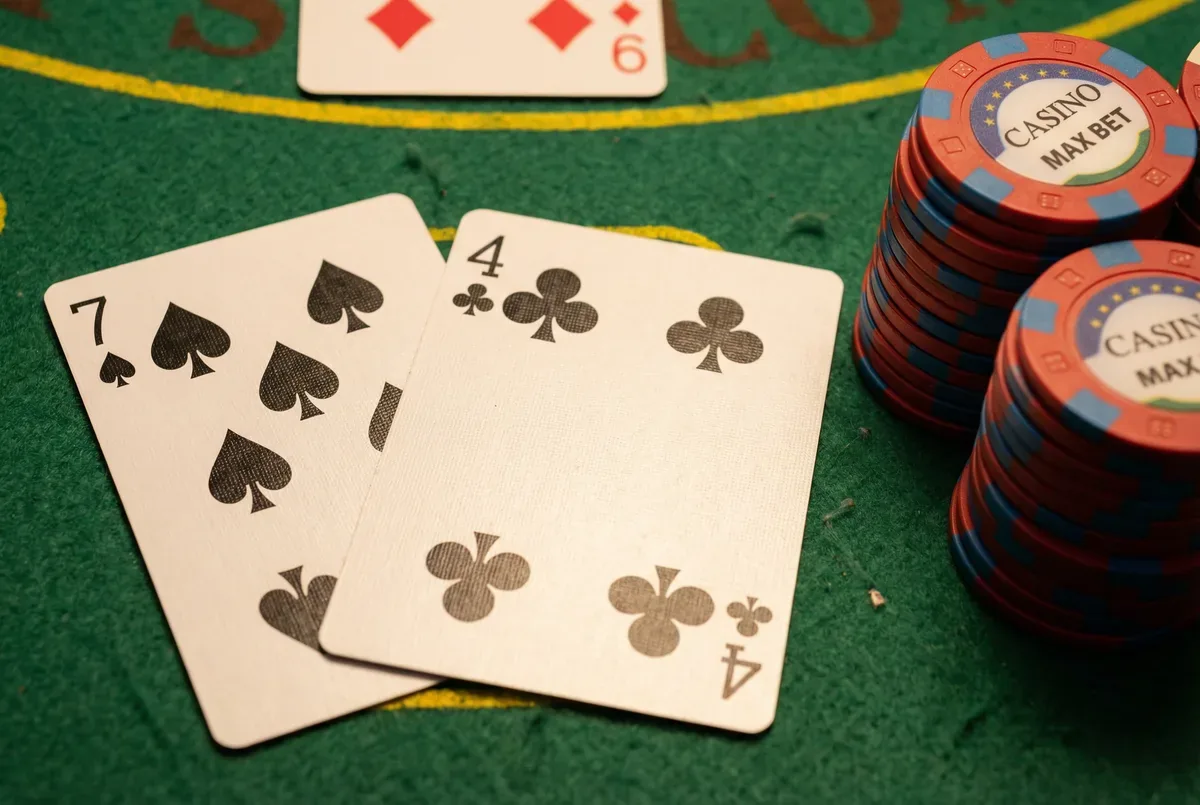
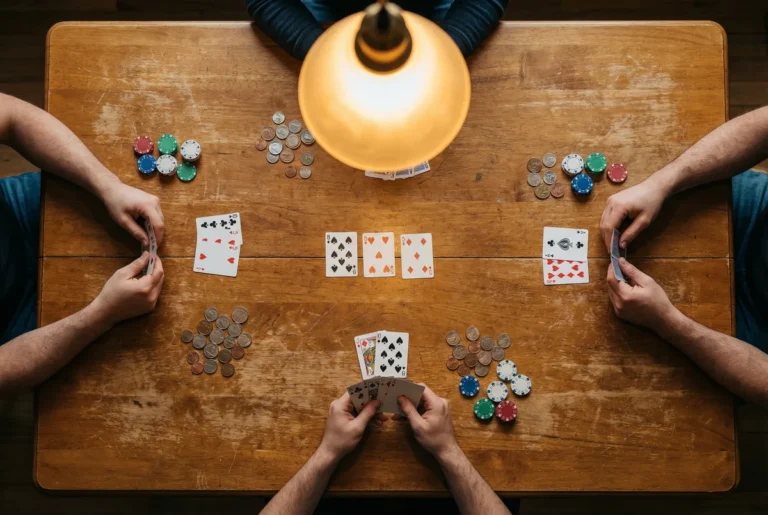
Handheld games are dealt from the dealer’s hands rather than from a shoe. Cards are held face-down and players are expected to handle them. The game pace is faster, the blackjack house edge is potentially lower, and the card distribution is noticeably different from a 6-deck shoe.
1-2 Deck (Handheld)
6-8 Deck (Shoe)
- 52 or 104 cards
- 312 or 416 cards
Why a Lower Deck Count Change the Correct Strategy?
A lower deck count changes blackjack basic strategy because fewer cards in play means each drawn card shifts the remaining distribution more. In a single deck game, removing one ace changes the composition significantly. In a 6-deck shoe, that same removal is negligible. The smaller the game, the more card-specific the correct strategy becomes.
This affects soft doubling and splitting decisions. The most common deviations from shoe strategy are: doubling soft 18 in more spots, standing on soft 18 vs. dealer 2 rather than doubling, and adjusting 2s, 3s, and 6s split decisions.
Using a shoe strategy card at a handheld table introduces errors in all of these spots. The adjustments are small in isolation. Across a session they are measurable.
The magnitude of these errors is small but real. Over 500 handheld hands, playing the wrong strategy for the deck count adds approximately 0.1% to the blackjack house edge. That is not catastrophic, but it is avoidable with the correct chart.
How to Find a Good Single or Double Deck Handheld Game?
A good handheld game meets three criteria: 3:2 natural payout, dealer stands on soft 17, and re-splitting aces allowed. Missing any one of these rules can erase the advantage a lower deck count provides.
Many casinos offer single deck games as an attraction, then claw back the edge with a 6:5 natural payout. The single deck label creates false confidence. The payout rate is the first thing to check.
The 6:5 payout is the most common trap in handheld games. A single deck game paying 3:2 with S17 has a blackjack house edge near 0.15%. The same game at 6:5 carries a blackjack house edge above 1.45%. The single deck label creates a false sense of advantage that the payout structure immediately erases. Always verify the payout before you sit.
1D S17 3:2
house edge
2D S17 3:2
house edge
1D H17 3:2
house edge
What Is the Most Important Strategy Adjustments for Handheld Games?
For single deck games, the main adjustments from standard shoe strategy are: always double 11 vs. dealer ace, double soft 19 vs. dealer 6, and never split 10s unless the count supports it. These plays are not correct in shoe games but become correct in single deck due to the changed card composition after early draws.
For double deck games, the adjustments are smaller. The most impactful: double 8 vs. dealer 5 or 6, surrender 15 vs. dealer 10 when late surrender is available, and split 2s and 3s vs. dealer 2 or 3 when doubling after split is permitted. A purpose-built double deck card covers all of these in one reference.
I carry separate strategy cards for single deck, double deck, and 6-deck shoe games when I travel. The cost of printing three small cards is zero. The cost of playing the wrong strategy for the game in front of you is measurable over a session at meaningful bet sizes.
Dealer Shows
Your Hand
You are playing a single deck game. You hold soft 19 (A,8) against the dealer's 6. What is the correct play?
Soft 19 vs. dealer 6 is a standard deviation from shoe strategy in single deck. The reduced deck size makes the probability distribution different enough to justify a double that shoe basic strategy does not recommend.
Sitting at a Handheld Table: What to Do Before Your First Bet
Before betting at a handheld game, complete three checks. Read the payout printed on the felt: 3:2 is the minimum requirement. Read the H17/S17 rule, which affects the blackjack house edge by roughly 0.20%. Confirm whether doubling after split is allowed, as this affects several splitting decisions in the handheld blackjack strategy chart.
Card handling rules are also specific to handheld games. Players are expected to pick up their cards with one hand only. You may not remove the cards from the table surface entirely, and you cannot hold them below the table edge. Violating these rules draws dealer attention and slows the game. Learn them before your first hand.
The fastest way to internalize handheld game flow is a real session. Join a live table and try 10 hands using the handheld strategy adjustments. Real money is in play from the first deal, so decide your session budget before you sit and keep a strategy card visible until the chart is memorized.
Frequently Asked Questions
Not always. A single deck game at 3:2 with S17 has one of the lowest house edges available. But many single deck games now pay 6:5 on naturals, which pushes the house edge above 1.45%. A 6-deck shoe game paying 3:2 with S17 at 0.28% is significantly better than a single deck 6:5 game.
You should use a handheld-specific strategy card instead. Several decisions in single and double deck games differ from shoe basic strategy, particularly in soft doubling and certain split decisions. Using the wrong chart introduces small but real errors over the course of a session.
Most modern single deck games offset the lower deck count with a 6:5 natural payout, which raises the house edge above the standard 6-deck game. Casinos use the single deck label as an attraction while recovering the mathematical advantage through the payout rate. Always verify the natural payout before sitting at any single deck table.
Before you test these plays at a real table, run them through our free blackjack simulator practice unlimited hands at zero cost until every move becomes automatic.
Verify the Rules Before Your First Bet
Payout rate, H17 or S17, and DAS rules determine your real house edge.
Blackjack Academy is an educational resource. All strategy is based on mathematical expectation. Always play within your means and set a session budget.
Learn More
Continue your education with these related lessons.
How Many Decks Are in a Blackjack Shoe?
Blackjack is dealt from 1, 2, 4, 6, or 8 decks. The number of decks directly affects the house edge…
Complete Glossary of Blackjack Terms Every Player Should Know
Do you know the difference between a hard hand and a soft hand? Between penetration and a burn card? Every…
5 Major Differences Between Casino Blackjack Rules and Home Games
Home blackjack and casino blackjack look like the same game. They are not. The dealer rules, the payouts, the deck…