
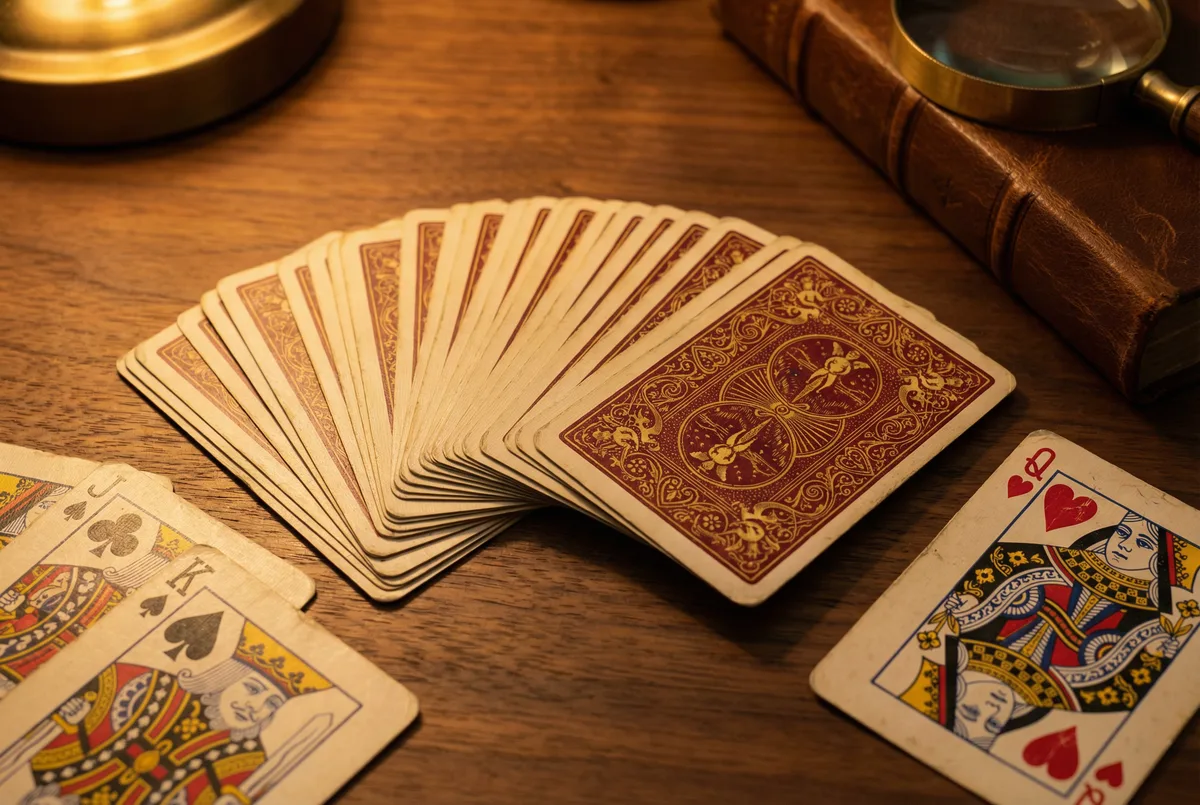
How the Standard 52 Card Deck Evolved for Casino Play
There is a reason the standard 52-card deck looks exactly the way it does at a blackjack table. The specific format, four suits of 13 cards each, with pip cards from ace to 10 and three face cards per suit, was not designed by committee. It survived because it worked for gambling.

The deck’s journey from 15th-century Europe to the modern casino shoe spans five centuries of printing innovation, regional competition between suit systems, and the specific mathematical requirements of casino card games. The 52-card deck is not arbitrary. Every element has a history, and understanding it changes how you relate to the equipment in front of you at every blackjack session.
Where Playing Cards Originally Came From
Playing cards entered Europe from the Islamic world in the late 14th century, most likely via trade routes through Italy and Spain. The earliest European decks used four suits derived from the Mamluk card system: cups, coins, swords, and polo sticks.
These suit symbols mapped roughly onto the social structure of the time, with the suit designs varying significantly by country.
German card makers in the 15th century replaced those suits with acorns, leaves, hearts, and bells. The French, working with the German system as a starting point, simplified the suit designs into hearts, diamonds, clubs, and spades.
The French suits were easier and cheaper to print, which gave them a significant commercial advantage as card printing industrialized across Europe.
The French suit system reached England and its colonies by the late 17th century and became the global standard largely because Britain’s maritime and commercial dominance spread English-manufactured playing cards worldwide. The French-suited deck was not technically superior to its competitors. It won through distribution.
Timeline
Late 14th century
Playing cards arrive in Europe from Islamic trade routes. Suits: cups, coins, swords, polo sticks.
15th century
German card makers replace suits with acorns, leaves, hearts, bells.
Late 15th century
French printers simplify to hearts, diamonds, clubs, spades. Cheaper to produce.
17th century
English decks standardize at 52 cards with the French suit system.
19th century
Rounded corners, indices (rank numbers in corners), and double-headed face cards introduced for casino use.
20th century
Plastic-coated and 100% plastic casino cards replace paper. RFID chips embedded in high-security decks.
Why the Standard Deck Contains Exactly 52 Cards?
The 52-card count was not universally standard until the 18th century. Earlier European decks ranged from 36 to 56 cards depending on the region and game. Spanish and Italian decks used 40 cards. German decks used 32 or 36. The French settled on 52 as their standard, and that number traveled with the French suit system when it became dominant.
The mathematical properties of 52 made it practical for gambling. Fifty-two divides evenly by 2, 4, 13, and 26, making it easy to deal equal hands to multiple players.
The 13-card suit structure means four ranks of 10-value cards (10, jack, queen, king) appear 16 times in a single deck, creating the distribution that makes blackjack’s probability calculations work as they do.
This specific distribution, 16 ten-value cards in 52, is the mathematical foundation of blackjack basic strategy and blackjack card counting. The 30.8% frequency of ten-value cards in a fresh deck is the number that determines correct doubling decisions, insurance calculations, and all of the dealer bust probability charts. The 52-card structure is not incidental to blackjack. It is structural.
- Total cards52 per deck
- Suits4 (hearts, diamonds, clubs, spades)
- Cards per suit13 (A, 2-10, J, Q, K)
- 10-value cards per deck16 (10, J, Q, K across 4 suits)
- 10-value frequency30.8% of a fresh deck
- Ace frequency7.7% (4 of 52)
- Casino shoe standard6 or 8 decks (312 or 416 cards)
How Does Casino Playing Cards Differ from Standard Retail Decks?
Casino-grade playing cards differ from retail decks in material, size, and security features. Most casinos use 100% plastic cards rather than paper or plastic-coated paper. Plastic cards resist marking, last longer under repeated use, and cannot be bent to create tactile signals.
A paper deck wears within hours of high-volume dealing. A casino plastic deck lasts through thousands of hands before retirement.
The standard casino card size is poker size: 3.5 inches by 2.5 inches. Bridge-size cards appear in some games but are less common in blackjack. Casino decks use large-index formatting with rank and suit printed in all four corners.
Early 19th-century card makers introduced corner indices specifically for gambling efficiency, allowing dealers and players to read hands at a glance without fully fanning the cards.
High-security casino environments embed RFID chips in individual cards to detect removed or substituted cards automatically. Shuffling machines verify card count electronically before reintroducing a deck to play.
The playing card itself has become a security device as well as a game piece. At the table level, what matters is that every deck in the shoe is a complete and unmodified 52-card set.
What Is Deck Structure?
Understanding the deck’s structure directly improves strategic reasoning. The fact that 16 of 52 cards are 10-value explains why hard 16 against a dealer 10 is a close decision and why dealer bust probabilities spike when the upcard is 4 through 6.
Every blackjack basic strategy decision is built on this distribution. Insurance in a fresh 6-deck shoe carries a 7.3% blackjack house edge for the same reason: 30.8% is not enough frequency to justify the 2:1 payout.
Knowing the ace frequency (4 per deck, 7.7%) explains why soft hands appear as often as they do, and why the natural blackjack probability in a single deck is approximately 4.8%.
Counting systems track the depletion of 10-value and low cards from this distribution. The entire architecture of advantage play sits on the 52-card structure that French printers standardized in the 17th century.
That context becomes tangible the moment you sit at a real table and start tracking card flow. The live dealer tables available through find a live dealer game with a freshly shuffled real shoe use the same standardized decks described here. Real money is in play from the first hand. Set your session budget before you sit and treat it as a firm limit.
Casino-grade playing cards are manufactured to much tighter tolerances than retail decks. The difference in card size, thickness, and corner radius is intentional, it reduces edge-sorting opportunities and makes card marking significantly harder. Most high-end casinos use cards for six to eight hours before replacing them.
Why Casinos Use Multiple Decks in a Shoe Instead of One
Single-deck blackjack was the original casino standard. The shift to multi-deck shoe games began in the 1960s after Edward Thorp published Beat the Dealer and proved that blackjack card counting in a single deck gave players a measurable edge. Casinos introduced the 4-deck shoe as a countermeasure. The 6-deck and 8-deck formats followed as counting teams became more sophisticated.
More decks reduce the effect of card removal. Removing one ace from a single deck changes the ace frequency significantly. In a 6-deck shoe with 312 cards, that same removal is negligible.
The shoe dilutes the impact of each card dealt, making it harder to maintain an accurate running count and slowing the rate at which the true count reaches actionable levels.
The blackjack house edge also changes with deck count. A single deck game with favorable rules carries a blackjack house edge near 0.15%. A 6-deck shoe with the same rules runs closer to 0.28%.
The extra decks add a small but real cost to the player, independent of counting. The 52-card deck is the unit. The shoe is just how many units the casino has chosen to stack.
Frequently Asked Questions
French suits, hearts, diamonds, clubs, and spades, became the global standard because they were cheaper to print than German or Latin suit systems, and British commercial and colonial distribution spread English-manufactured decks worldwide in the 17th and 18th centuries. The French suit system won through manufacturing cost and distribution reach, not technical superiority.
No. All casino playing cards use the same 52-card structure with identical rank and suit distribution. The material (plastic vs paper-coated) affects durability and security but has no effect on the probability distribution of the deck. A GEMACO, Cartamundi, or Kem deck all produce the same mathematical game.
Six-deck shoes became standard after card counting was proven viable in single-deck games in the 1960s. More decks reduce the impact of card removal, making it harder for counters to gain a significant edge. The 6-deck format also allows longer play before reshuffling, which improves casino throughput.
Before you test these plays at a real table, run them through our free blackjack simulator practice unlimited hands at zero cost until every move becomes automatic.
The Deck Is 52 Cards. Every Decision Flows From That.
Basic strategy is built on the exact distribution of a standard deck. Understanding that distribution is the first step to playing with mathematical precision.
Blackjack Academy is an educational resource. All strategy content is based on mathematical expectation. Set a session budget before you play.
Learn More
Continue your education with these related lessons.
Key Differences Between British Pontoon and American Blackjack
British Pontoon and American blackjack share a common ancestor but diverged into distinct games with different rules, terminology, and strategy.…
How the Number of Decks in a Shoe Affects Your Winning Odds
Moving from a 6-deck shoe to a single-deck game saves you roughly 0.35% in house edge unless the casino compensates…

Finding the Best Table Limits for Your Bankroll
Sitting at the wrong table minimum is the most expensive mistake in blackjack. The correct table minimum for your bankroll…