
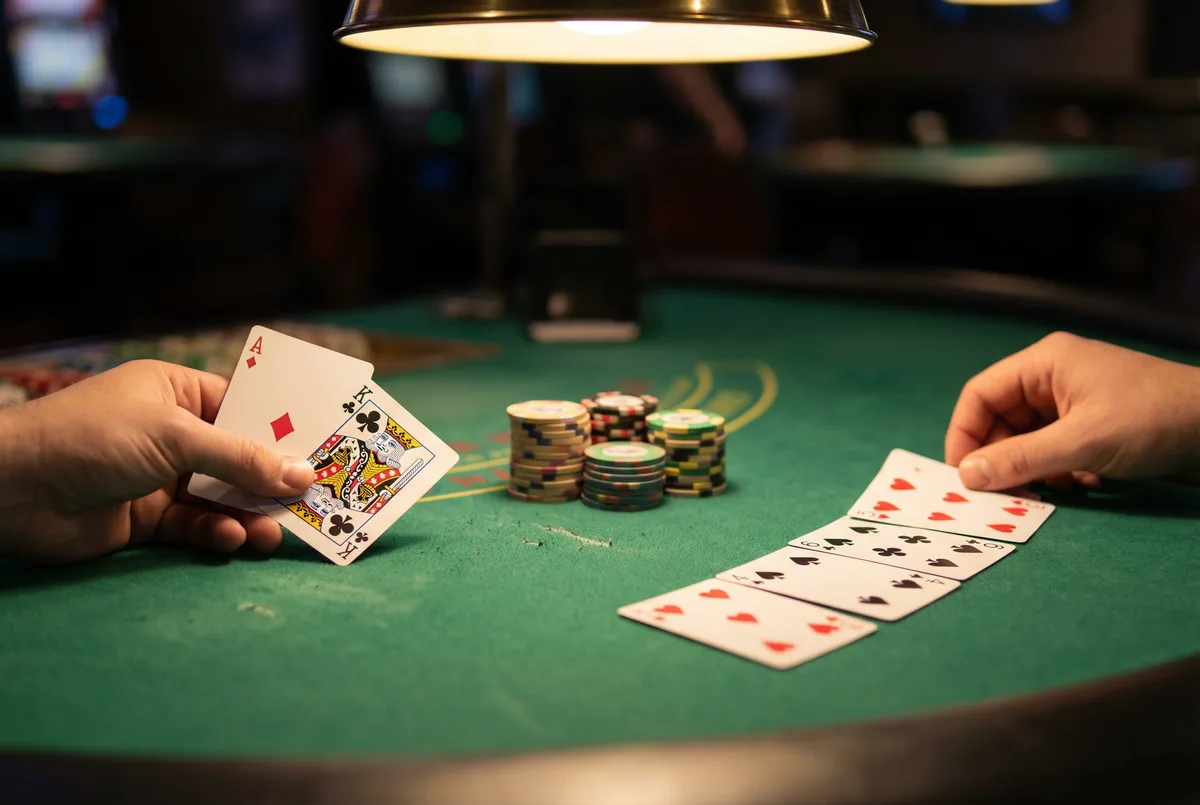
Comparison of Spanish 21 vs Classic Blackjack Rules
Spanish 21 tables appear to offer standard blackjack with extra bonuses. That impression is intentional. The bonus payouts on the placard are real: 3:2 on five-card 21s, 2:1 on six-card 21s, jackpot triggers on suited 7-7-7. But before any of those bonuses become relevant, the casino has already made a structural change to the deck.
Spanish 21 and Classic Blackjack: Two Games, Very Different Rules
Spanish 21 vs classic blackjack is not a comparison of bonus schedules. It is a comparison of two games built on fundamentally different card distributions. The 10s have been removed from a Spanish 21 deck before a single card is dealt. That change drives everything else in this comparison.
Spanish 21 uses a 48-card Spanish deck. All four 10s have been removed. Face cards (jacks, queens, and kings) remain, so the deck still contains cards valued at 10 points. But the actual 10s are gone, and that changes the mathematics of every hand in the game.
Spanish 21
Classic Blackjack
- 48 cards (10s removed)
- 52 cards per deck
What Makes Spanish 21 Different From Standard Blackjack?
Spanish 21 differs from standard blackjack in two interconnected ways: the deck is shorter and the player rules are more generous. Every Spanish 21 table removes all four 10s from each deck, resulting in a 48-card deck. In exchange, casinos offer a set of rules that favor the player in ways that standard blackjack never does.
The most important player-friendly rules are: your 21 always beats the dealer’s 21, your blackjack always beats the dealer’s blackjack, late surrender is always available, and you may double down on any number of cards. You can also rescue a double down by surrendering after seeing your doubled card. These options do not exist in standard blackjack.
Bonus payouts add another layer. A 5-card 21 pays 3:2 instead of even money. A 6-card 21 pays 2:1. A 7-card or longer 21 pays 3:1. Specific combinations like 6-7-8 or 7-7-7 in mixed suits pay bonuses, and a suited 7-7-7 against a dealer 7 triggers a major jackpot at many casinos.
How Removing the 10s From the Deck Affects Spanish 21 Players?
Removing the 10s from a Spanish 21 deck significantly increases the blackjack house edge before any bonus rules are applied. The 10s are critical to blackjack mathematics: they drive naturals, dealer busts, and optimal doubling opportunities. A deck without 10s produces fewer naturals and fewer dealer busts.
Without the compensating rules, a 48-card Spanish deck would carry a blackjack house edge roughly 2% higher than a standard 52-card deck. The generous player rules claw most of that back. Double down rescue alone is worth approximately 0.10% to a skilled player. The “player 21 always wins” rule recovers another 0.16%.
The net result depends on which version you play. Spanish 21 with 6 decks and the dealer standing on soft 17 carries a blackjack house edge of approximately 0.40%. That figure assumes you play optimal Spanish 21 strategy, which differs in several key spots from standard blackjack basic strategy.
Spanish 21 (6D S17)
house edge
Classic BJ (6D H17)
house edge
Classic BJ (2D S17)
house edge
What Is Spanish 21 vs Classic Blackjack?
Spanish 21 offers a lower blackjack house edge than classic blackjack in most configurations you will actually encounter on a floor today. The comparison is not absolute: a 2-deck S17 classic game at 3:2 beats Spanish 21. But that game is rare.
The common 6-deck H17 classic game at 3:2 runs at 0.67%, which is higher than Spanish 21’s 0.40% with S17. On most casino floors, Spanish 21 is the sharper choice.
The key variable is your strategy. Standard blackjack basic strategy is wrong for Spanish 21. Several decisions that are correct in classic blackjack become errors in the 48-card game. Standing on soft 17 vs. a dealer 6 is one example. Players who bring their classic BJ strategy to a Spanish 21 table give back most of the advantage the rules provide.
Strategy cards for Spanish 21 are available at casino gift shops in any jurisdiction that spreads the game. Bring one, or study the specific deviations before you sit. The bonus rules only pay their full EV value when you play the hands that trigger them correctly.
Dealer Shows
Your Hand
You are playing Spanish 21. You hold soft 17 against the dealer's 6. What is the correct play?
Spanish 21 strategy deviates from classic basic strategy in multiple spots. Soft 17 vs. dealer 6 is one example where the correct play differs. Always use a Spanish 21 strategy card, not a standard blackjack chart.
Choosing Your Game at the Casino and Playing the Correct Strategy
If the floor offers both games and you play optimal strategy for each, choose based on the available classic blackjack rules. Find the blackjack house edge on the classic table first. If it is a 6-deck H17 game offering 3:2 or worse, the Spanish 21 table is likely the better choice at 0.40% with S17.
If the classic table is a 2-deck S17 game at 3:2, play that instead. The 0.19% edge is the best standard blackjack available in most casinos. Spanish 21 does not beat it. The presence of bonus payouts on the Spanish 21 sign does not override the mathematics.
If you enjoy the Spanish 21 format and want to practice the strategy differences before betting, play a few real-money hands at a live table and compare how the decisions feel under pressure. The rules are genuinely different enough that live experience accelerates the learning curve faster than any chart study alone. Set a practice budget before you sit.
Spanish 21 removes all four 10-spot cards from each deck, which is why it can offer liberal bonus rules without giving up edge. The missing 10s increase the house edge by approximately 2% before bonuses, and the bonuses don't fully compensate. Basic strategy is substantially different in Spanish 21, and using standard charts will cost you.
Frequently Asked Questions
No. Spanish 21 and Pontoon are different games with different rules and payouts. Both use modified decks, but the card values, hand names, and win conditions differ significantly. Pontoon is more common in the UK and Australia. Spanish 21 is found primarily in US and Canadian casinos.
No. Standard basic strategy is incorrect for Spanish 21 in several key decision spots. The 48-card deck without 10s changes the correct play for a number of hands, particularly soft totals and doubling decisions. Use a Spanish 21 strategy card instead.
Yes. Without the bonus payouts and player-friendly rules, the 48-card Spanish deck would carry a house edge roughly 2% higher than a standard deck. The bonuses recover most of that. With optimal Spanish 21 strategy, the house edge lands near 0.40% for most common casino configurations.
Before you test these plays at a real table, run them through our free blackjack simulator practice unlimited hands at zero cost until every move becomes automatic.
Check the Rules Before You Bet
House edge varies by table rules. Know your number before the first deal.
Blackjack Academy is an educational resource. All strategy content is based on mathematical expectation. Always set a session budget before you play.
Learn More
Continue your education with these related lessons.

How the 1956 Baldwin Paper Created the First Winning Strategy
In 1956, four US Army mathematicians published a paper that changed blackjack forever. Roger Baldwin, Wilbert Cantey, Herbert Maisel, and…
Step by Step Guide to Your First Hour Playing Real Money
Your first real money blackjack session is decided before you sit down. This step-by-step guide covers pre-session prep, buying chips,…
How to Choose a Blackjack Table at a Casino
Not all blackjack tables are created equal. Learn how to read the floor, pick the right minimum, and find the…