
The Complete Guide to Blackjack Rules and How the Game Works
I once sat at a blackjack table in Atlantic City and played 80 hands before I realized the table was paying 6:5 on naturals. I checked afterward: that single rule cost me roughly $27 more than the 3:2 table ten feet away. That was the day I started reading the felt before I read my cards. Blackjack’s blackjack house edge ranges from 0.46 percent at the best tables to over 2 percent at the worst, and every number in that range traces back to a specific rule printed on the table. At $25 per hand over 80 hands, the difference between a 0.46 percent edge and a 2 percent edge is $31.20. Understanding how this game is built is the first strategic move of your session, and most players skip it entirely.
Common Myth
“Blackjack rules are the same at every casino.”
Card values and basic hand flow look identical at every table, so most players assume the underlying math is identical too.
The Reality
The core bust mechanics are universal, but payout structures, dealer standing rules, and split and double permissions vary by table and shift the house edge by up to 1.39 percent.
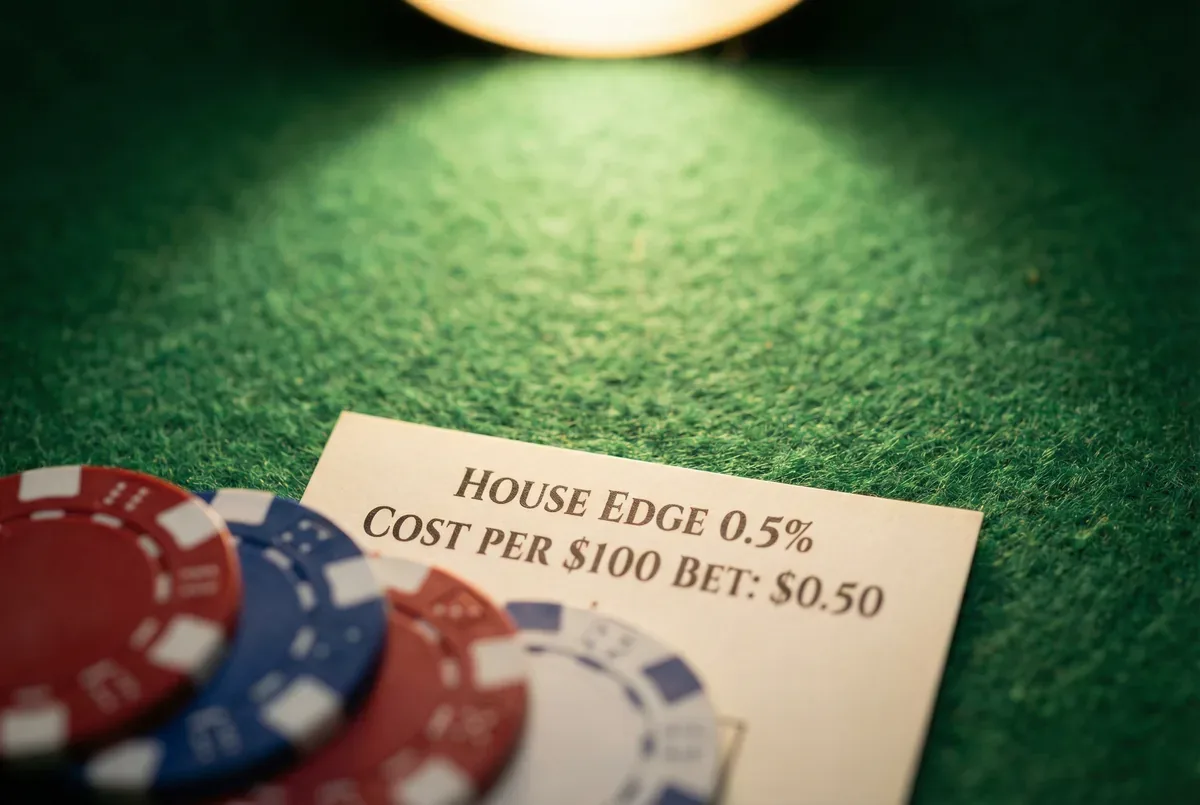
A table paying 3 to 2 on naturals runs at 0.46% house edge under full conditions. The same game paying 6 to 5 runs at approximately 1.85%. That gap cannot be closed with strategy.
How a Round of Blackjack Is Structured
I have played thousands of rounds, and every single one follows the same five stages: place the bet, receive the deal, make your decisions, dealer plays, settle the bets. The dealer distributes two cards to each player and two to themselves, one dealer card face up and one face down. Every player at the table acts in sequence before the dealer reveals the hole card. You make all decisions based on what you can see: your two cards and the dealer’s single visible up card. That information asymmetry is intentional. The concealed card is the mechanism the casino uses to structure the entire game around the player acting first.
The dealer’s hole card is the structural source of the casino’s edge. You go first. If you bust by exceeding 21, you lose immediately, before the dealer plays their hand at all. That sequencing asymmetry: where both hands can bust on the same round and only the casino collects, is called the double-bust rule. Basic strategy is built entirely as a response to this asymmetry. Every decision on the blackjack strategy chart is derived from dealer bust probabilities and the mathematical cost of acting before the dealer is forced to reveal their hand.
A natural blackjack: any Ace paired with any 10-value card on the initial two-card deal, is the only outcome that bypasses normal play entirely. If you hold a natural and the dealer does not, you win at the blackjack payout rate immediately. If both you and the dealer hold naturals, the hand is a push and your bet is returned. The payout rate for a natural is the single most important rule printed on the table. That rate is either 3 to 2 or 6 to 5, and the difference between those two numbers determines more about your expected results than any in-session decision you will ever make.
Dealer Shows
Your Hand
You hold hard 13 against a dealer 5. What is the correct play?
Stand on hard 13 vs. dealer 5. The dealer has a 42.9 percent bust probability with a 5 showing. Your move is to stop and let the dealer self-destruct. Hitting here risks busting a hand the dealer will likely lose for you.
What Are Card Values and How Soft Hands Work?
Card values in blackjack are fixed for every rank except the Ace. Number cards 2 through 10 are worth their face value. Face cards (Jack, Queen, King) are all worth 10. The Ace is worth 1 or 11, whichever produces the better total for your hand. A hand containing an Ace counted as 11 is called a soft hand. A hand where the Ace must count as 1 to avoid busting is a hard hand, and it plays identically to any hand without an Ace at that same total.
Soft hands change your decision tree in specific ways. Soft 17 (Ace-6) is a hand you should never stand on, because hitting cannot bust you: draw a 10, and your Ace shifts to 1 to produce a hard 17. That protection against busting makes soft hands more aggressive in correct strategy. Soft 18 versus a dealer 9 is a hit or double in most rule sets. Hard 18 is always a stand. These are not stylistic choices. They are distinct mathematical outcomes, and blackjack basic strategy resolves them differently for each hand type.
| Rule | Payout on $25 Bet | House Edge Impact |
|---|---|---|
| 3 to 2 Blackjack | $37.50 per natural | |
| 6 to 5 Blackjack | $30.00 per natural | |
| Even Money (1 to 1) | $25.00 per natural |
What Are Your Five Table Decisions?
You have exactly five decisions available in blackjack: hit, stand, double down, split, and surrender. Hit means taking another card. Stand means playing your current total. Double down means doubling your initial wager and receiving exactly one more card. Split is available when your first two cards are a pair and separates them into two independent hands, each requiring a full additional bet. Surrender (where available) lets you fold your hand before taking any action and recover half your initial bet. These five decisions, applied correctly against dealer up cards, are what blackjack basic strategy codifies.
Not all five decisions are available in every game. Surrender is the most commonly restricted, absent from many Las Vegas Strip tables and most single-deck games. Doubling after splits (DAS) adds approximately 0.14 percent to your expected return when permitted. The allowed doubling range (any two cards versus 10 and 11 only), the maximum number of splits, and whether re-splitting aces is allowed: these are the variables you confirm before sitting down. Playing a blackjack strategy chart that assumes DAS in a game that prohibits it introduces systematic error on specific hands, most commonly on split decisions where the follow-up double is the correct play.
How Does the Table Rules That Determine the House Edge?
Every rule variation printed on the felt shifts the blackjack house edge by a calculable percentage. The largest single variable is the blackjack payout. A table paying 3 to 2 on naturals runs at approximately 0.46 percent blackjack house edge under standard conditions. The same game paying 6 to 5 raises that figure to approximately 1.85 percent. That 1.39 percent difference costs $1.39 per $100 wagered. Over 80 hands at a $100 table, you pay $111.20 more in expected losses from the payout rule alone, before a single strategic decision is accounted for.
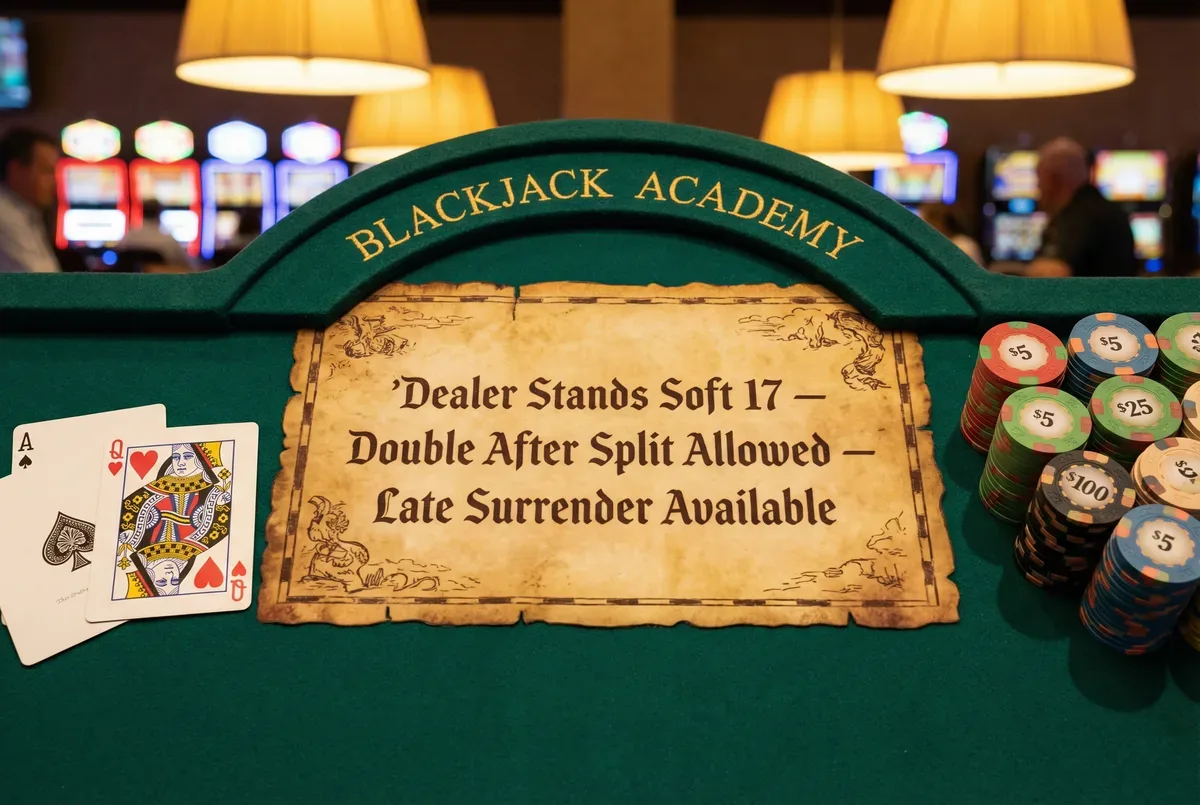
The next variable to check is the dealer standing rule. H17, where the dealer hits soft 17, adds 0.22 percent to the blackjack house edge compared to S17, where the dealer stands on all 17s. Number of decks is the third variable: a single-deck game run with otherwise identical rules carries approximately 0.59 percent lower blackjack house edge than a six-deck shoe. The best standard blackjack available in most casinos combines a 3 to 2 payout, S17, doubling after splits, and late surrender on a six-deck or fewer shoe. Under those conditions, with correct blackjack basic strategy on every hand, the blackjack house edge falls below 0.50 percent.
Sitting Down and Playing Your First Hand Correctly
Three data points on the felt tell you everything you need before committing a dollar: the blackjack payout, the dealer standing rule, and the number of decks in the shoe. A table paying 6 to 5 and running H17 costs 1.61 percent above the minimum price of playing blackjack. A table paying 3 to 2 and running S17 is a game where correct blackjack basic strategy reduces the blackjack house edge below 0.50 percent. No betting system, no intuition, and no session management strategy closes the gap between those two games. Rule selection happens before you sit, not after the cards are dealt. You now know what to look for before you commit a dollar. I check these three rules at every table I sit at, and it takes less than ten seconds. When you are ready, see how this plays out with real stakes. Confirm the payout, the dealer standing rule, and the deck count before your first bet. Every hand is real money, so pick your session number before you sit and do not adjust it mid-session.
Frequently Asked Questions
The natural blackjack payout. A table paying 3:2 on naturals has roughly 0.46% house edge with basic strategy. A table paying 6:5 raises that to approximately 1.85%. No other rule variation produces this magnitude of difference, so the payout ratio is always the first thing to verify.
The dealer must draw another card on any soft 17 (Ace plus 6). This adds approximately 0.22% to the house edge compared to tables where the dealer stands on all 17s. It also changes several basic strategy decisions, including soft doubles and some surrender situations.
No. Payout ratios, dealer standing rules, doubling restrictions, split permissions, and surrender availability all vary by table and sometimes by shift. The rules printed on the table felt and placard govern each specific game. Always read them before placing a bet.
Before you test these plays at a real table, run them through our free blackjack simulator practice unlimited hands at zero cost until every move becomes automatic.
Know Your Edge Before You Sit Down
The calculator shows your exact expected value for any rule combination before you commit a dollar.
Blackjack Academy is an educational resource. All strategy is based on mathematical expectation. Always play within your means.
Learn More
Continue your education with these related lessons.
How Many Decks Are in a Blackjack Shoe?
Blackjack is dealt from 1, 2, 4, 6, or 8 decks. The number of decks directly affects the house edge…
What Really Happens When You Bust in Blackjack and How to Avoid It
Busting in blackjack means going over 21 and the fact that the dealer acts last is the entire source of…
Why the Dealer Removes a Burn Card Before Starting the Round
The burn card looks like a ritual with no purpose. It has a precise security and procedural function that every…