
How Late Surrender Saves Your Bankroll on 15s and 16s
Hard 15 and hard 16 are the two most punishing hands in blackjack. Against a dealer showing 9, 10, or ace, you are a heavy underdog whether you hit or stand.

Most players either hit reflexively or freeze and stand. Neither instinct is correct. Late surrender turns a losing position into a controlled, half-price exit, and the expected value math makes it the best play in every one of these specific spots.
This article covers the full late surrender framework: exactly which hands qualify, why the numbers justify folding, how to handle the 8,8 exception, and how to ask for surrender at a live table without hesitation.
Late Surrender Explained
Late surrender is a table rule that lets you fold your hand and recover half your bet after the dealer checks for blackjack. If the dealer has a natural, surrender is not available and the full bet is lost. The “late” distinction is what separates it from early surrender, which allows folding before the peek.
Early surrender is extremely rare today. Nearly every casino offering surrender uses the late version. When a rules placard says “surrender offered,” that means late surrender unless the card explicitly states otherwise.
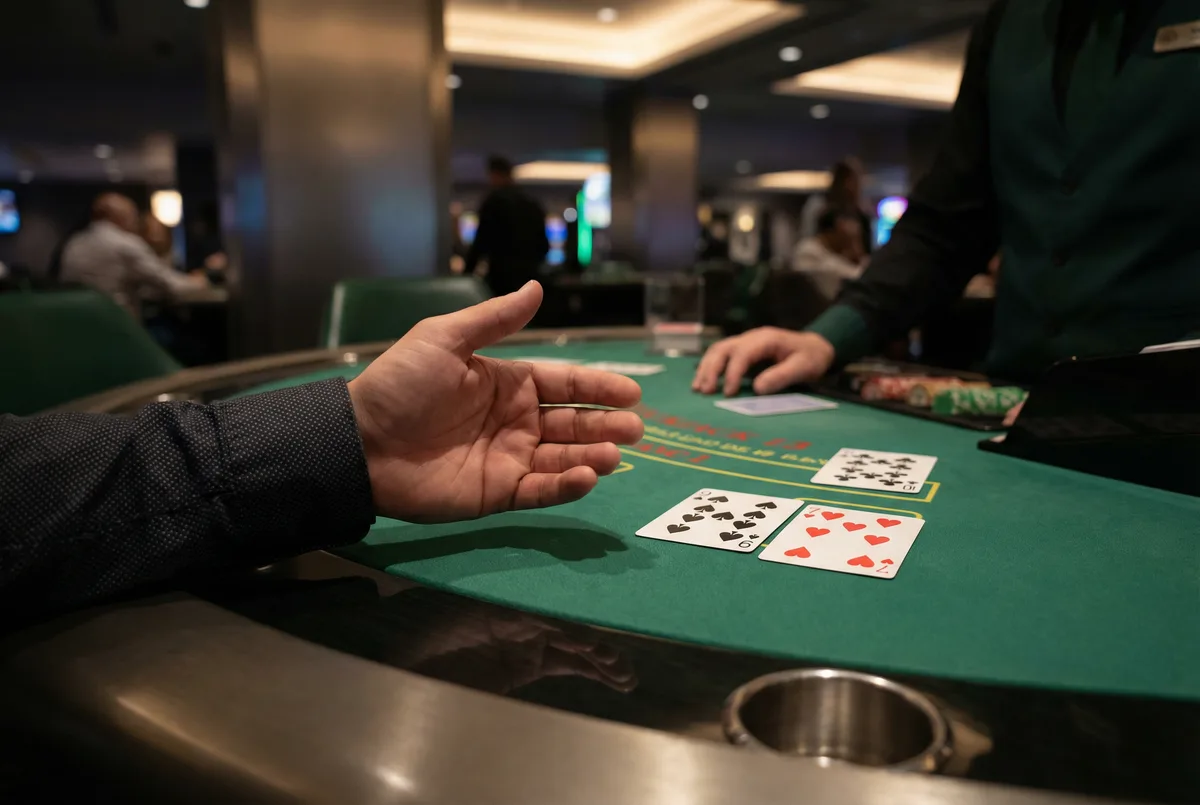
To signal surrender at a live table, draw two fingers horizontally behind your bet or say “surrender” clearly. Some dealers require the verbal call. The dealer removes half your chips, returns the rest, and your hand is over. No card is drawn.
- Hard 16 vs dealer 9SURRENDER
- Hard 16 vs dealer 10SURRENDER
- Hard 16 vs dealer AceSURRENDER
- Hard 15 vs dealer 10SURRENDER
- Hard 15 vs dealer AceSURRENDER (H17 games only)
- Hard 17 vs dealer AceSURRENDER (H17 games only)
- 8,8 vs any upcardSPLIT, never surrender
Why Surrender Saves Money on 15s and 16s?
Surrendering always costs exactly 0.50 units. The question is whether hitting or standing costs more than that. On the surrender hands, the answer is yes in every case.
Hard 16 vs a dealer 10 produces an expected value of roughly -0.54 when you hit and approximately -0.54 to -0.56 when you stand. Surrendering locks in -0.50. The gap is around 4 cents per dollar wagered. Multiply that across 300 hands in a session and the difference becomes real.
Hard 15 vs dealer 10 shows the same pattern. Hitting returns approximately -0.54 expected value. Surrendering returns -0.50. That 4-cent advantage per hand is not exciting, but it is consistent and it compounds.
Hard 16 vs dealer ace is the highest-variance scenario. The dealer completes a hand of 17 through 21 almost 83% of the time. Both hitting and standing produce expected losses above 0.50, making surrender the clear choice when available.
Common Myth
“Surrendering on 15 or 16 is just giving up”
Folding feels like you are refusing to compete. Players associate surrender with weakness and prefer to take a card even when the math says otherwise.
The Reality
Surrender is the highest-EV play on four specific hand-dealer combinations.
Hard 16 vs dealer 10: hitting EV is -0.54, standing EV is -0.54 to -0.56, surrender EV is -0.50. Surrender wins by losing less. Over 500 qualifying hands, the difference exceeds 20 units saved.
How the 8-8 Exception Affects Your Surrender Decision?
A pair of 8s totals hard 16, but it is never surrendered. Splitting 8,8 against any dealer upcard outperforms surrendering in expected value terms. This is one of the most important exceptions in blackjack basic strategy and one of the most commonly misapplied.
When you split 8s against a dealer 10, each new hand starts with an 8. Those hands are manageable compared to a stiff hard 16. The combined expected value of the two split hands beats the -0.50 from surrendering, even against strong dealer upcards.
The surrender rule applies to non-pair hard 16 hands: 9+7, 10+6, and multi-card totals like 5+4+7. When your 16 comes from two 8s, the action is always split. Confusing these two is a common mistake that costs players at tables where both options are available.
Dealer Shows
Your Hand
You hold hard 16 made from 9 and 7. The dealer shows a 10. Late surrender is available at this table. What is the correct play?
When late surrender is offered, surrender any non-pair hard 16 against a dealer 9, 10, or ace. This hand (9+7) qualifies. The only hard-16 exception is 8,8 which must always be split. Say surrender clearly to the dealer or scrape two fingers behind your bet to signal the fold.
Where to Find Late Surrender?
Late surrender reduces the blackjack house edge by approximately 0.08% in a 6-deck game when applied correctly. That is a measurable advantage, but it sits below higher-priority rules like 3:2 payouts on naturals and dealer stands on soft 17.
Always confirm the surrender rule before sitting. Ask the dealer directly or read the rules placard on the felt. Online blackjack tables list all active rules in a help screen. Live dealer platforms show rule variants before you join a table.
In H17 games (dealer hits soft 17), the surrender list expands slightly. Hard 15 vs ace and hard 17 vs ace both become surrender plays under H17 rules. In S17 games (dealer stands on soft 17), ignore those two additions and stick to the four core situations.
Before testing surrender decisions with real chips, practice the rule with zero stakes. The live tables at use surrender with real stakes in play offer real-money action where the rules are posted clearly, but only play there once you have the surrender chart memorized. Applying surrender in the wrong spots at a real-money table will cost you more than skipping the rule entirely.
Executing the Surrender Decision at the Table
Surrender is evaluated first, before any other decision. The sequence is: check for surrender, then split pairs, then double down, then hit or stand. Most players apply it last or skip it entirely because it does not appear on condensed strategy cards.
Memorize four core triggers: hard 16 vs 9, hard 16 vs 10, hard 16 vs ace, hard 15 vs 10. That covers late surrender in standard S17 games. Add hard 15 vs ace and hard 17 vs ace if you are playing H17. Everything else follows normal blackjack basic strategy.
If the table does not offer surrender, treat those four hands normally. Hard 16 vs a dealer 7 or below is a stand. Hard 16 vs 7 through ace (no surrender) is a hit. The strategy shifts when surrender is unavailable, so knowing which rule set is in play matters before every hand.
Frequently Asked Questions
No. Under late surrender rules, the dealer checks for blackjack first. If the dealer has a natural, the round ends immediately and you lose your full bet with no surrender option. You only lose half your bet when you surrender against a non-blackjack dealer hand.
No. The core late surrender hands for hard 15 are dealer 10 in all games, and dealer ace in H17 games only. Hard 15 vs dealer 9 is a hit, not a surrender, under standard basic strategy. Check whether your table uses H17 or S17 before expanding the chart.
No. Surrender is a first-action-only decision made before any cards are drawn. Once you hit, split, or double, the surrender option is gone for that hand. If you accidentally draw a card first, you must complete the hand normally.
Before you test these plays at a real table, run them through our free blackjack simulator practice unlimited hands at zero cost until every move becomes automatic.
Surrender Saves Fractions. Fractions Add Up.
Late surrender cuts expected losses on hard 15s and 16s by roughly 4 cents per dollar. That is 0.08% off the house edge when applied correctly to every qualifying hand. Even small edges matter across a full session of real-money play.
Blackjack carries real financial risk. No strategy eliminates the house edge. Never wager money you cannot afford to lose and always confirm table rules before playing for real money.
Learn More
Continue your education with these related lessons.
Doubling Soft 13 Through 18 Against a Dealer 5 or 6
Most players double hard 10 and 11 without hesitation but miss the six soft doubles against a dealer 5 or…
Proven Blackjack Strategy Adjustments That Work for Two-Deck Games
Two-deck blackjack requires specific strategy deviations from 6-deck play. Here are the exact changes: hard 11 vs Ace, soft doubles,…
When to Stand on 12 Through 16 Against a Dealer 2 Through 6
Stiff hands from 12 to 16 are the most misplayed zone in blackjack. Learn exactly when to stand against a…