
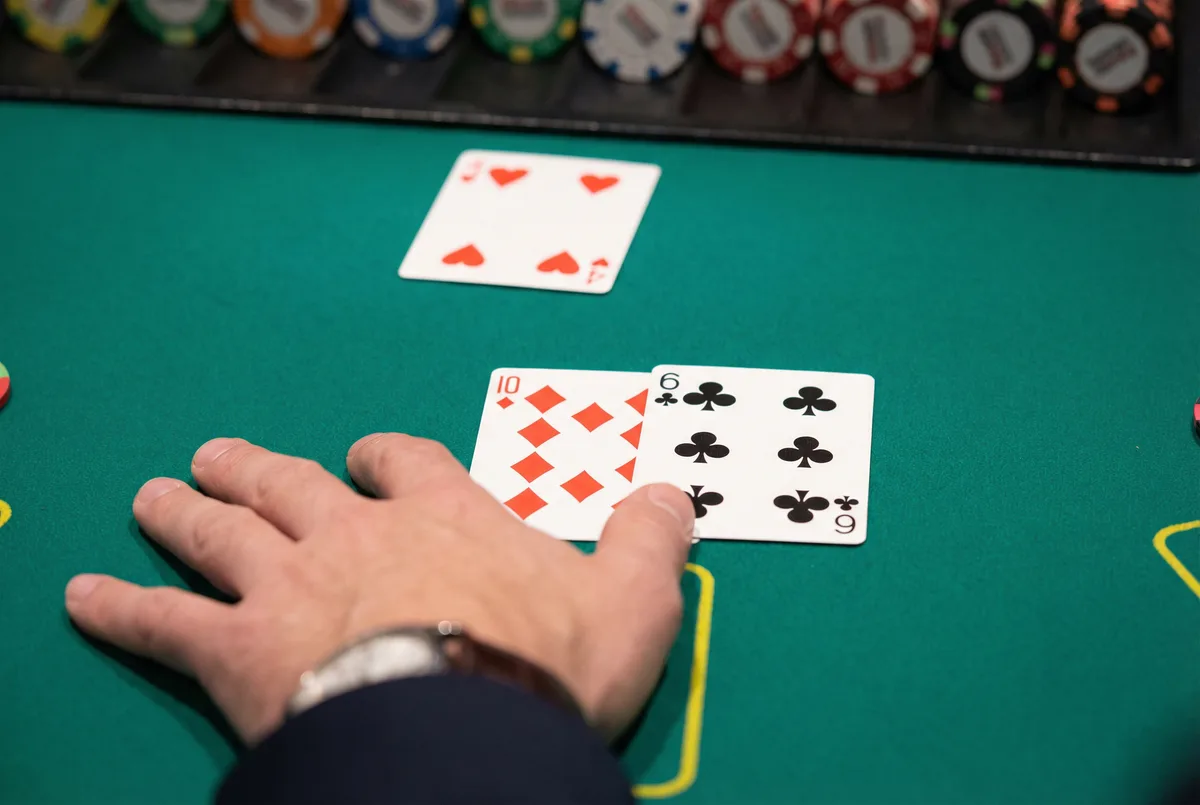
When to Stand on 12 Through 16 Against a Dealer 2 Through 6
- The Dealer Bust Rates That Drive Every Stiff-Hand Decision
- When Should You Stand on 12 Through 16 Against a Weak Dealer Upcard?
- Why Does Basic Strategy Say Hit 12 Against a Dealer 2 or 3?
- Why Do Players Keep Hitting 16 Against Weak Upcards When the Math Says Stand?
- Applying the Stiff-Hand Rule at a Live Blackjack Table
[bja_toc]
Stiff hands — totals between 12 and 16 — generate more incorrect decisions and more lost chips than any other situation in blackjack. Most players react to these hands emotionally rather than mathematically: they hit because 16 feels like it cannot win, or they stand because hitting seems too risky. Both instincts lead to errors that compound over hundreds of hands. The correct approach is built on dealer bust rates — specific numbers that quantify exactly how dangerous the dealer’s upcard is — and those numbers give you a precise set of rules that replace guesswork entirely. Against a dealer showing 2 through 6, standing on most stiff totals is the highest expected-value play. The one critical exception at hard 12 against a dealer 2 or 3 is where even experienced players leak chips by standing when they should be hitting.
The Dealer Bust Rates That Drive Every Stiff-Hand Decision
Dealer bust rates are the mechanical foundation of stiff-hand strategy. When the dealer’s upcard forces them to complete a hand with a high probability of exceeding 21, standing on a weak total becomes mathematically superior to risking your own bust. The progression from dealer 2 through dealer 6 is not uniform — each upcard has its own specific bust probability, and those differences matter for your decisions on individual hand combinations.
A dealer showing a 6 will bust approximately 42% of the time after completing their hand under standard rules. That means four out of every ten hands where the dealer shows a 6, you win by doing nothing more than not busting yourself. A dealer showing a 2, by contrast, busts only 35% of the time — still meaningfully elevated compared to a dealer 9 (23%) or dealer ace (17%), but low enough that 12 cannot afford to stand and wait for a bust that arrives less than 4 times in 10.
Dealer 2 bust rate
%
Dealer 3 bust rate
%
Dealer 4 bust rate
%
The jump from dealer 6 to dealer 7 is one of the most consequential transitions on the entire strategy chart. Dealer 6 busts 42% of the time. Dealer 7 busts only 26% — a 16-point drop that changes your stiff-hand response from standing to hitting on every total. When the dealer shows a 7 or higher, they are completing hands at a rate that makes passive standing on 12 through 16 a losing play. Against 2 through 6, the bust probability is high enough that the reverse applies. Understanding this inflection point is the clearest way to internalise why the strategy shifts where it does.
When Should You Stand on 12 Through 16 Against a Weak Dealer Upcard?
The core standing rule for stiff hands covers totals 13 through 16 against any dealer upcard from 2 through 6, without exception. Hitting a 13 against a dealer 5 costs you expected value on every repetition regardless of what individual hands produce. Hitting a 16 against a dealer 4 is even more damaging — you are risking a high-probability bust (approximately 62% of 16s bust on a single draw) to improve a total that would have benefited from the dealer’s own 40% bust probability doing the work for you.
The logic of standing on stiff totals against weak upcards is not about hoping. It is about converting the dealer’s predetermined bust rate into a reliable edge over time. In a 100-hand session where the dealer shows a 6 approximately eight times, you can statistically expect to win roughly three of those eight hands simply by not busting — regardless of what you hold. Hitting into that scenario forfeits the portion of your edge that comes from dealer self-destruction and substitutes a 62% bust risk on your own hand instead.
Dealer Shows
Your Hand
Hard 13 against a dealer 5. What is the correct play?
Hard 13 against any dealer 2 through 6 is a standing hand without exception. The dealer's elevated bust rate makes passive standing the highest expected-value option — hitting reduces your EV on every repetition.
Why Does Basic Strategy Say Hit 12 Against a Dealer 2 or 3?
Hard 12 against a dealer 2 or 3 is the most frequently misplayed hand in the stiff zone. Players see a dealer upcard below 4 and assume that the universal “stand on stiff hands against weak cards” rule applies. It does not apply here, and the reason is the dealer’s specific bust rate on those two upcards.
A dealer showing a 2 busts 35% of the time. A dealer showing a 3 busts 37% of the time. Those rates sound high in absolute terms, but they mean the dealer is completing a hand that beats 12 on 63 to 65% of deals. Holding a 12 passively against that completion rate produces a significant expected loss. The question is whether hitting improves the outcome, and it does — marginally, but consistently enough that basic strategy mandates the hit.
The reason hitting 12 is viable is the bust risk on the draw. Hard 12 only busts on a ten-value card: 10, J, Q, K. That is 16 cards out of 52, or approximately 31%. The other 69% of draws give you a total of 13 to 21, most of which are stronger hands against a marginally weak upcard. The net expected value of hitting 12 against a dealer 2 or 3 is slightly higher than standing, which is why the strategy specifies the hit. Against dealer 4, 5, or 6, the dealer’s bust probability rises enough that even holding 12 becomes worth defending — so the rule changes to stand at 12 versus 4, 5, and 6.
Common Myth
“Always stand on 12 when the dealer shows a low card”
Players group all upcards from 2 through 6 as 'weak' and apply a single standing rule across all of them — it feels consistent and safe
The Reality
Hard 12 against a dealer 2 or 3 is a hit. The dealer's bust rate on those upcards is not high enough to justify holding the weakest stiff total
Standing on 12 vs dealer 2 carries a slightly worse expected value than hitting once. The EV gap is small but real, and over hundreds of repetitions it adds up. The correct play is to hit 12 against a 2 or 3 and stand against a 4, 5, or 6.
Why Do Players Keep Hitting 16 Against Weak Upcards When the Math Says Stand?
Hard 16 is the most uncomfortable hand in blackjack — it looks unwinnable, which creates a pull toward hitting as the only available action. The feeling is that 16 cannot beat anything, so drawing must be the right move. That reasoning is incorrect in all situations where the dealer shows 2 through 6, and understanding precisely why reveals something important about how basic strategy works.
Hard 16 does not need to beat the dealer’s hand directly. It needs the dealer to bust. Against a dealer 6, the dealer busts 42% of the time. Standing on 16 captures that 42% without exposing your hand to a 62% bust risk on a single draw. Hitting converts a win you get for free (the dealer busts) into a gamble where you are the one more likely to go over 21. That is the mathematical argument for standing — the dealer is doing the losing for you, and hitting interrupts that process.
The psychological barrier is that 16 loses often even when you stand correctly. The dealer completes their hand without busting 58% of the time against a 6 upcard. You will lose those hands. But you would have lost them at an even higher rate by hitting and busting before the dealer even finished their hand. Basic strategy does not eliminate losses on 16 — it minimises them. Players who cannot tolerate frequent small losses on a correct play and react by hitting instead are shifting from a losing position to a worse losing position, and their bankroll reflects it over time.
The 16 versus dealer 6 hand is one of the clearest illustrations of why blackjack rewards discipline over intuition. Standing on 16 feels like surrender. But the dealer's 42% bust rate makes standing the correct choice mathematically. The players who understand this and stand without hesitation every time are playing a fundamentally different game from the players who hit because 16 makes them uncomfortable. The chip counts diverge accordingly over any meaningful sample of hands.
Applying the Stiff-Hand Rule at a Live Blackjack Table
Two rules cover the vast majority of stiff-hand decisions you will face at a real table. First: stand on 13 through 16 against any dealer upcard from 2 through 6. Second: hit 12 against a dealer 2 or 3, and stand on 12 against a dealer 4, 5, or 6. Committing these two rules to automatic memory before you sit down removes the most common source of decision errors in the stiff zone.
There is one additional scenario worth knowing before you play: hard 16 against a dealer 9, 10, or ace. Against those strong upcards, the correct play is surrender in any game that offers it. Surrendering hard 16 against a dealer 10 returns 50 cents of every dollar wagered and avoids the worst expected-value scenario on the entire basic strategy chart. If the table does not offer surrender, you hit — standing on 16 against a dealer 9, 10, or ace has negative expected value that exceeds even hitting, so standing is wrong in those situations despite the instinct to preserve your hand. The surrender and hit rules for strong upcards are completely separate from the standing rules that apply against upcards 2 through 6.
Practise these decisions across several hundred hands before playing with real money. The stiff zone is where correct decision speed matters most — a live table moves quickly, and hesitation on a hard 16 draws attention that can affect your composure. The free blackjack simulator lets you drill stiff-hand situations specifically at zero cost until every response is automatic. When you are ready to test these decisions against a real human dealer where the rules match a casino environment exactly, a live dealer session involving real money is the most realistic bridge between simulator practice and a physical casino floor.
Frequently Asked Questions
Yes. Standing on 16 versus a dealer 6 is the correct basic strategy play without exception. The dealer busts 42% of the time showing a 6, and hitting a hard 16 busts you approximately 62% of the time. Standing converts the dealer's bust probability into a win without adding your own bust risk.
The dealer's bust rate on a 2 is 35% and on a 3 is 37% — not high enough to justify standing on the weakest stiff total. Hard 12 only busts on a ten-value draw (roughly 31% probability), making a single hit the higher-EV play. Against a dealer 4, 5, or 6, the bust rates rise enough that standing 12 becomes correct.
Surrender hard 16 against a dealer 9, 10, or ace whenever the game offers late surrender. Those strong upcards lower your win probability enough that surrendering — which recovers half your bet — produces better expected value than either standing or hitting. If surrender is not available, hit 16 against those upcards.
Mathematical Risk Warning
Basic strategy minimises the house edge on stiff hands but does not eliminate it. You will lose frequently on 12 through 16 even when every decision is correct. Set loss limits before you sit down and treat them as absolute.
Blackjack Academy is an educational resource. All strategy recommendations are based on mathematical expectation. Always gamble responsibly and within your means.

Written by
Mark AnurakProfessional card counter since 2009 · 500,000+ hands logged · Former Macau advantage player. Studied under Thorp, Griffin & Wong methodology. Full bio →
Learn More
Continue your education with these related lessons.
Complete Post-Split Strategy Guide for Playing Blackjack After Splitting
Post-split strategy explained: playing each split hand independently, why split aces get one card only, re-splitting rules, and doubling after…

Why You Always Split Aces and 8s in Every Version of Blackjack
Splitting aces and 8s is the one pair-splitting rule that never changes. Here is the mathematical case for both unconditional…
Attacking the Dealer by Splitting 7s Against a 2 Through 7
Splitting 7s against dealer 2 through 7 converts a losing hard 14 into two independent hands starting at 7. The…