
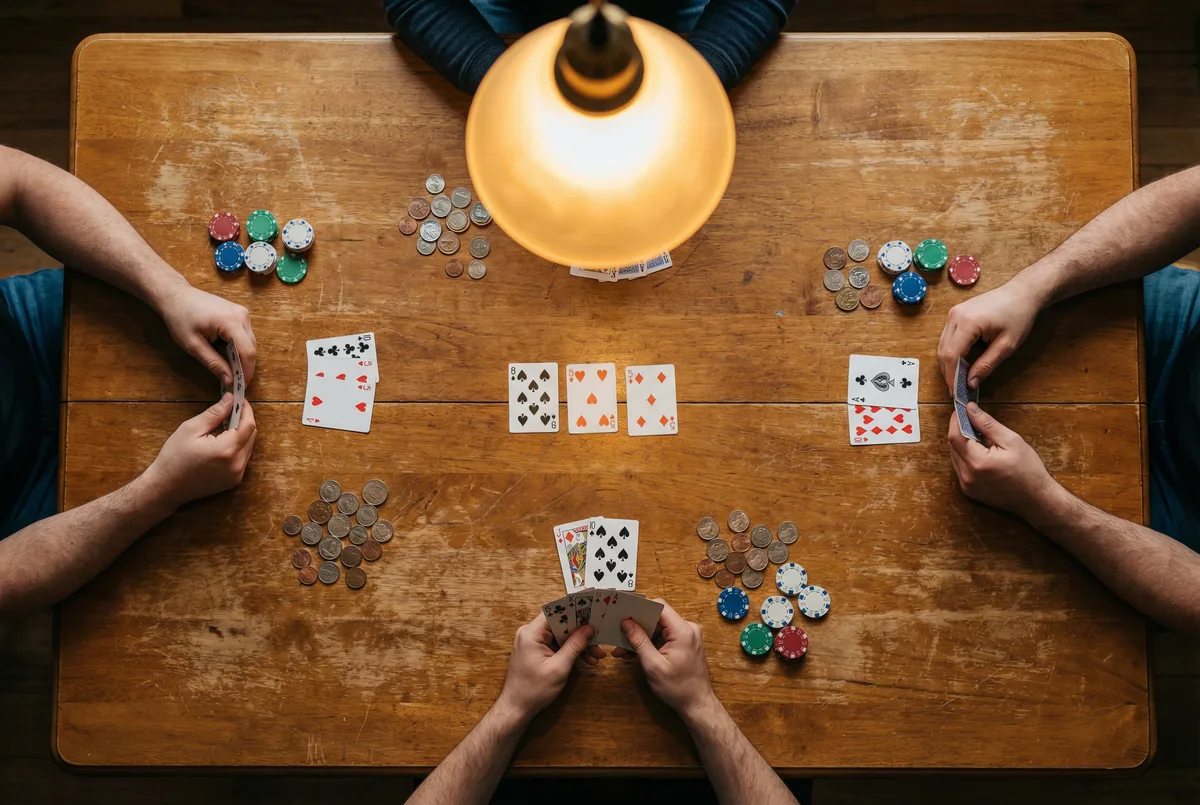
5 Major Differences Between Casino Blackjack Rules and Home Games
Everyone at the table told me they knew how to play blackjack. They learned at home, on the kitchen table, with house rules their uncle made up. Half of them did not know the dealer had to stand on 17. A third of them thought ties meant the dealer wins. One player was genuinely surprised that a natural pays more than even money. The gap between home blackjack and casino blackjack is not small. It is roughly 2% to 4% in blackjack house edge, depending on which home rules you grew up with. That gap costs real money the moment you sit at a real table.

Dealer Rules Are Fixed, Not Flexible
In a casino, the dealer follows mandatory rules printed on the table felt. The dealer must hit on any total of 16 or below and must stand on 17 or above (at most tables). There is no choice, no strategy, and no deviation. The dealer is executing an algorithm. In a home game, whoever plays the dealer makes their own decisions. They might stand on 15 because they feel lucky, or hit on 18 because they want to take a risk.
This single difference changes the entire mathematical structure of the game. Basic strategy exists because the dealer follows fixed rules. Every correct play on the blackjack strategy chart is calculated against the predictable dealer algorithm. When the dealer can make choices, those calculations break down. You cannot optimize against an unpredictable opponent the same way you optimize against a machine.
The most dangerous home game variation is letting the dealer hit until they beat everyone at the table. In a casino, the dealer follows fixed rules regardless of player hands, they hit soft 16, stand on hard 17. Home games that give the dealer discretion add significant edge that's difficult to calculate.
I played home games for years before my first casino session. The biggest adjustment was realizing that the dealer was not trying to beat me. The dealer was executing a rule set. Once I understood that, every strategy decision made more sense. You are not playing against a thinking opponent. You are playing against a probability distribution defined by a fixed algorithm.
The soft 17 rule is another difference most home players have never encountered. In many casinos, the dealer must hit on soft 17 (a hand containing an Ace counted as 11 that totals 17). This adds 0.22% to the blackjack house edge compared to standing on all 17s. Home games almost never specify this rule, which means home players do not know to look for it and do not understand its cost when they see it at a real table.
Why Casino Payouts Are Standardized?
Casino blackjack pays 3:2 for a natural 21 at standard tables, while most home games pay even money, a difference worth approximately $12.50 per natural on a $25 bet. Home games pay whatever the group decides, which is usually even money. The 3:2 payout is the single most important player-friendly rule in casino blackjack. It is the primary mechanism that offsets the blackjack house edge. Without it, the game would have roughly a 2.3% blackjack house edge instead of 0.5%.
At 3:2, a natural on a $25 bet pays $37.50. At even money (common in home games), the same natural pays $25. Over 200 hands, you can expect roughly 9 to 10 naturals. The 3:2 bonus adds approximately $112 to $125 in extra value across those hands compared to even money. That is real money that home game payouts simply do not provide.
| Setting | $25 Bet Payout | House Edge Impact |
|---|---|---|
| Casino 3:2 (standard) | $37.50 | |
| Casino 6:5 (avoid) | $30.00 | |
| Home game even money | $25.00 | |
| Home game double | $50.00 |
Some home games go the other direction and pay double (2:1) for a natural. This is more generous than any casino in the world. If you learned on a 2:1 home game, your expectation at a casino 3:2 table will feel like a downgrade, even though 3:2 is the best payout you will find on any commercial table. Knowing the standard payout before you sit down prevents the confusion I see on players’ faces when they get their first 3:2 payout and expected more.
How Does Casino Deck Handling and Shuffling Differ from Home Games?
Casino blackjack uses standardized shuffling procedures, cut cards, and multi-deck shoes, a 6-deck shoe contains 312 cards and the casino cuts approximately 1 to 1.5 decks from the back before dealing begins. A 6-deck shoe contains 312 cards, and the casino cuts approximately 1 to 1.5 decks from the back to prevent players from seeing the bottom of the shoe. A continuous shuffling machine may be used, which eliminates the shoe entirely and shuffles cards back in after every few hands. Home games typically use 1 to 2 decks hand-shuffled by whoever is dealing.
The number of decks directly affects the blackjack house edge. A single-deck game with proper rules has a blackjack house edge around 0.28%. A 6-deck game with the same rules has an edge around 0.50%. An 8-deck game is approximately 0.61%. Home games with a single deck are mathematically better for the player, but this advantage is usually offset by the lack of standardized dealer rules, uneven payouts, and inconsistent dealing.
Advantages
- Casino: Fixed dealer rules enable basic strategy
- Casino: 3:2 payout on naturals offsets house edge
- Casino: Standardized shuffling prevents manipulation
- Casino: Multiple decks reduce card counting effectiveness
Disadvantages
- Home: No fixed dealer rules, strategy charts do not apply
- Home: Even money payout increases effective house edge by 2.27%
- Home: Single deck shuffled by players, potential bias
- Home: Variable rules create inconsistent game conditions
Card counting is possible at casino tables because the shoe is dealt to a specific depth before reshuffling. This gives the counter time to identify favorable counts and adjust their bet. In a home game with a single deck shuffled every few hands, counting provides minimal advantage because the shoe is reset too frequently. The casino paradoxically makes counting possible by using a multi-deck shoe dealt deeply, though they compensate with surveillance, bet limits, and backing off suspected counters.
What Player Options Do Casinos Offer That Most Home Games Never Include?
Casino blackjack offers doubling down, splitting, surrender, and insurance, player options that most home games do not include and that collectively reduce the blackjack house edge by 0.1% to 0.5% when used correctly. Doubling down lets you double your bet and receive exactly one more card. Splitting lets you separate a pair into two hands, each with its own bet. Surrender lets you forfeit half your bet on a bad hand. Insurance lets you make a side bet when the dealer shows an Ace. Each option has specific rules about when it is available and how it affects the blackjack house edge.
Home games rarely include all of these options. Most home players have never heard of surrender. Many do not know you can double on any two cards (some home rules restrict doubling to 10 or 11 only). Some home games allow unlimited resplitting while casinos limit splits to 2 or 3 times. The mismatch between home and casino options means a player who walks into a casino from a home game is missing opportunities worth 0.1% to 0.5% in expected value.
I once sat next to a player who did not know he could double down on soft 18 against a dealer 5. He had been playing at home for years. That one play, when available, is worth approximately $3.50 in expected value on a $25 bet. Multiply that across every missed opportunity over a session, and the cost of not knowing the full casino rule set becomes significant.
Making the Transition from Home to Casino
The transition from home blackjack to casino blackjack requires unlearning as much as learning. Forget that the dealer makes choices. Forget even money payouts on naturals. Forget that shuffling is casual. Replace those habits with an understanding of fixed dealer rules, 3:2 payouts, standardized shoe dealing, and the full menu of player options. The casino version is a different game with different math, even though the cards look the same.
The single best preparation is memorizing a blackjack basic blackjack strategy chart before your first casino session. The chart is designed specifically for casino rules. It assumes a fixed dealer algorithm, a multi-deck shoe, and 3:2 payouts. None of those assumptions hold in a home game. A player who walks into a casino with the chart memorized has a 0.5% blackjack house edge. A player who walks in with home game instincts has a 2% to 4% edge working against them. The difference over 200 hands at $25 is between losing $25 and losing $100 to $200.
I made this transition over a decade ago and the adjustment took about three sessions. Play your first real casino hands at a live table with the blackjack basic blackjack strategy chart open beside you. Notice every rule that is different from what you played at home. The fixed dealer hits, the 3:2 payout on your first natural, the double down option on any two cards. Each one is a mathematical advantage that home games never gave you. The stakes are real from the first deal, so bring only what you budgeted for the session and stop when it is gone.
Frequently Asked Questions
The dealer follows fixed rules in a casino (must hit on 16 or below, stand on 17 or above). In home games, the dealer makes their own choices. This single difference makes basic strategy possible at casinos and meaningless at home.
Casino blackjack pays 3:2 for a natural, adding $12.50 in bonus value per natural on a $25 bet. Home games typically pay even money, which costs the player approximately 2.27% in additional house edge compared to the 3:2 standard.
Yes. Basic strategy is designed for casino rules and reduces the house edge to approximately 0.5%. Without it, playing by instinct or home game habits puts you at a 2% to 4% disadvantage, costing $75 to $200 more per 200 hands at a $25 table.
Before you test these plays at a real table, run them through our free blackjack simulator practice unlimited hands at zero cost until every move becomes automatic.
Know Your Edge Before You Bet
The calculator shows your exact expected value under any rule set.
Blackjack Academy is an educational resource. All strategy is based on mathematical expectation. Always play within your means.

Written by
Mark AnurakProfessional card counter since 2009 · 500,000+ hands logged · Former Macau advantage player. Studied under Thorp, Griffin & Wong methodology. Full bio →
Learn More
Continue your education with these related lessons.
What Actually Happens During a Push or Tie in Casino Blackjack
A push occurs when you and the dealer finish with the same total. Your bet is returned, nobody wins, nobody…
How to Build a Blackjack Practice Routine Using Free Online Tools
Build a structured blackjack practice routine using free online tools. Covers weekly study plans, focus areas by phase, progress tracking,…
Why Blackjack Is a Skill Game, Not Luck
Blackjack's house edge drops to 0.5% with correct play and climbs past 4% without it. That gap is the proof…