
Complete Visual Guide to Blackjack Hand Signals Every Player Needs
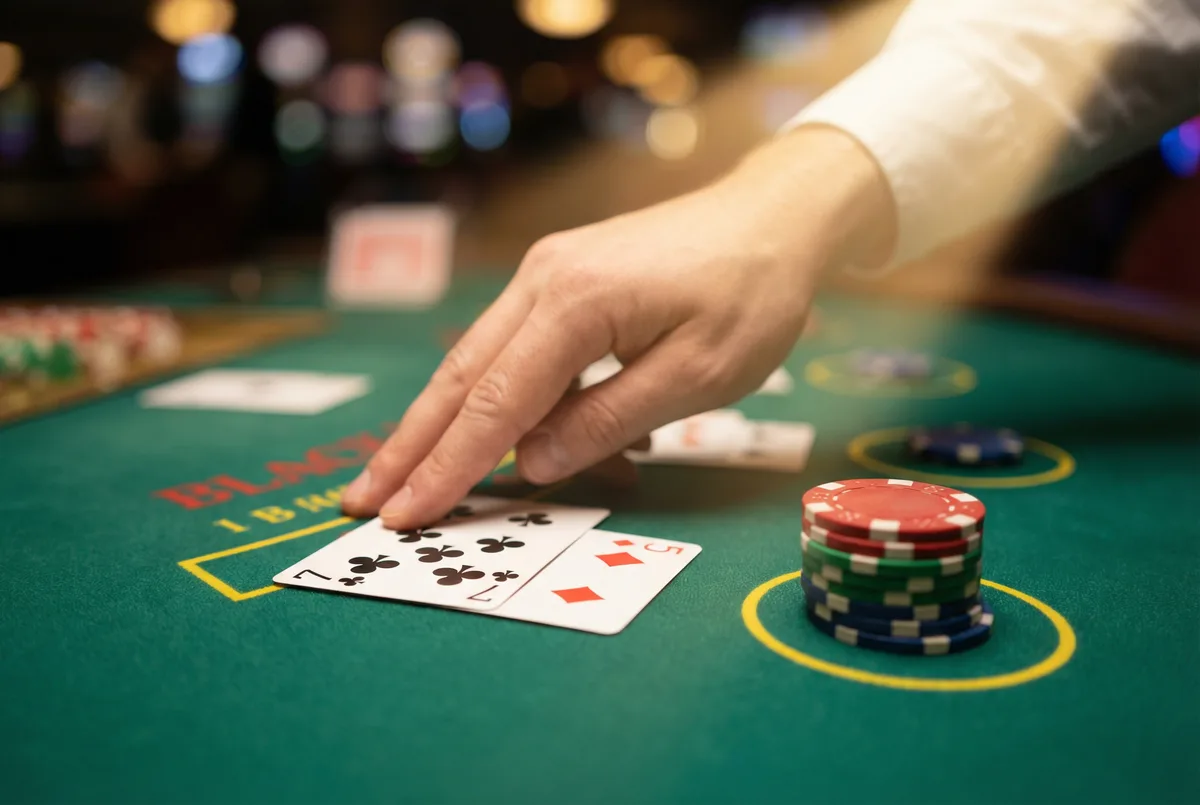
Every casino blackjack table is recorded by overhead surveillance cameras. Those cameras cannot pick up spoken words, but they can clearly record physical hand gestures. Hand signals exist so that every player decision is documented on video this protects the casino against disputes, protects players against dealer errors, and creates an unambiguous record of what happened on any given hand. Saying “hit” or “stand” is not sufficient at a casino table. If a dispute arises and no hand signal was made, the casino’s position almost always prevails. Learning the five standard signals takes about ten minutes and eliminates one of the most common beginner mistakes on the floor.

Why Hand Signals Exist and Why You Must Use Them
- Hittap the felt once or scrape cards toward you (handheld)
- Standwave hand flat over cards, palm down
- Double/Splitplace equal chip beside original bet, hold up one or two fingers
What Is Hit and Stand?
To signal a hit at a face-up shoe game, tap the felt behind your cards once with one or two fingers. Do not touch the cards in a face-up game. At a handheld single or double-deck game, scrape the edge of your cards lightly toward you on the felt. This scraping motion is the traditional signal and is universally recognized by dealers.
To signal a stand, wave your hand flat over your cards with your palm facing down. A single horizontal wave is enough. Avoid the temptation to verbalize your decision simultaneously some players say “stand” while waving, but the physical signal is what matters. At a handheld game, slide your cards face-down under your bet chips to signal a stand. Do not bend or crease the cards.
Timeline
Shoe game hit
Tap felt behind cards once with one or two fingers
Shoe game stand
Wave hand flat over cards, palm facing down
Handheld hit
Scrape card edges toward you on the felt
Handheld stand
Slide cards face-down beneath your chips
Double down
Place equal chip beside the bet, hold up one finger
Split
Place equal chip beside the bet, hold up two fingers (or point)
Surrender
Draw a line on the felt from left to right with one finger
What Are Double Down, Split, and the One-Chip Rule?
To double down, place a second stack of chips beside your original bet not on top of it. The two stacks should be equal or the additional stack may be less than the original. Placing chips on top of your bet is not permitted after cards are dealt; this rule prevents players from adding to a winning hand illegally. After placing the chip beside your bet, hold up one finger toward the dealer to signal a double.
Dealer Shows
Your Hand
You hold hard 11 against a dealer 6. What is the correct signal?
Dealer 6 is the weakest upcard. Combined with your 11, you have the highest probability of landing a 21 or strong total with one additional card. Doubling maximizes the expected value of this hand.
What Are the Surrender Signal and When to Use It?
Late surrender is not available at every table, but where it is offered, the signal is a single horizontal line drawn on the felt with one finger as if you are drawing a slash in front of your cards. Some casinos require you to verbalize “surrender” along with the signal because the gesture can look ambiguous to both the dealer and the camera. When in doubt, say the word and draw the line simultaneously. Surrender returns half your bet and forfeits the hand. It is mathematically correct on hard 15 and hard 16 against a dealer 10 or ace, and should not be confused with folding out of frustration on a losing streak.
Practicing Signals Before You Play for Real Money
The fastest way to internalize hand signals is to practice them alongside blackjack basic strategy drills at home reach for the felt tap, wave flat, place the phantom chip. Within a few sessions your hands will respond before your brain consciously decides. If you want to rehearse them under live conditions before your first casino trip, the live dealer rooms at experience this rule with real money on the line require proper signals just like a physical casino keep in mind that real money is on the line in those rooms, so go in with a clear session limit.
Frequently Asked Questions
Place an additional bet equal to your original wager beside it never on top and point with one finger. The single finger indicates you want exactly one more card. In handheld games, turn your cards face up and place the additional bet.
Draw an imaginary horizontal line behind your bet with your index finger. Not all casinos offer surrender, and many dealers are unfamiliar with the signal verbally saying 'surrender' simultaneously ensures the decision is heard and recorded before the dealer acts.
No. Once a hand signal is made and acted upon by the dealer, the decision stands. Verbal instructions without a corresponding signal may be ignored or disputed. This is why correct signals are required, not optional disputes are resolved in favor of the signal that was made.
Before you test these plays at a real table, run them through our free blackjack simulator practice unlimited hands at zero cost until every move becomes automatic.
Mathematical Risk Warning
Incorrect hand signals can result in unintended decisions and immediate financial loss. Practice all five signals before playing at a live casino table with real money.
Blackjack Academy is an educational resource. All strategy is based on mathematical expectation. Always play within your means.

Written by
Mark AnurakProfessional card counter since 2009 · 500,000+ hands logged · Former Macau advantage player. Studied under Thorp, Griffin & Wong methodology. Full bio →
Learn More
Continue your education with these related lessons.
Why Blackjack Is a Skill Game, Not Luck
Blackjack's house edge drops to 0.5% with correct play and climbs past 4% without it. That gap is the proof…
How to Beat the Dealer in Blackjack Without Going Over 21
The dealer busts more than 28% of all hands in a standard 6-deck game. That number is the foundation of…
History of French Vingt-et-Un the Ancestor of Modern 21
Vingt-et-un was played in French salons for over a century before it crossed the Atlantic. The rules were different, the…