

Complete Blackjack Table Etiquette Guide Every Serious Player Must Know
Blackjack table etiquette is the set of protocols that govern how players interact with the dealer, the cards, and each other at a casino blackjack table. These rules are not arbitrary politeness many exist because the game is monitored by cameras from above, and casinos must be able to verify every action on tape. When you touch cards incorrectly, handle chips improperly, or act out of turn, you slow the game, create disputes, and mark yourself as inexperienced. Walking in prepared means fewer mistakes, faster play, and a dealer who is happy to help you rather than correct you every hand.
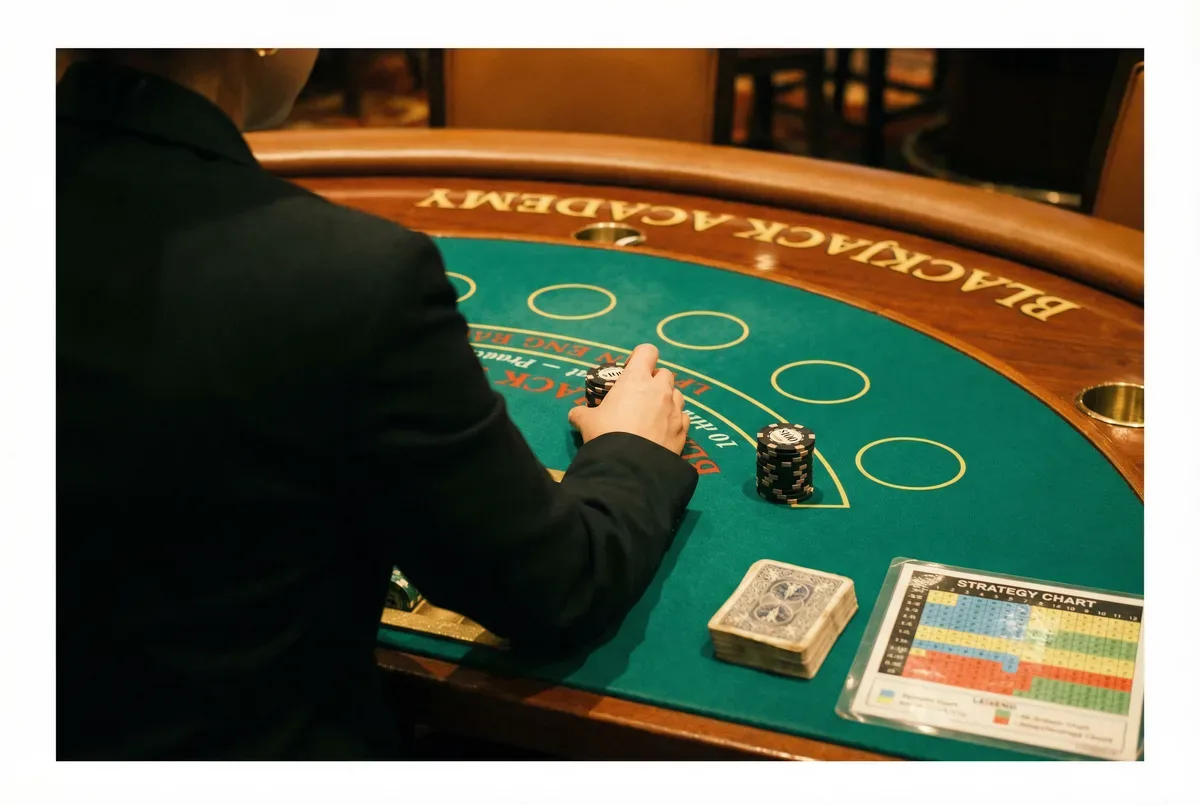
Why Table Etiquette Matters in Blackjack
- Never touch chips after cards are dealt
- Use hand signals cameras can't hear you
- Buy chips between hands, never mid-deal
- Tip by placing a chip for the dealer on the felt
- Phones off the felt casino policy everywhere
How to Buy Chips and Sit Down Correctly?
Buying in at a blackjack table follows a specific sequence. Wait for the current hand to finish before approaching. Place your cash flat on the felt outside the betting circle never hand it directly to the dealer. The dealer will spread it for the camera, count it aloud, and exchange it for chips. Never put your hands near the cash once you have placed it on the table. The dealer cannot take anything from a player’s hand; everything must transit via the felt. If you sit at a table mid-shoe, some casinos have a no-mid-shoe-entry policy posted on the felt respect it without argument.
Stack your chips in your own betting area, organized by denomination. Larger chips go on the bottom of any stack you place in the betting circle. Never touch another player’s chips not to admire them, not to point at them, not for any reason. Casino disputes over chip handling are taken seriously, and the surveillance footage will not be on your side if your hand was near chips that were not yours. When you want to leave, ask the dealer to color up: they will exchange your smaller chips for larger denominations before you walk to the cage.
Dealer Shows
Your Hand
You have soft 18. What is the correct play against a dealer 6?
Doubling soft 18 against a 6 is one of the highest-value doubles in the game. The dealer busts roughly 42% of the time showing a 6, and your ace gives you zero bust risk on the double card. Most etiquette errors happen when players are uncertain about this kind of play knowing your strategy keeps the game moving smoothly.
What Is Hand Signals?
Hand signals are mandatory, not optional. Every blackjack table in a licensed casino is filmed from above, and verbal declarations are not recorded clearly enough to resolve disputes. The signals differ slightly based on whether you are playing a face-down game (where you hold the cards) or a face-up shoe game (where you never touch the cards). In a shoe game, tap or scratch the felt toward yourself to hit, wave a flat hand over your cards to stand, and place an additional chip next to your original bet to double or split. In a handheld game, scratch the cards toward you to hit and slide them under your chips to stand. When splitting or doubling, place a matching chip beside the original bet never on top of it, which can look like a cap.
Surrender, where available, is signaled by drawing a horizontal line behind your bet with your index finger. The dealer will announce the surrender, remove half your bet, and clear the hand. Act on your own hand only when the dealer gets to you never gesture or announce early. Players who act out of turn disrupt the natural information flow of the game and, in a face-down game, can expose strategic information to other players. Stay quiet during other players’ decisions and focus on tracking the cards while you wait.
Shoe Game
Handheld Game
- Never
- Yes, with one hand
What Are Tipping, Cellphones, and Handling Cards?
Tipping dealers is standard casino culture, though never required. The correct way to tip is to place a chip on the felt in front of your bet, slightly forward, and announce “for the dealer” or simply say “it’s for you.” You can also bet a chip for the dealer by placing it on top of or beside your main bet before the hand the dealer wins if you win, loses if you lose. Do not hand the dealer chips directly. A good rule of thumb: tip after a session where the dealer has been courteous and helpful, not after every hand. Dealers in large casinos pool tips, so a single generous tip at session end carries the same weight as many small ones.
Cellphones must stay off the felt at all times. Most casinos prohibit photographing the table, and many also prohibit calls at the table while a hand is in progress. This is partly policy, partly courtesy. If you need to take a call, step away from the table do not hold up a hand in progress by fumbling with your phone. In handheld games, cards must be held with one hand only and kept above table level at all times. Two-handing cards is a red flag for marking or switching, and dealers are trained to immediately call it out. Keep cards visible, handle them gently, and never remove them from the table surface entirely.
Practice Your Etiquette Before You Play for Real Money
Knowing the rules on paper and executing them under pressure are two different things. Before committing real chips in a live casino, drill your hand signals, practice your buy-in sequence, and run through common scenarios, including splits and doubles, and until the motions are automatic. The watch this play out with real money section of this site lets you practice in a realistic live-dealer environment, but carry this warning: those games involve real money, and the same stakes that create useful pressure can also create expensive mistakes if your fundamental etiquette and strategy are not yet solid. Build the habit first, then take it live.
Frequently Asked Questions
Many casinos allow printed strategy cards but prohibit phones at the table during play. Check the casino's specific policy before sitting down some properties have begun allowing phones as long as they are not used for calls or photography.
If you touch your chips after cards have been dealt, the dealer will remind you of the rule and, if it appears intentional, may call a pit supervisor. Accidental contact with a clear verbal acknowledgment is usually handled informally. The key is to keep your hands off the betting area from the moment the first card is dealt until the hand is settled.
Tipping is customary but not mandatory. Dealers understand that not every player tips on every session. What is considered genuinely rude is being hostile, arguing over correct strategy, or blaming the dealer for your losses. A pleasant player who does not tip is far more welcome than an aggressive player who does.
Before you test these plays at a real table, run them through our free blackjack simulator practice unlimited hands at zero cost until every move becomes automatic.
Mathematical Risk Warning
Every session at a real-money blackjack table carries genuine financial risk. Perfect etiquette and correct strategy reduce the house edge but never eliminate it. Set a firm session budget before you sit and walk away when it is gone.
Blackjack Academy is an educational resource. All strategy is based on mathematical expectation. Always play within your means.

Written by
Mark AnurakProfessional card counter since 2009 · 500,000+ hands logged · Former Macau advantage player. Studied under Thorp, Griffin & Wong methodology. Full bio →
Learn More
Continue your education with these related lessons.
Complete Roadmap to Becoming a Professional Blackjack Player
Becoming a professional blackjack player is a 4-stage progression that takes most people two to four years of deliberate practice.…

Blackjack Payout Structures Explained from 3 to 2 to Even Money
The payout on a natural blackjack is the single biggest variable in the game. Here is exactly what 3:2, 6:5,…
Why You Must Demand a 3 to 2 Natural Blackjack Payout
The difference between a 3:2 and a 6:5 natural payout is not a small rule variation. It is a 1.39%…