
Why Dealers Show One Card and Players Get Two in Blackjack
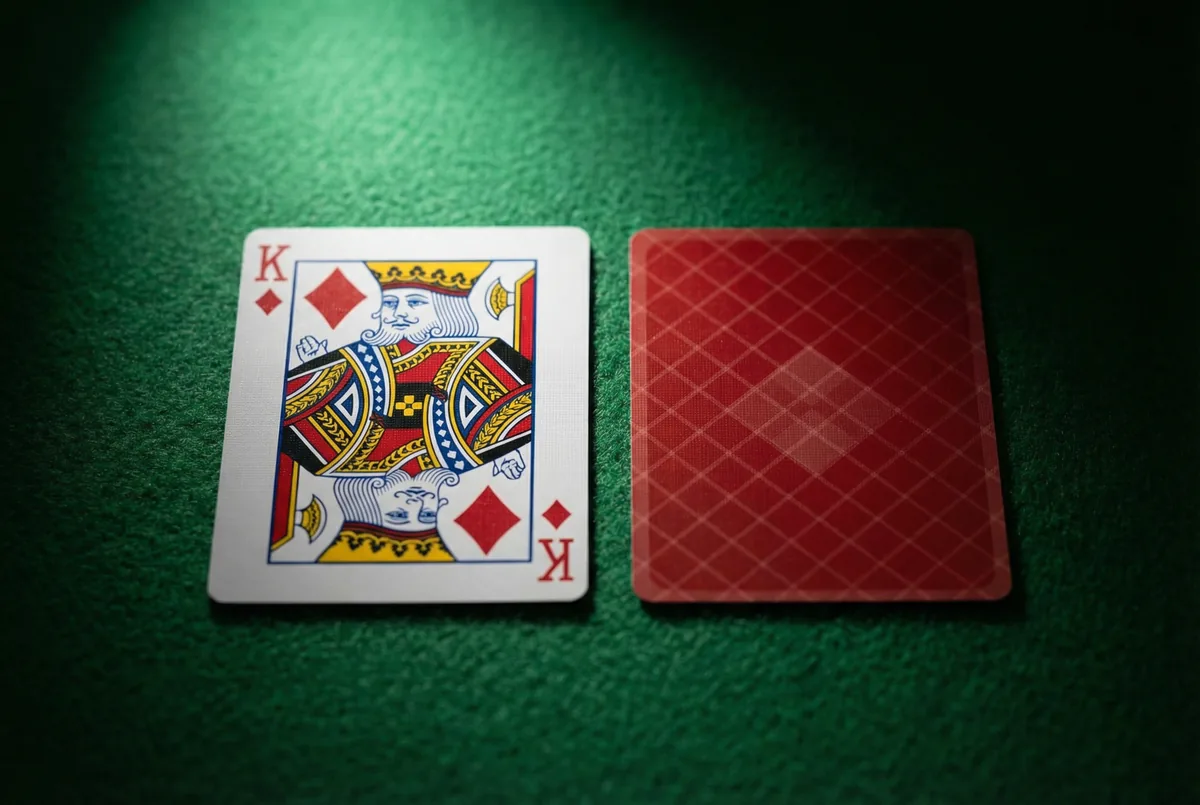
There is a reason the dealer keeps one card hidden, and it is not the reason most players think. I used to assume the hidden card was just tradition. Then I ran the numbers and realized the entire game is built around it. 46% of dealer hole card combinations produce a bust when paired with specific low upcards. That number explains why blackjack basic strategy tells you to stand on hard 12 against a dealer 4, even though your own total looks terrible. The dealing format, two cards to you face up, one to the dealer face up and one face down, was deliberately designed to create information asymmetry. The upcard reveals enough to make a probabilistic decision. The hole card is where the mathematical tension lives.
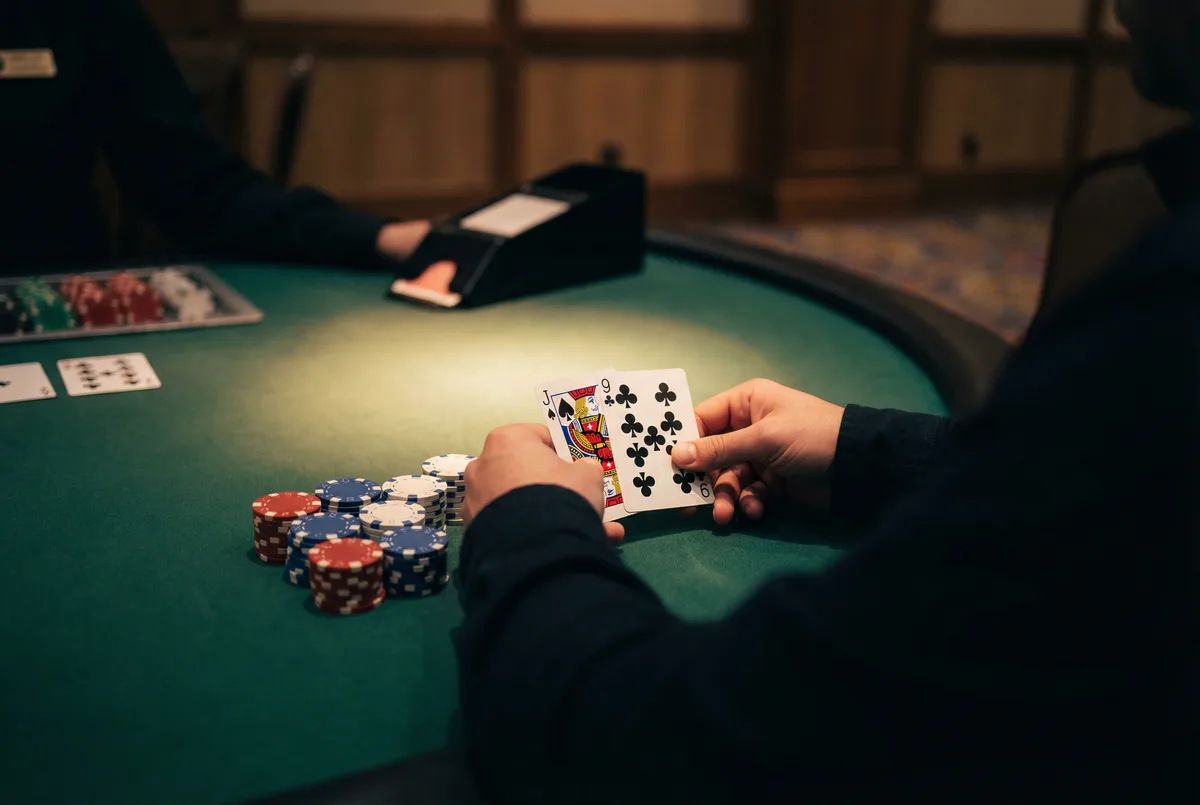
The hole card creates asymmetric information. Players see both their cards and one dealer card, which is why basic strategy can be derived at all. Without the visible upcard, every hand decision would be made against an unknown total. The visible card is what separates blackjack from a pure guessing game.
Why One Card Is Dealt Face Down
The one-face-down card rule exists to give the house a structural advantage that does not depend on dealer skill or randomness. If both dealer cards were face up, players would know the dealer’s exact total before acting and could adjust strategy with perfect information. The probability of optimal play would increase, reducing the blackjack house edge to near zero or eliminating it entirely. The face-down card creates a layer of uncertainty that requires players to act on incomplete information, which systematically disadvantages them compared to the dealer, who always knows their own full total before drawing.
Players receive two cards face up because player transparency does not help the house. The dealer’s fixed rule set means the dealer never adjusts strategy based on player totals. Whether you hold 20 or 12, the dealer hits 16 and stands on hard 17. The house gains nothing from the dealer seeing your hand. The information asymmetry runs in one direction only: the house knows its own full total and you do not.
Dealer bust rate with 5 upcard
Highest single-card bust probability
How Do You Read Dealer’s Upcard Actually?
The dealer’s upcard does not reveal the hole card directly, it tells you the distribution of probable hole cards and the resulting bust probability for the dealer’s current total. It tells you the distribution of probable hole cards and, from that distribution, the probability that the dealer’s current total falls into various ranges. A dealer showing a 6 most likely holds a total between 12 and 16, requiring at least one draw, with approximately 42% of all possible hole card combinations producing a bust on that draw. A dealer showing an Ace most likely holds a total near 11 or 21, making a bust on the first draw statistically unlikely.
Basic strategy encodes these probability distributions into simple decision rules. You do not need to calculate the full distribution at the table. You need to know whether the dealer is in weak territory (2 through 6) or strong territory (7 through Ace) and apply the corresponding decision. The upcard is enough information to make that determination. The hole card is uncertainty the strategy has already priced in.
⚠ Alert
Do Not Over-Interpret the Upcard
Knowing the dealer’s upcard does not tell you what the hole card is. It tells you a probability range. A dealer showing a 6 will still make a hand 57% of the time. Standing on hard 12 in that spot is correct because of the 43% bust rate, not because the dealer is guaranteed to bust. Never stand on a stiff hand assuming the dealer will bust. The math says the dealer is more likely to bust than average. More likely is not certain.
What Is the Dealer Peek Rule?
Under the American peek rule, when the dealer’s upcard is an Ace or 10-value card, the dealer checks the hole card for a natural blackjack before players act, protecting you from losing doubled or split bets to an unseen natural. If the dealer holds a natural blackjack, the round ends and bets are collected before players can double down or split. This rule protects players from losing doubled or split chips to a dealer natural they could not have anticipated. The peek rule adds a small amount of expected value to the player position.
European blackjack and many other non-American variants use the no-peek rule: the dealer does not check for a natural until after all players have acted. Players who doubled or split against a dealer Ace or 10 upcard lose those additional chips when the dealer draws the second card and completes a natural. The no-peek rule adds approximately 0.11% to the blackjack house edge. When you play outside North America, confirm whether the table uses peek before splitting or doubling against an Ace or 10.
How to Adjust Your Strategy Based on Which Card the Dealer Shows?
The dealer upcard divides into two territories and each territory requires a different posture from you: when the dealer shows 2 through 6 (weak), you stand more, double more, and let the dealer draw into trouble; when the dealer shows 7 through Ace (strong), you hit more aggressively and accept bust risk to avoid conceding to a made dealer hand. This is the operational translation of the information the upcard provides.
Against a weak upcard, I stand on hard 12. That is the most counterintuitive play blackjack basic strategy requires, and it is correct because the dealer’s bust probability against a 4, 5, or 6 upcard runs from 40% to 43%. Standing on 12 does not require the dealer to bust. It requires the dealer to bust often enough that my standing expected value exceeds my hitting expected value. Against a dealer 4, standing hard 12 produces a higher expected return than hitting. The upcard gave me that information before I acted.
Against a strong upcard, I hit hard 16 against a 9, 10, or Ace. Hitting hard 16 against a 10 busts me roughly 62% of the time. But standing on hard 16 against a dealer 10 loses approximately 77% of the time to a made dealer hand. Hitting is correct not because the outcome is good, but because hitting loses less over time than standing does. The upcard tells me the dealer will make a hand most of the time. The correct response to that information is to fight, not fold.
Using the Information Asymmetry in Your Favor
The dealing format that disadvantages you also gives you the upcard, and the upcard is worth using. Every standing decision on a stiff hand, every aggressive double on hard 10 or 11, every decision to stand rather than hit, is built on reading the upcard correctly. You do not need the hole card to make the correct play. You need the probability range the upcard represents, combined with your total, to execute what blackjack basic strategy says.
Here is a drill I still use to keep my reads sharp. Put this to work at a real table: before acting on each hand, categorize the dealer upcard as weak (2-6) or strong (7-Ace) before you look at your own cards. Then make your decision from blackjack basic strategy. After 20 hands this becomes automatic and your reads get faster. Every hand costs real money, so treat the session like a paid drill: decide the cost before you begin and stop when you reach it.
Frequently Asked Questions
The face-down hole card creates information asymmetry that benefits the house. If both dealer cards were face up, players would know the dealer's exact total and could optimize strategy with perfect information, eliminating most of the house edge. The hidden card forces players to act on incomplete information while the dealer always knows their own full total before drawing.
The dealer peek rule means the dealer checks the hole card for a natural blackjack when the upcard is an Ace or 10-value card, before players act. If the dealer holds a natural, the round ends immediately. This protects players from losing doubled or split chips to a dealer natural. Without peek, players who double or split against an Ace or 10 can lose extra chips they had no way to anticipate.
No, in standard blackjack the hole card remains face down until after all players have acted. In some variants, the dealer receives only one card until all players finish, after which the second card is drawn. Neither format lets players see the hole card before acting. The upcard and the probability distribution of hole card combinations is the only dealer information available to you.
Before you test these plays at a real table, run them through our free blackjack simulator practice unlimited hands at zero cost until every move becomes automatic.
Know Your Edge Before You Bet
The calculator shows the correct play for any hand total against any dealer upcard under your exact table rules.
Blackjack Academy is an educational resource. All strategy is based on mathematical expectation. Always play within your means.

Written by
Mark AnurakProfessional card counter since 2009 · 500,000+ hands logged · Former Macau advantage player. Studied under Thorp, Griffin & Wong methodology. Full bio →
Learn More
Continue your education with these related lessons.

How Casino Surveillance and the Eye in the Sky Monitor Tables
Casino surveillance operates on two levels: the floor staff you can see and the monitoring room above you. Understanding how…
Real History of Blackjack from 17th Century Spain to Today
The earliest documented reference to blackjack dates to 1601, in a Spanish story by Miguel de Cervantes. The game traveled…
Comparison of Spanish 21 vs Classic Blackjack Rules
Spanish 21 looks like blackjack with bonus payouts. But the deck has been modified before a single bonus is added.…