
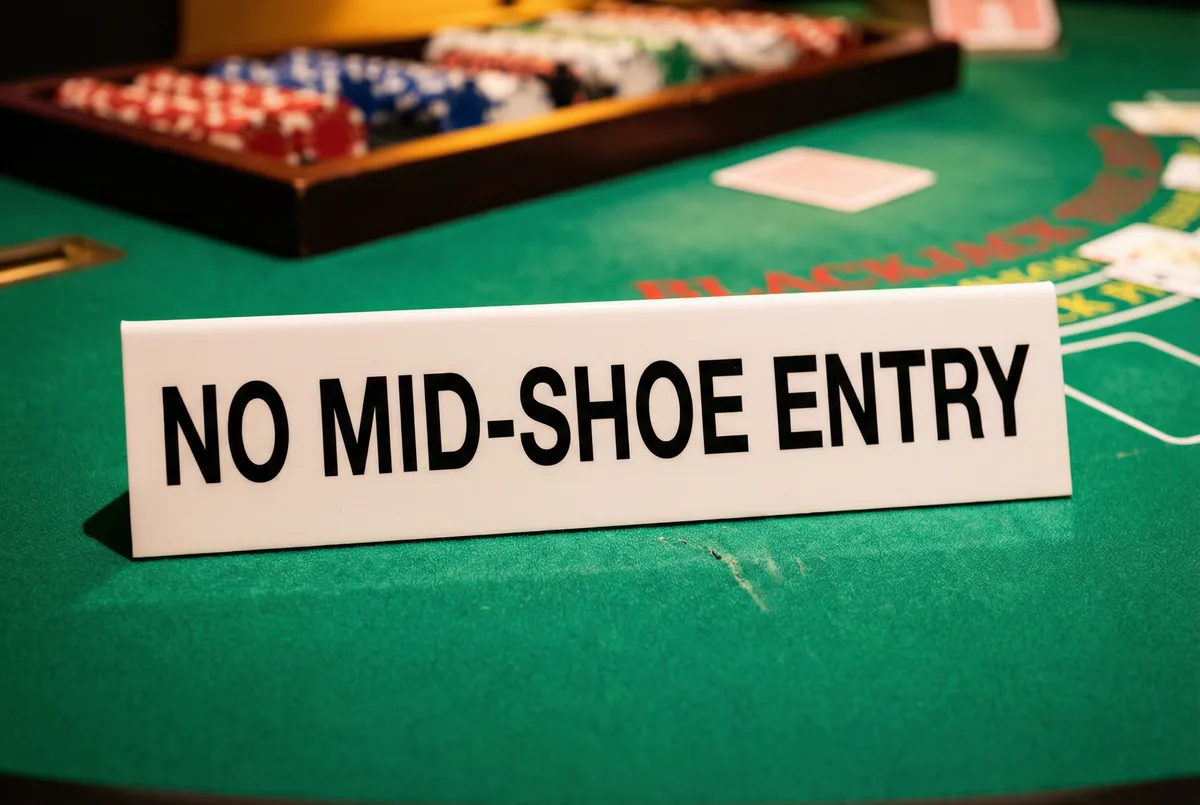
Why Some Casinos Have a No Mid Shoe Entry Rule
You approach a blackjack table mid-shoe and the dealer waves you off. A small placard reads: “No Mid-Shoe Entry.” Most players assume this is a quirk of casino policy and find a different table. Few stop to ask why the rule exists or what specific threat it is designed to neutralize.
The answer reveals something important about the ongoing cat-and-mouse relationship between casinos and skilled players. No mid-shoe entry is a targeted countermeasure with a precise origin, and understanding it changes how you think about table selection entirely.
The Real Meaning of No Mid-Shoe Entry
No mid-shoe entry (NMSE) is a casino rule that prevents players from joining a shoe game after the first hand has been dealt. Once the dealer burns a card and deals round one, no new players may sit down until the current shoe is exhausted and a fresh shuffle begins.
The rule applies only to shoe games, typically six-deck and eight-deck tables. Single-deck and double-deck games are not subject to it because those games reshuffle far more frequently, eliminating the opportunity the rule is designed to close.
- Rule applies to6-deck and 8-deck shoe games
- Enforcementno new players after hand one
- Trigger eventfresh shuffle resets the entry window
- TargetWong-style advantage players, not basic strategy players
- Effect on basic strategy playersminimal to none
Why Casinos Introduce This Rule?
The rule was introduced specifically to counter a technique called wonging, named after Stanford Wong, who described it in his 1975 book “Professional Blackjack.” Wonging is the practice of watching a shoe from behind the table, tracking the running count, and sitting down only when the count swings into significantly positive territory.
A positive count means the remaining deck is rich in tens and aces, which benefits the player through better natural blackjack frequency and more favorable double and split outcomes. A card counter who enters only during positive counts and leaves during negative counts plays an almost entirely positive expected value game.
Casinos tracked the win-rate differential between regular seated players and players who appeared suddenly during favorable conditions. The pattern was unmistakable. NMSE eliminated the entry point by requiring commitment from hand one, when no count information is available.
Common Myth
“No mid-shoe entry rules affect all players equally”
The rule is posted as a blanket policy, so it looks like a neutral procedural requirement for everyone at the table
The Reality
NMSE is targeted almost entirely at card counters who exploit favorable count conditions by joining mid-shoe
Basic strategy players lose the ability to join a table between rounds, which is a minor inconvenience with zero effect on their long-run expected value
How Does NMSE Affect Basic Strategy Players?
Basic strategy players are not the target of NMSE and suffer almost no mathematical consequence. The rule prevents joining a table between rounds, but it does not change the blackjack house edge on any hand you do play. A player sitting from the first hand through the last faces the same edge throughout.
The practical inconvenience is having to wait for a shoe to finish before sitting down. At a busy table playing 60 to 80 rounds per shoe, that wait can run 20 to 30 minutes. At a quieter table, the wait is shorter. This is a time cost, not an edge cost.
If you encounter NMSE on a table with otherwise strong rules, the strategic choice is to wait for the shuffle and take your seat then. The rules on the placard matter far more than the inconvenience of waiting. A 3:2 S17 NMSE table outperforms a 6:5 H17 open-entry table on every mathematical measure.
Dealer Shows
Your Hand
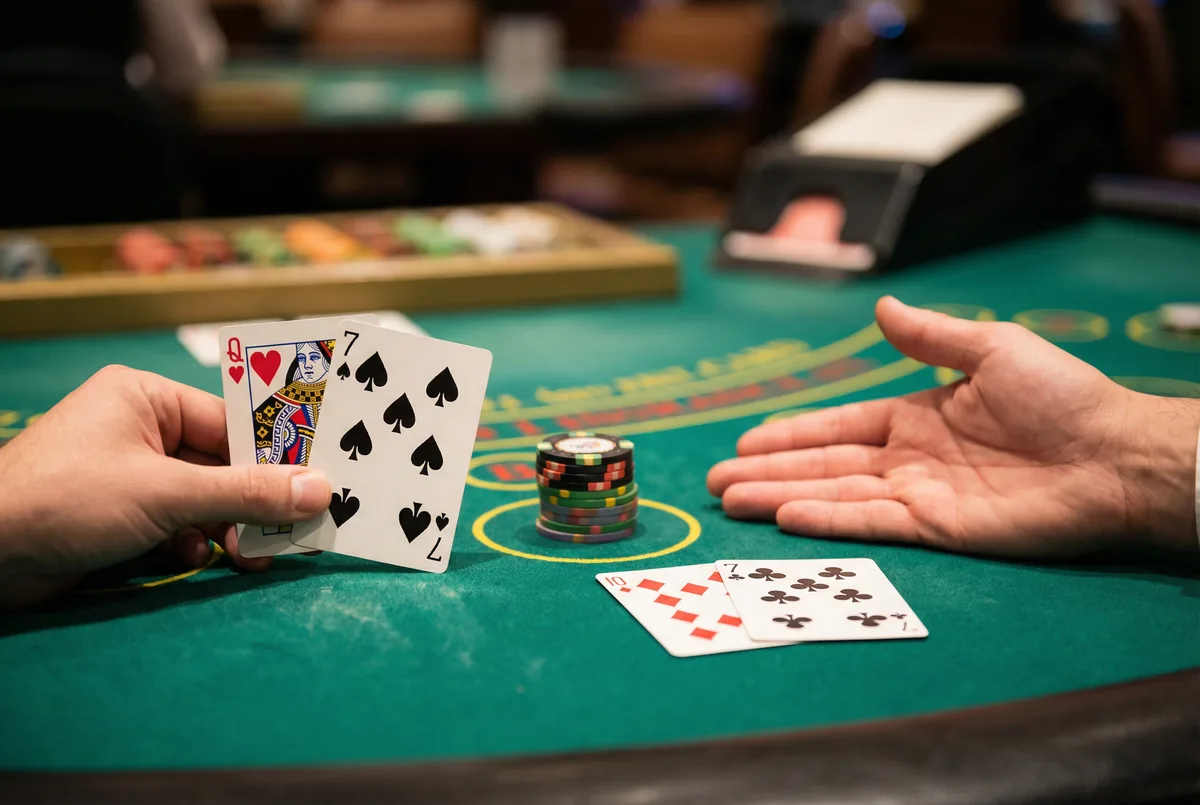
You finally sit down at a fresh shoe at a casino with no-mid-shoe-entry rules. You hold soft 18 vs dealer 5. What do you do?
No-mid-shoe-entry rules exist to prevent counters from Wonging in at favorable counts. The lesson: if the casino bans mid-shoe entry, you commit to the full shoe from the start. Strategy itself does not change.
What Is the Wonging?
Wonging is back-counting: standing behind a shoe game, tracking the card count without wagering, and entering the game only when the count crosses a threshold that gives the player an edge. The player bets during positive counts and leaves or sits out during negative counts.
The mathematical advantage is significant. A skilled back-counter who enters only at a true count of +2 or higher plays virtually all their hands with a positive expected value. They avoid the long stretches of negative-count play that grind down even the most skilled seated counter.
NMSE closes the entry point by requiring players to commit at the start of the shoe, before any count information exists. A back-counter forced to sit from hand one must ride through negative counts just like any other player. This eliminates most of the mathematical advantage that back-counting provides.
Casinos in Las Vegas adopted NMSE widely through the 1980s and 1990s as blackjack card counting became better documented. Today, high-limit rooms with deep penetration are the most likely to enforce it. To see how entry timing shapes a live session with real money at stake, check mid-shoe entry rules before buying into a live table runs actual stakes from hand one.
Handling No Mid-Shoe Entry Tables as a Counter
For blackjack basic strategy players, NMSE is a minor inconvenience rather than a reason to walk away. The rule itself does not change the blackjack house edge. What matters is the full rule set on the placard: deck count, S17 vs. H17, doubling restrictions, surrender availability, and the natural payout.
If a table has NMSE alongside excellent rules, wait for the shuffle and sit down. If a table has no NMSE but poor rules, the open entry is not compensation for the elevated blackjack house edge you face on every hand. Always evaluate rule quality over entry policy.
For card counters, NMSE is a meaningful constraint. It forces you to count through negative shoes without the option of sitting out. Skilled counters adjust by seeking tables with deeper penetration and fewer decks, where the count swings more sharply and the advantage periods are more pronounced even without back-counting.
Frequently Asked Questions
No. NMSE prevents you from joining a table between rounds but does not change the house edge on any hand you play. A basic strategy player sitting from shoe start to shoe end faces the same mathematical edge throughout. NMSE is a time inconvenience, not an edge cost.
Enforcement depends on the casino's assessment of their exposure to card counters. High-limit rooms, games with deep penetration, and casinos in markets with a history of advantage play tend to enforce it more strictly. Lower-limit games and casual properties often skip the rule entirely.
Yes. NMSE only restricts mid-shoe entry. Once the shoe is exhausted and the dealer shuffles, the entry window resets and you may take a seat normally. Waiting through the remaining rounds is the correct response when you find a high-quality table with NMSE posted.
Before you test these plays at a real table, run them through our free blackjack simulator practice unlimited hands at zero cost until every move becomes automatic.
Casino Rules Protect the House First
No mid-shoe entry is one of many casino measures designed to limit skilled play. Understanding these rules helps you select better tables and set realistic expectations before wagering real money.
Blackjack involves real financial risk. Advantage play techniques carry no guarantee of profit. Play within your means.
Learn More
Continue your education with these related lessons.

Best Blackjack Books for Learning Professional Strategy
Four books define the canon of serious blackjack strategy. Beat the Dealer started it. Basic Blackjack refined it. Professional Blackjack…

Step by Step Guide to Your First Hour Playing Real Money
Your first real money blackjack session is decided before you sit down. This step-by-step guide covers pre-session prep, buying chips,…
Why You Must Demand a 3 to 2 Natural Blackjack Payout
The difference between a 3:2 and a 6:5 natural payout is not a small rule variation. It is a 1.39%…