
Why Dealers Must Draw to 16 and Stand on All 17s
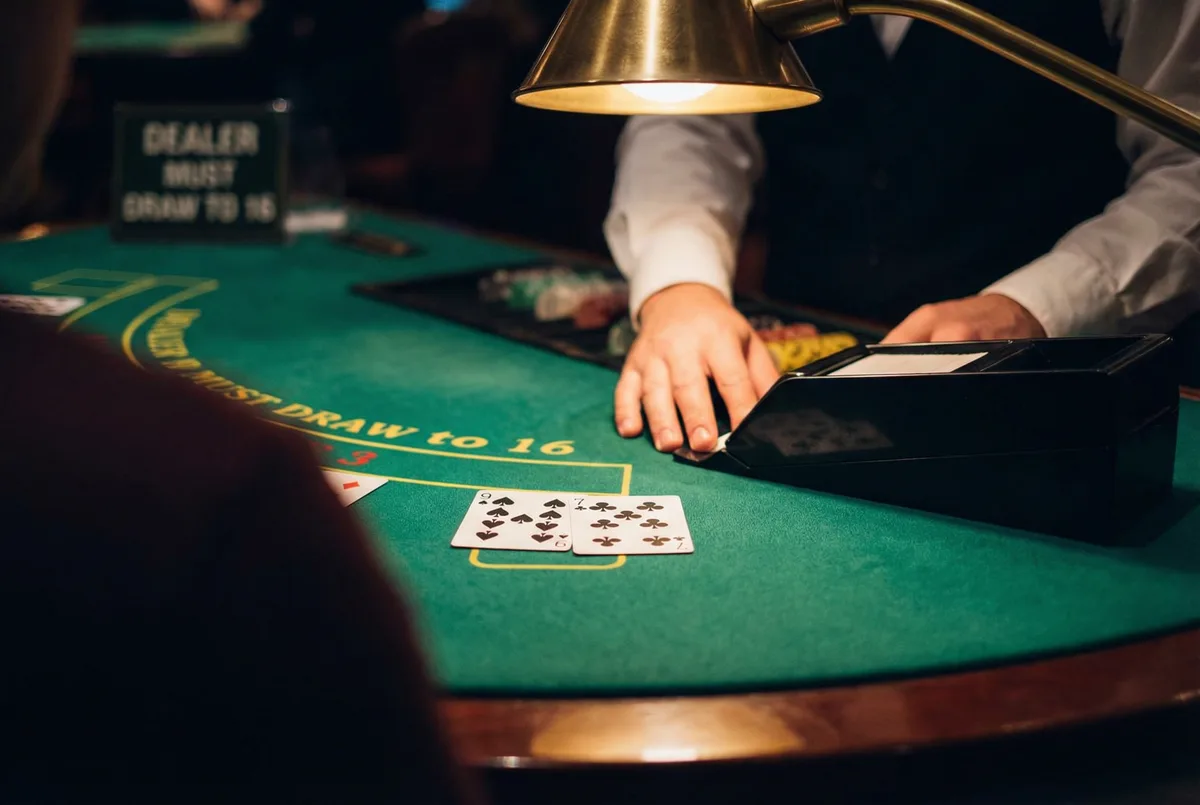
I once sat next to a player who was frustrated with the dealer for hitting a hard 16 against a player blackjack. “Why did they have to take that card?” he asked. They had no choice. The dealer is not making a decision. They are executing a printed rule. In casino blackjack, the dealer hits any total of 16 or below and stands on any total of 17 or above, without exception, without judgment, and without any awareness of what any player holds. This mechanical rule is the entire foundation on which blackjack basic strategy is built. If the dealer made choices, blackjack strategy charts would be impossible to create.
The Dealer Algorithm in Plain Terms
After all players complete their hands, the dealer reveals their hole card and executes a fixed sequence. If the total is 16 or below, they draw. If the total is 17 or above, they stop. That is the entire rule. There is no consideration of what players hold, what the count is, or what the pit boss wants. The dealer follows the rule regardless of the outcome it produces. They will hit into a bust just as willingly as they hit into a 21, because the rule does not distinguish between outcomes, only totals.
The rule exists because a mechanical dealer with predictable behavior creates a calculable blackjack house edge. If the dealer could choose when to hit and when to stand, the blackjack house edge would become variable and unverifiable. Regulators require predictable dealer behavior so that the published odds are accurate. The casino is operating a mathematical product with a known return rate. Variable dealer strategy would invalidate the math.
- Step 1Reveal hole card, total is now known
- Step 2If total is 16 or below → draw a card, recalculate
- Step 3If total is 17 or above → stop drawing
- Step 4Repeat Step 2 until total reaches 17+
- Step 5Compare final total to each player's total
- Step 6Pay wins, collect losses, push on ties
The algorithm has one well-known variation: the soft 17 rule. A soft 17 is a hand containing an Ace counted as 11 that totals exactly 17. Example: Ace + 6. At tables where the dealer must hit soft 17, that Ace-6 hand requires a draw. At tables where the dealer stands on all 17s (including soft), the dealer stops at Ace-6 and does not draw. This one rule difference adds 0.22% to the blackjack house edge at tables where the dealer hits soft 17.
You can always identify which rule applies by reading the felt. Tables where the dealer stands on all 17s print “Dealer Must Stand on All 17s” or “S17.” Tables where the dealer hits soft 17 print “Dealer Hits Soft 17” or “H17.” If the felt is worn and unreadable, ask the dealer before your first bet. I ask every time I sit at an unfamiliar table, because the difference compounds across hundreds of hands.
Why Was the Hit-16 Stand-17 Threshold Chosen Instead of Any Other Number?
The hit-16 stand-17 rule was not chosen arbitrarily, it is a calibrated balance between player attraction and house profit, established over decades of commercial operation as the threshold that maximizes casino revenue while keeping the game attractive. It is a calibrated balance between player attraction and house profit. If the dealer stood on 15, they would bust far less often, and the blackjack house edge would be so high that fewer players would sit down. If the dealer stood on 18, the dealer would bust frequently enough to eliminate the blackjack house edge entirely. The 17 threshold was established over decades of commercial operation as the point that maximizes casino revenue while keeping the game attractive to players.
The bust probabilities behind this threshold are significant. A dealer holding 16 will bust approximately 62% of the time if they draw. A dealer holding 17 will bust approximately 42% if forced to draw. Standing at 17 instead of drawing means the casino avoids a 42% bust probability on every 17 hand. Over millions of hands, that preservation of push and win outcomes at 17 generates an enormous amount of casino revenue.
Common Myth
“The dealer chooses to hit or stand based on what will beat the most players.”
Players sometimes believe dealers make strategic decisions to maximize wins, especially when the dealer pulls a perfect card.
The Reality
The dealer follows a fixed rule with no knowledge of player hands and no discretion. Every decision is mechanically determined by the dealer's own total. The dealer will hit into a guaranteed bust just as automatically as they hit toward a winning 21.
Dealer has no expected-value calculation, only a binary rule: total ≤ 16 = hit, total ≥ 17 = stand.
What Is Soft 17 Rule Actually Cost You Over a Full Session?
When the dealer hits soft 17, they draw an additional card on any hand containing an Ace counted as 11 that totals exactly 17, and most of these draws improve the dealer’s hand because the Ace absorbs excess without busting. Most of these draws improve the dealer’s hand. An Ace-6 drawing a 2 becomes Ace-6-2 (19). Drawing a 3 gives Ace-6-3 (20). Drawing a 4 gives Ace-6-4 (21). Drawing a 5 gives Ace-6-5 (12, then the dealer must continue). The probability of improving from a soft 17 is higher than the probability of busting. That is why hitting it is profitable for the casino.
The 0.22% cost to the player from H17 is not theoretical. At a $25 table over 300 hands, that is approximately $16.50 in expected additional losses. Over a weekend of moderate play, the S17 versus H17 difference easily exceeds $50. When I evaluate two otherwise identical tables and one shows S17 while the other shows H17, I sit at S17 without hesitation. The 0.22% is real and persistent across every session.
Basic strategy adjusts for the H17 rule. Under H17, you should double down on soft 18 (Ace-7) against a dealer 2, because the dealer’s increased drawing activity raises the probability they bust or land below 18. Under S17, the same play is a borderline case. The soft 17 rule is one of the few dealer rule changes that directly alters blackjack basic strategy for the player, not just the expected value.
Why Does the Dealer’s Fixed Rule Shape Every Single Decision You Make?
Basic strategy exists because the dealer algorithm is fixed and predictable: every cell in the blackjack strategy chart is a probability calculation against the known dealer behavior, optimized across billions of simulated hands. Every cell in the blackjack strategy chart is a probability calculation against the known dealer behavior. When you stand on hard 12 against a dealer 6, the correct decision is based on the probability that the dealer’s hole card is a 10-value card (creating a 16 that must bust) combined with the forced drawing rule. If the dealer had the option to stand on 15, the entire calculation changes. The chart would be useless.
The dealer bust probability by upcard is the most important input to blackjack basic strategy. A dealer showing 4, 5, or 6 has a bust rate between 40% and 42% after applying the drawing rule to all possible hole cards. A dealer showing 7, 8, or 9 has a bust rate between 23% and 26%. A dealer showing 10 or Ace has a bust rate of 21% to 23%. These probabilities are computed using the mandatory drawing rule. Change the rule and every bust probability changes with it.
The rule of 17 eliminates dealer discretion entirely. Without it, dealers would face impossible decisions every hand, and any inconsistency would be exploited immediately. Fixed rules also make the math behind basic strategy calculable. If the dealer had any decision-making authority, the game's expected value could not be derived from first principles.
Using the Dealer Rule to Your Advantage
Understanding that the dealer is an algorithm gives you a psychological advantage over players who anthropomorphize the dealer. The dealer is not your opponent in the sense of trying to beat you. They are a mechanical device with a predictable behavior pattern. Your decisions are responses to their upcard, not reactions to their personality, their luck, or their momentum. Beginners sometimes play too conservatively when “the dealer is on a run.” The dealer’s past results have no bearing on the rule they will apply to their next hand.
The dealer algorithm also tells you exactly how to exploit a weak upcard. When the dealer shows a 5 or 6, you know the drawing rule forces them to hit on many strong intermediate hands. That is why you stand on hard 12 against a 6, you are waiting for the dealer’s forced draws to bust them, not because your 12 is strong. You are using the rule against the house by refusing to take the risk yourself. The algorithm does the work when you play correctly.
Every blackjack basic strategy decision is a statement about what the dealer’s mandatory rule will produce next. Watch 20 dealer hands at a live table and count how many times the dealer busts on upcards between 4 and 6 versus upcards of 9 or 10. The bust rate difference is exactly what the blackjack strategy chart is optimizing around. Play with real money only what you planned to risk before sitting down, the dealer’s rule is fixed, and so should your session limit be.
Frequently Asked Questions
The dealer follows a fixed rule to create a predictable, calculable house edge. The 17 threshold was chosen because it balances player attraction with casino profit. At 16 or below, the dealer draws without exception. At 17 or above, the dealer stops. No judgment or strategy is involved.
A soft 17 is a hand containing an Ace counted as 11 that totals 17, such as Ace-6. Tables where the dealer hits soft 17 (H17) add approximately 0.22% to the house edge compared to tables where the dealer stands on all 17s (S17). Always choose S17 tables when available.
Basic strategy is calculated against the dealer's fixed drawing rule. The dealer's bust probability by upcard, the key input to every correct decision, depends entirely on when the dealer is forced to draw. Change the rule and every calculation changes. S17 versus H17 alters optimal strategy on several soft-hand doubles.
Before you test these plays at a real table, run them through our free blackjack simulator practice unlimited hands at zero cost until every move becomes automatic.
Check the Soft 17 Rule Before You Bet
The calculator shows your exact expected value under both S17 and H17 rule sets.
Blackjack Academy is an educational resource. All strategy is based on mathematical expectation. Always play within your means.
Learn More
Continue your education with these related lessons.
How to Practice Blackjack Before Going to a Casino
Free apps, kitchen table drills, and strategy card repetition can get you casino-ready. Here is a step-by-step practice plan with…

Best Blackjack Books for Learning Professional Strategy
Four books define the canon of serious blackjack strategy. Beat the Dealer started it. Basic Blackjack refined it. Professional Blackjack…

Why the Name Changed from Vingt-Un to Blackjack in the Gold Rush
The name blackjack is less than 120 years old. The game it describes had been played for over 300 years…