
Why Blackjack Is a Skill Game, Not Luck
Blackjack is unique among casino table games because the blackjack house edge is not fixed it is variable, and that variable is the player’s decision-making. A player using correct blackjack basic strategy in a standard six-deck game faces a blackjack house edge of approximately 0.5%. A player making random or intuition-based decisions faces somewhere between 2% and 4%. That gap up to 3.5 percentage points represents thousands of dollars over a typical playing lifetime, and every cent of it is explained not by luck, but by the quality of decisions made on individual hands. No other mainstream casino game has an equivalent skill differential.
The House Edge Gap That Proves Skill Matters
Basic strategy player
% house edge
Average uninformed player
% house edge
Edge gap
percentage points
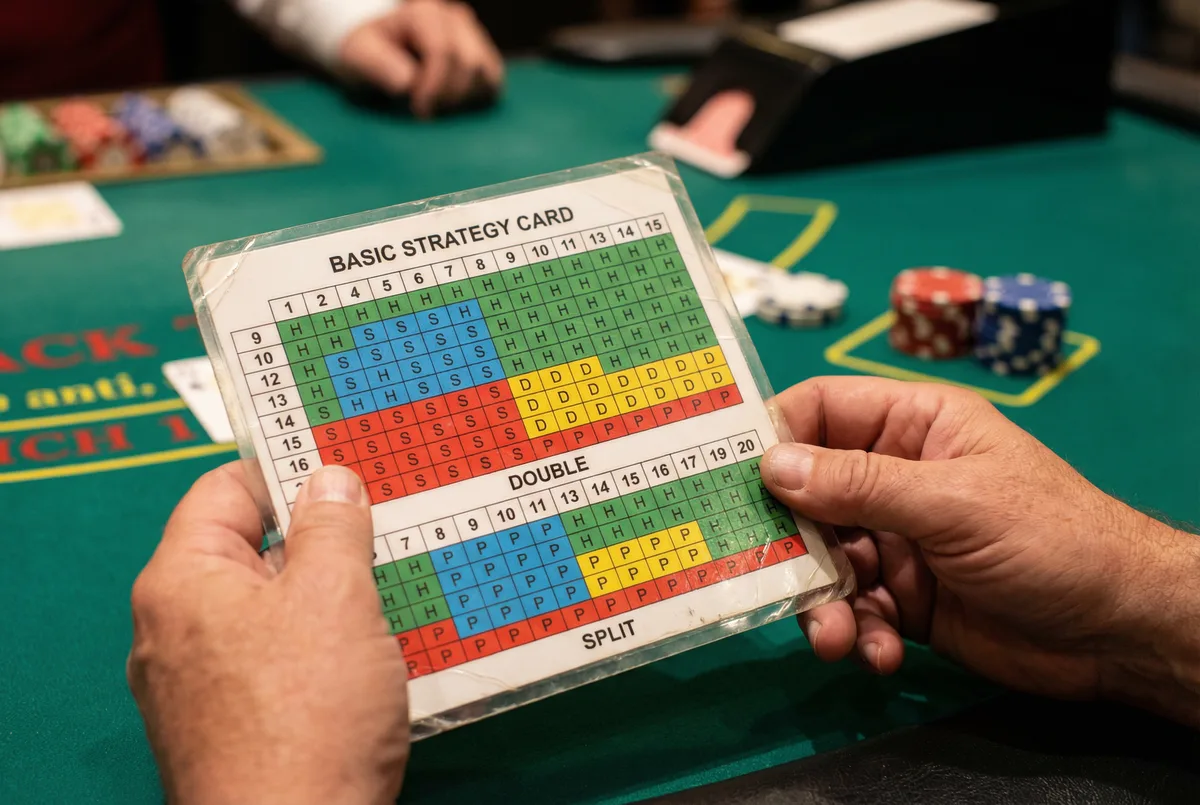
What Basic Strategy Actually Is and Where It Comes From?
Basic strategy is not a guess or a rule of thumb it is the mathematically optimal action for every possible combination of player hand and dealer upcard, computed by running hundreds of millions of simulations. It was first published in 1956 by four US Army mathematicians: Baldwin, Cantey, Maisel, and McDermott. Their paper demonstrated for the first time that blackjack, played correctly, was nearly breakeven from a mathematical standpoint. Edward Thorp extended that work in 1962 in Beat the Dealer, and the strategy has been refined ever since.
The strategy covers roughly 250 unique decision points every combination of player total and dealer upcard, including pairs and soft hands. Each decision has one mathematically superior answer. Deviating from that answer always has a cost, even when the deviation occasionally produces a winning hand. The key is thinking in expected value across thousands of hands, not in terms of individual outcomes.
Common Myth
“It doesn't matter what you do the cards are random anyway”
Short-term wins from bad plays feel like validation for ignoring strategy
The Reality
Wrong decisions have a measurable mathematical cost on every hand
Hitting hard 20 costs approximately 78% of your bet in lost expected value the damage is real regardless of what card you get
What Is the Quantifiable Cost of Playing Without Knowledge?
The difference between a 0.5% and a 3% blackjack house edge is not abstract. On a $25 minimum table playing 80 hands per hour, the blackjack basic strategy player expects to lose about $10 per hour in the long run. The uninformed player at 3% expects to lose $60 per hour at the same table and same bet size. Over a weekend trip with six hours of play, that is a $50 loss versus a $360 loss on identical bets. Skill in blackjack is worth real money and the math is explicit.
The measurable skill gap in blackjack: a player using no strategy faces ~4% house edge. A player using perfect basic strategy faces ~0.5%. That 3.5% difference, over 500 hands at $25 per hand, is $437.50 in expected value. The skill is not optional it is the difference between entertainment and education.
How to Develop Skill Before Risking Real Money?
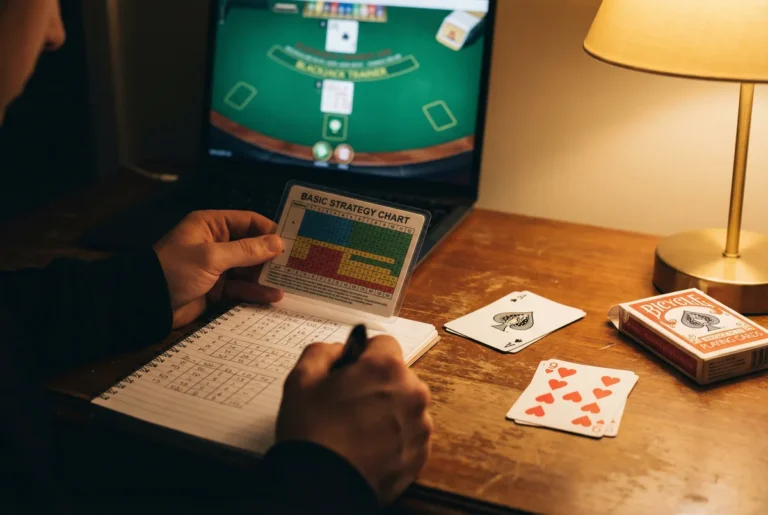
Skill development in blackjack follows a clear path: study the blackjack basic blackjack strategy chart, test yourself with a deck of cards at home, use free online simulators to drill decision speed, and only transition to real money once your error rate falls below 2–3%. If you want to test your decision-making under live conditions, the live dealer games at experience this rule with real money on the line under pressure put real stakes behind every choice that real-money pressure is different from practice mode, so start at the lowest available table limit until your strategy is fully automatic.
Putting the Math to Work at a Real Table
Bringing these principles together at a real table requires practice under live conditions.
Frequently Asked Questions
Most players can memorize the complete basic strategy chart in two to four weeks of daily practice. The key is drilling with flashcards or software until decisions feel automatic, not deliberate. Aim for under three seconds per decision before playing at a casino.
No. Basic strategy minimizes the house edge but does not eliminate it. You will still lose more sessions than you win in the long run because the house retains a small mathematical advantage. What basic strategy does is give you the best possible return on every dollar wagered.
Casinos allow strategy cards because even a perfect basic strategy player still loses to the house edge over time. The cards do not overcome the casino's built-in advantage they merely minimize it. From the casino's perspective, strategy cards are not a threat.
Before you test these plays at a real table, run them through our free blackjack simulator practice unlimited hands at zero cost until every move becomes automatic.
Mathematical Risk Warning
Even with perfect basic strategy, the house retains a mathematical edge. Blackjack skill reduces losses it does not eliminate them. Never play with money you cannot afford to lose.
Blackjack Academy is an educational resource. All strategy is based on mathematical expectation. Always play within your means.
Learn More
Continue your education with these related lessons.
Why Dealers Show One Card and Players Get Two in Blackjack
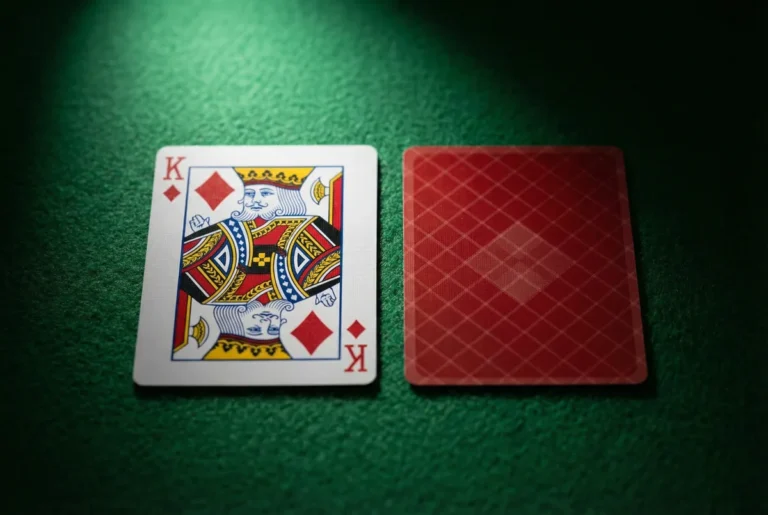
The dealer's hidden card is the structural source of blackjack's information asymmetry. You start each hand with 100% of your…
When to Hit or Stand in Blackjack for the Best Results
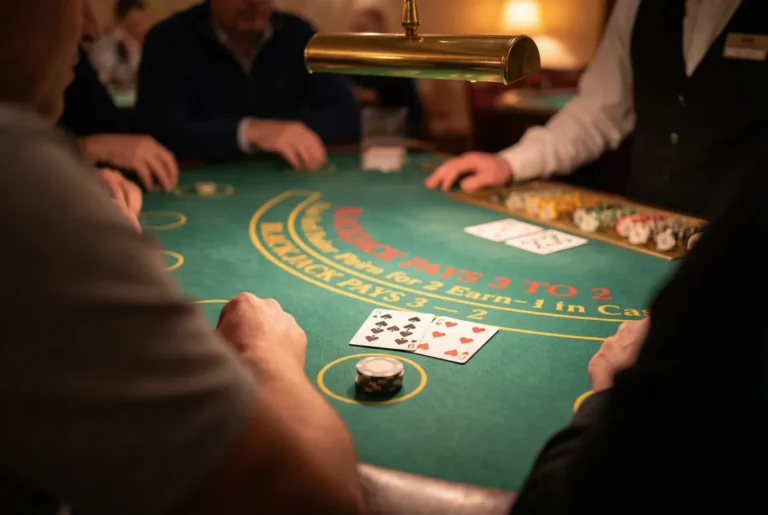
Hitting and standing are the two most frequent decisions in blackjack. The correct choice depends on your total and the…
How to Build a Blackjack Practice Routine Using Free Online Tools
Build a structured blackjack practice routine using free online tools. Covers weekly study plans, focus areas by phase, progress tracking,…