
What the Blackjack Felt Secretly Tells You Before You Place a Single Bet
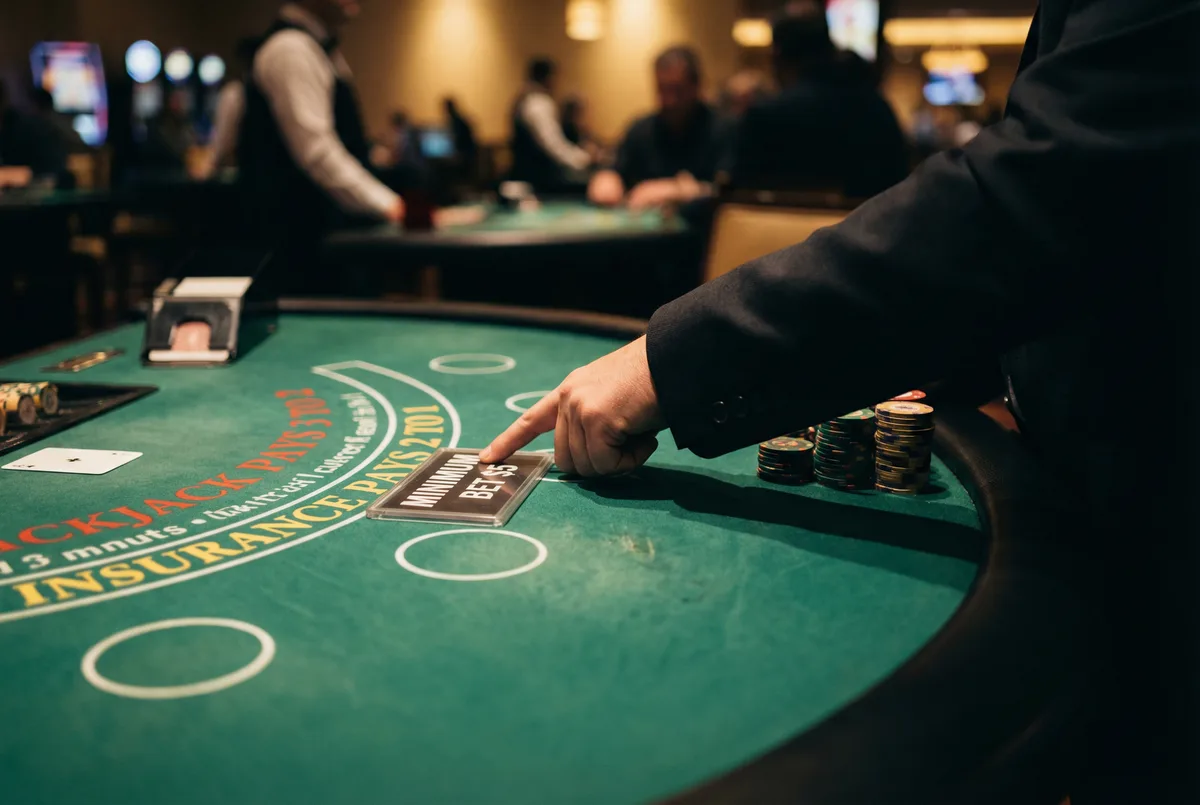
A blackjack table felt is a document. Every casino is legally required to post specific game information on the table surface, and reading it before you sit down is the fastest, most reliable way to assess whether a game is worth playing. The felt tells you the minimum and maximum bet, the payout on a natural blackjack, the house’s soft-17 policy, and the insurance rule. In under sixty seconds, a player who knows how to read that information can calculate the approximate blackjack house edge and make a rational decision. New players who skip this step routinely sit at games that cost two or three times as much per hour as a better game at the same casino. The felt is always telling you something the question is whether you are listening.
What the Blackjack Felt Tells Every Player
- Minimum and maximum bet posted on a plastic sign or printed on felt
- Natural payout 'Blackjack Pays 3 to 2' or '6 to 5' printed in arc near dealer
- Soft-17 rule 'Dealer Must Stand on All 17s' or 'Dealer Hits Soft 17'
- Insurance rule 'Insurance Pays 2 to 1' or notation about even money
- Number of decks usually on a placard or identifiable from the shoe size
What Is Minimum and Maximum Bets?
Table limits are posted on a color-coded plastic sign attached to the dealer’s side of the table. The sign shows the minimum bet (the smallest amount you can place to enter a hand) and the maximum bet (the largest single wager the casino will accept on that table). In most casino markets, minimum bets range from $5 on the main floor to $25, $50, or $100 at premium tables. The color of the sign typically correlates with the minimum green signs commonly indicate $25 minimums, black signs indicate $100 minimums, though this varies by property.
Maximum bets matter for two reasons. For high-volume recreational players, maximums set an upper bound on any progressive betting scheme. For advantage players, the maximum-to-minimum ratio (the spread) determines how large a bet can be placed relative to the table minimum when count conditions are favorable. A table with a $25 minimum and a $500 maximum allows a 20:1 spread. The typical recreational player never approaches the maximum, but it is worth confirming the ceiling before sitting at a high-stakes table where the minimum is already at the top of your session budget.
Main Floor
High Limit Room
- $10–$25
- $100–$500
What Are the Natural Payout Arc and the Soft-17 Line?
The most important text on the felt runs in a semicircular arc facing the players, printed in the center of the table between the betting circles and the dealer. This line almost always reads “Blackjack Pays 3 to 2” or “Blackjack Pays 6 to 5.” As covered elsewhere on this site, the difference between those two payouts represents roughly 1.39 percentage points of blackjack house edge about three times the total edge of a well-run 3:2 game with good rules. If this text is absent or unusually small, that is a deliberate design choice; look more carefully or ask the dealer.
Below or alongside the payout line, many tables print the soft-17 rule. The most favorable version reads “Dealer Must Stand on All 17s” this is S17, the player-friendly rule. The unfavorable version reads “Dealer Hits Soft 17.” Some tables omit this line entirely and print it on a small placard; others have it embedded in the full rule text printed in smaller type around the table edge. If you cannot find it, ask the dealer directly before placing any chips. The soft-17 rule is worth 0.22% and is non-negotiable if two tables have the same payout, always choose the S17 game.
The felt never lies, but it relies on you to read it. Most players who sit at 6:5 tables do so because they never read the arc. Twenty seconds of attention before buying in is worth more than any betting system.
Table Selection Rule
What Are the Betting Circle, Insurance Bar, and Side Bet Areas?
Each player position has a betting circle a printed semicircle or rectangle where all wagers must be placed before cards are dealt. Chips placed outside the betting circle are not in play. Some tables print a small dot or line above the betting circle, which is the position for a dealer tip bet. Adjacent to or above the betting circle on many tables is the insurance bar: a curved or straight line with the text “Insurance Pays 2 to 1.” When the dealer shows an ace, players are offered insurance by placing up to half their original bet on this line. Insurance is a losing bet for non-counters in all standard conditions its presence on the felt is informational, not an invitation to use it every time.
Side bet areas appear on the felt outside the main betting circle, usually to the left or right. Common side bets Perfect Pairs, 21+3, Lucky Ladies each have their own printed betting zone with a posted maximum. These bets have blackjack house edges ranging from 4% to 25%, which is several times the edge of the main game even at its worst. Their presence on the felt is worth understanding because players who do not recognize them may accidentally place chips in a side bet zone when intending to make a main bet. Keep your chips organized and place them deliberately in the correct position before each hand.
Using What You Know Before Playing for Real Money
Developing the habit of reading a blackjack felt takes a small amount of practice. The best way to build it is to walk casino floors without sitting down, identifying payout ratios and soft-17 rules across multiple tables before picking the best game. You can also use the test your training at a live real-money session section of this site, where each table’s rules are posted in the game interface but be aware that those tables involve real money wagering, and a misread of the rules there carries the same financial consequences as it would on a casino floor. Treat every rule review as a pre-flight checklist: quick, systematic, and non-negotiable before the first bet.
Frequently Asked Questions
Ask the dealer before placing any chips. Dealers are required to explain game rules to players. Asking 'Is late surrender available?' or 'Does the dealer hit soft 17?' is completely standard and expected. You are entitled to full rule clarity before risking any money.
Casino gaming tables are regulated by state or national gaming authorities and must accurately display the game rules. Knowingly misrepresenting payout ratios on the felt would be a regulatory violation. The risk is not dishonesty it is that the correct information is printed in small type that players do not read carefully.
The inner circle is often the main bet position; the outer ring may indicate a specific placement for a side bet or bonus wager. Layouts vary by table manufacturer. If the table has both a main game and side bet positions, the two zones are almost always labeled. When in doubt, ask the dealer to point out the correct placement before the hand starts.
Before you test these plays at a real table, run them through our free blackjack simulator practice unlimited hands at zero cost until every move becomes automatic.
Mathematical Risk Warning
A full felt-read gives you the house edge before you risk a dollar. Skipping it guarantees you are playing a game whose terms you do not fully understand. Game selection is the first and most controllable decision in every session.
Blackjack Academy is an educational resource. All strategy is based on mathematical expectation. Always play within your means.
Learn More
Continue your education with these related lessons.
The Critical Difference Between Hard and Soft Hands in Blackjack
Every blackjack hand is either hard or soft, and confusing the two costs you money on every misplayed hand. The…
Complete Glossary of Blackjack Terms Every Player Should Know
Do you know the difference between a hard hand and a soft hand? Between penetration and a burn card? Every…

Complete Blackjack Table Etiquette Guide Every Serious Player Must Know
Learn the unwritten rules of the blackjack table hand signals, chip buying, tipping, and everything else that separates a smooth…