
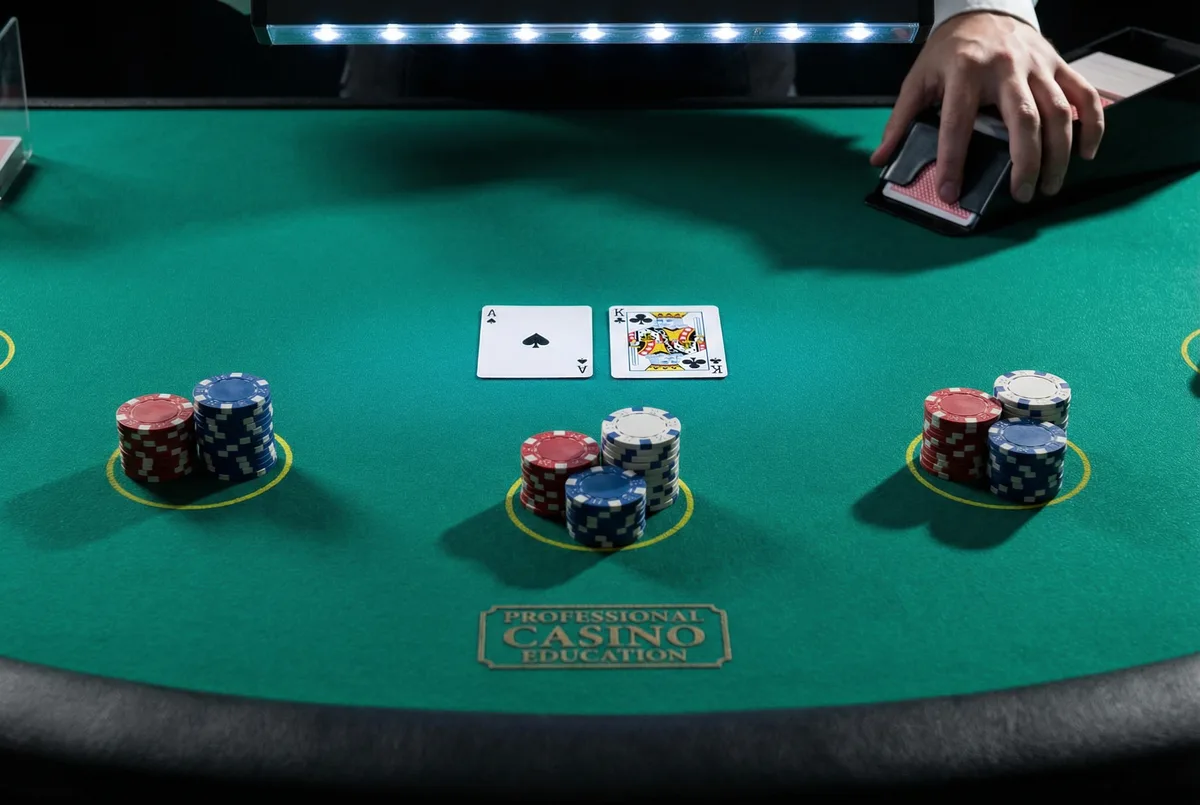
Real Blackjack Odds and Your Mathematical Chance of Winning
I have tracked thousands of my own hands across dozens of casinos, and the number that keeps showing up is 0.5%. That is the blackjack house edge at a standard blackjack table when you play perfect blackjack basic strategy. For every $100 you wager, you lose 50 cents on average. Compare that to roulette at 5.26% or slot machines at 2% to 15%, and blackjack is the best mathematical bet on the casino floor. But that 0.5% is not guaranteed. It depends on the rules posted at the table, the number of decks in the shoe, and whether you actually play the correct strategy on every hand. I have seen tables where one bad rule pushed the edge above 2%. Change any variable and the number moves. Understanding exactly how these odds work is what separates informed players from everyone else.
What House Edge Actually Means
The blackjack house edge is the mathematical percentage of every wager that the casino expects to keep over time. It is not what you lose on any single hand. It is the average loss across thousands of hands. On a single hand, you either win, lose, or push. The blackjack house edge only becomes visible over a large sample of decisions.
At a 0.5% blackjack house edge and $25 per hand, your expected loss over 400 hands is $50. That does not mean you will lose exactly $50. You might win $200 or lose $300 in any given session. Variance dominates in the short term. But over 10,000 hands, your actual results converge toward the expected value. The casino counts on this convergence. You should too.
House Edge (basic strategy)
6-deck, 3:2, S17
House Edge (no strategy)
Playing by feel
Roulette Edge
Double zero
A common misconception is that the blackjack house edge means you lose on more than half of your hands. That is not quite right. You win approximately 43% of hands, lose approximately 49%, and push approximately 8%. The reason the blackjack house edge is only 0.5% (not 6%) is because winning hands sometimes pay more than 1:1. Naturals pay 3:2, doubles pay double your bet, and splits can produce multiple winning hands. These bonus payouts compress the effective edge down from the raw win/loss ratio.
How Do Table Rules Change the Odds Before You Play a Single Hand?
Every rule printed on the table felt shifts the blackjack house edge by a specific, calculable amount: the two biggest factors are the blackjack payout ratio and the number of decks in the shoe. The two biggest factors are the blackjack payout ratio and the number of decks. A 3:2 natural payout is baseline. A 6:5 payout adds 1.39% to the blackjack house edge. That single rule change turns a 0.5% game into a 1.89% game. It is the difference between one of the best bets in the casino and one of the worst.
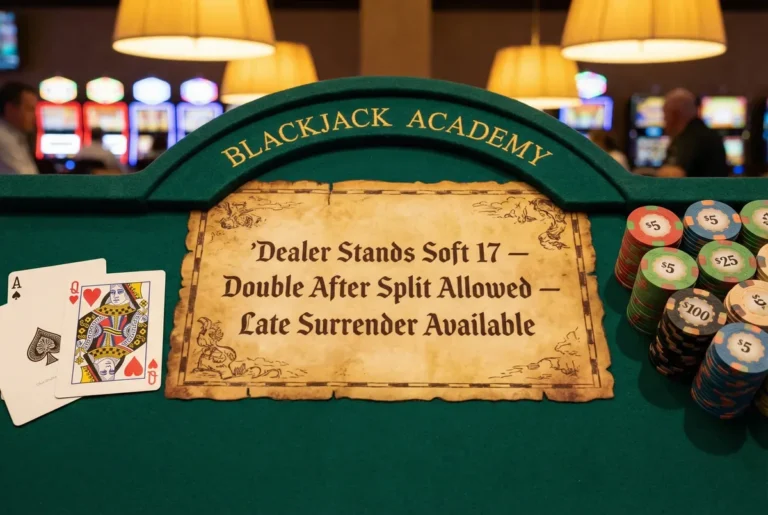
The dealer’s soft 17 rule is the second most impactful. When the dealer hits soft 17 (H17), the blackjack house edge increases by 0.22% compared to when the dealer stands on soft 17 (S17). Over 500 hands at $25, that 0.22% costs you about $27.50. It is not dramatic on a single session, but across a year of regular play, it adds up to hundreds of dollars.
| Rule | Edge Change | Direction |
|---|---|---|
| 6:5 payout (vs 3:2) | +1.39% | |
| Dealer hits soft 17 | +0.22% | |
| 8 decks (vs 1 deck) | +0.61% | |
| No double after split | +0.14% | |
| No surrender | +0.08% | |
| Resplitting Aces allowed | -0.06% | |
| Double after split allowed | -0.14% | |
| Early surrender | -0.62% |
Deck count matters because fewer decks mean a higher concentration of tens and Aces relative to total cards. A single-deck game with favorable rules can have a blackjack house edge as low as 0.28%. An 8-deck shoe with 6:5 payout and H17 can push the edge above 2.5%. Before you sit down at any table, read the rules on the felt. The information is right there. Most players ignore it. I check every single time.
Double after split (DAS) gives you the option to double down on a hand created by splitting a pair. This saves you about 0.14% in blackjack house edge. Surrender lets you forfeit half your bet on bad hands like 16 vs dealer 10, saving roughly 0.08%. Each rule is a small number on its own, but stacking favorable rules together is how you get the blackjack house edge down to the 0.3% to 0.5% range where blackjack becomes genuinely competitive.
What Is Your Real Probability of Winning, Losing, or Pushing a Hand?
In a standard 6-deck game with blackjack basic strategy, you win approximately 43.3% of all hands, lose 48.2%, and push 8.5%, but bonus payouts on naturals, doubles, and splits bring the effective blackjack house edge down to about 0.5%. Those numbers look like the casino wins more hands, and it does. But the player’s winning hands include naturals at 3:2, doubled bets, and split hands that can each win independently. These bonus payout situations bring the effective return closer to breakeven.
The probability of specific outcomes shifts based on your hand and the dealer’s upcard. You win roughly 63% of the time when you hold 20 against a dealer 6. You win only about 23% of the time when you hold hard 16 against a dealer 10. Basic strategy does not change these probabilities. What it does is ensure you make the decision with the highest expected value in each situation, which means you lose the least possible amount on bad hands and win the most on good ones.
Over 100 hands, variance can swing your results by hundreds of dollars in either direction. Over 10,000 hands, variance shrinks relative to the expected value and the blackjack house edge becomes the dominant factor. This is why bankroll management matters. You need enough chips to survive the short-term swings so that your correct strategy has time to produce its mathematical advantage.
How Do You Play Basic Strategy Shifts the Math in Your Favor?
A player using no strategy faces a blackjack house edge of roughly 2–3%, while a player using perfect blackjack basic strategy at the same table faces just 0.5%, a gap entirely within your control. A player using perfect blackjack basic strategy at the same table faces 0.5%. That gap is entirely within your control. No other casino game offers this much player agency over the blackjack house edge. The rules are fixed, the cards are random, but the decisions are yours.
Casinos track the theoretical house edge for every table based on its rule configuration. They know that most players do not use basic strategy and play at an effective 2% edge or higher. The few players who play at 0.5% barely dent the casino’s margin because the majority subsidize them.
Card counting pushes the math further. A skilled counter using the Hi-Lo system with a 1-to-12 bet spread can achieve a player edge of 0.5% to 1.5% over the house, depending on penetration, rules, and spread ratio. This is the only scenario in standard casino blackjack where the expected value is positive for the player. But it requires precise execution, adequate bankroll, and the ability to avoid detection.
Even without counting, playing blackjack basic strategy at a table with good rules puts you in a better mathematical position than 95% of casino visitors. A 0.5% blackjack house edge means your expected cost of entertainment is $50 per 400 hands at $25. That is cheaper than most concerts, dinners, or sporting events. I treat it as the price of the experience, not an investment with expected returns. Once I made that shift, my sessions became calmer and my decisions got sharper.
What the Odds Mean for Your Bankroll
Understanding the odds helps you set realistic expectations and appropriate budgets. At a 0.5% blackjack house edge with $25 bets and 80 hands per session, your expected loss per session is $10. But standard deviation for that same session is roughly $200. That means your actual result will typically fall somewhere between winning $190 and losing $210. The expected loss is tiny relative to the swings.
This is why bankroll sizing matters more than strategy optimization for recreational players. Having 40 to 50 betting units per session (so $1,000 to $1,250 for a $25 table) gives you enough cushion to absorb normal variance without going broke. Playing with 10 units means a few bad hands can end your session before the math has a chance to work. A short session dominated by variance tells you nothing about the odds. A properly funded session lets the probabilities emerge from the noise, which is the entire point of understanding the math before you sit down.
The odds are real. They are not opinions, superstitions, or casino marketing. They are derived from the finite number of card combinations in a known deck. Every probability in blackjack has been calculated through billions of simulated hands and confirmed through decades of real-world play. When someone tells you they have a “system” that beats the math, ask them to show you 10,000 hands of data. The math does not lie, and it does not care about streaks, hunches, or lucky seats. Here is your assignment: deal yourself 50 hands at a live table and track your wins, losses, and pushes. Compare your actual numbers to the 43/48/8 split. Over 50 hands the variance will be obvious. Over 500 it starts converging. That is the blackjack house edge becoming visible. I still do this drill every few months to keep the numbers real in my head. Every one of those hands involves real money, so decide your ceiling before the first card and walk away when you reach it.
Frequently Asked Questions
With basic strategy, you win approximately 43.3% of hands, lose 48.2%, and push 8.5%. Despite winning fewer hands, bonus payouts on naturals, doubles, and splits bring the effective house edge down to about 0.5%.
Under the most favorable rules (single deck, 3:2 payout, dealer stands on soft 17, double after split, early surrender), the house edge can drop to approximately 0.28% with perfect basic strategy.
Yes. A skilled counter using the Hi-Lo system with proper bet spreading can achieve a 0.5% to 1.5% edge over the house. This is the only standard casino game where the player can have a positive mathematical expectation through skill alone.
Before you test these plays at a real table, run them through our free blackjack simulator practice unlimited hands at zero cost until every move becomes automatic.
Know Your Edge Before You Bet
The calculator shows your exact expected value for every rule combination.
Blackjack Academy is an educational resource. All strategy is based on mathematical expectation. Always play within your means.
Learn More
Continue your education with these related lessons.
How to Beat the Dealer in Blackjack Without Going Over 21
The dealer busts more than 28% of all hands in a standard 6-deck game. That number is the foundation of…
The Complete Guide to Blackjack Rules and How the Game Works
Blackjack's house edge ranges from 0.46 percent to over 2 percent depending on the rules printed on the felt. This…
What Really Happens When You Bust in Blackjack and How to Avoid It
Busting in blackjack means going over 21 and the fact that the dealer acts last is the entire source of…