
Master Every Official Blackjack Hand Signal for Hitting and Standing
Hand signals are not optional at a blackjack table. They are required. Every casino in the world mandates them because the surveillance cameras overhead need a visual record of every decision you make. I say this with absolute certainty: knowing 4 hand signals is the difference between looking like you belong at the table and looking like someone who has never been inside a casino. It took me exactly one session to learn them, and I have used the same motions thousands of times since. The signals take 5 minutes to memorize and last a lifetime.
Why Hand Signals Are Mandatory
Casinos require hand signals because verbal instructions create disputes that cannot be resolved after the fact. If you say “hit” and the dealer hears “stand,” there is no record of what happened. If you tap the felt with your finger, the ceiling camera recorded a clear hit signal. The pit boss can review the tape and verify. This protects both the player and the casino from miscommunication.
Dealers are trained to wait for the correct hand signal before acting. If you say “hit me” without making the corresponding gesture, many dealers will prompt you: “Signal please.” This is not rudeness. It is protocol. The dealer is protecting you. I have seen a player insist they said “stand” when the dealer heard “hit.” The camera showed no hand signal at all. The ruling went against the player. Use the signals every time, without exception.
⚠ Alert
Never Touch Your Cards at a Face-Up Table
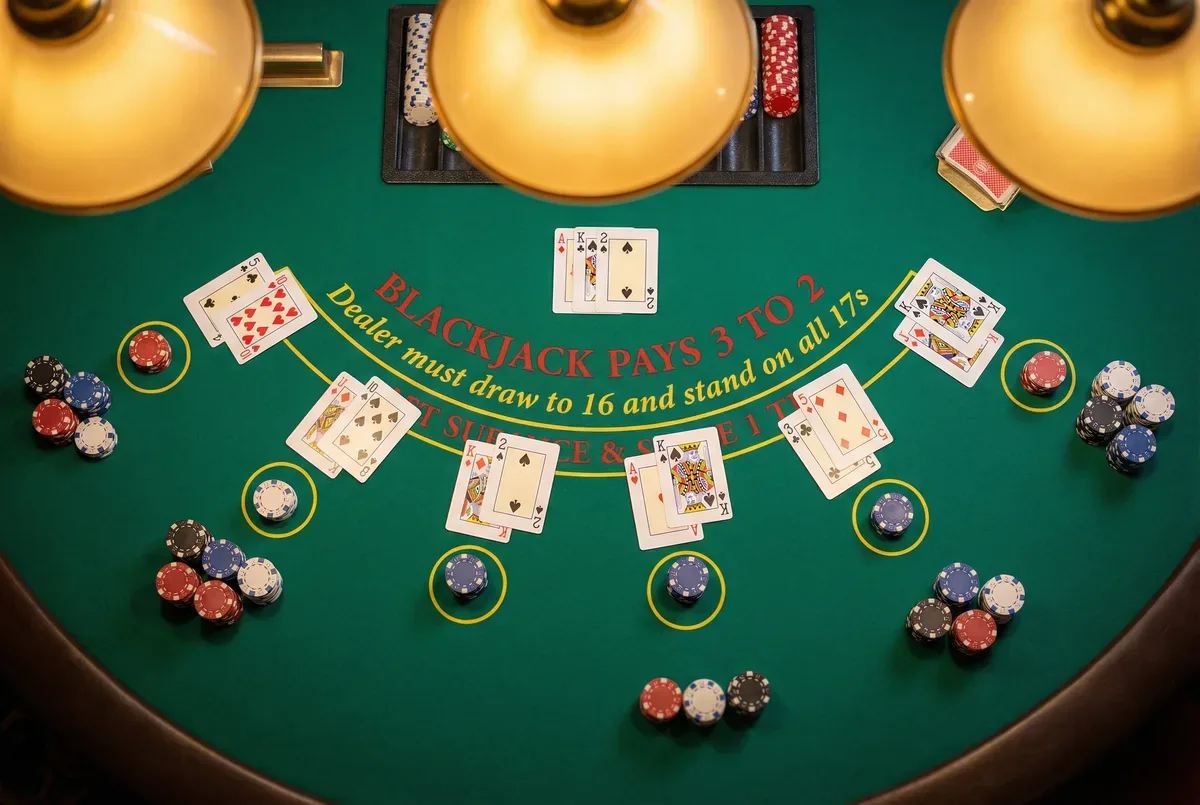
At most modern blackjack tables, cards are dealt face up and players are not allowed to touch them. Reaching for your cards will draw an immediate warning from the dealer. The only tables where you handle cards are single- or double-deck games dealt face down, and even then, you must use one hand only.
Hand signals also prevent a form of cheating called past posting, where a player claims they made a different decision after seeing the outcome. With a clear video record of every signal, the casino can verify exactly what the player requested. This is why dealers sometimes ask you to repeat a signal if it was ambiguous. They are not being difficult. They are ensuring the camera has a clean recording.
At tables in the United States, Europe, Asia, and Australia, the same basic signals are universal. There are minor variations, but the core 4 signals are recognized everywhere. Learn them once and you are set for any casino on the planet.
How Does Four Essential Blackjack Hand Signals Every Player Must Know?
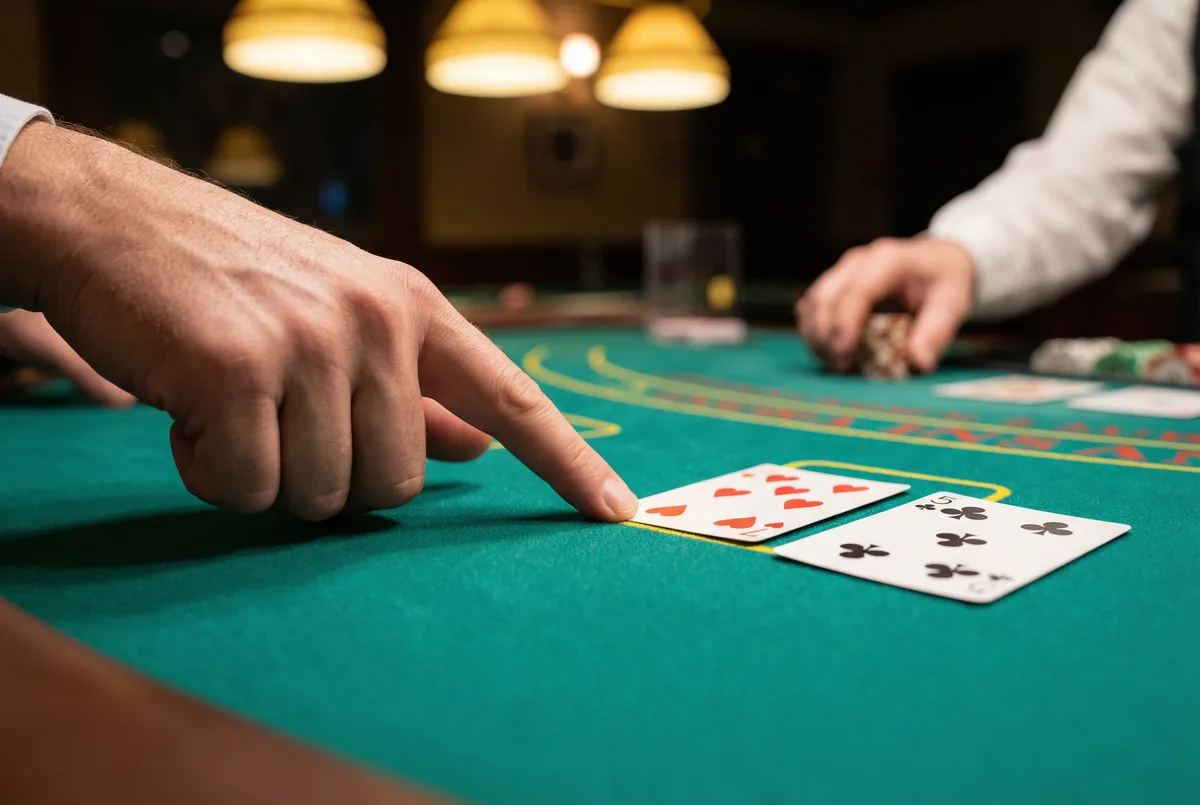
There are exactly four hand signals every blackjack player must know: hit (tap the felt), stand (wave your hand flat), double down (place chips beside your bet and hold up one finger), and split (place a matching bet and hold up two fingers). Some players scratch the felt toward themselves. Either motion works. The key is a clear downward or inward gesture that the camera can distinguish from a wave. The dealer will give you one card. You can signal hit as many times as you want until you stand or bust.
Stand: wave your open hand horizontally over your cards, palm down. Keep your fingers together and make a smooth side-to-side motion. This tells the dealer you are done taking cards. Do not move your hand up and down. A vertical motion can look like a hit signal from certain camera angles. Keep it flat and horizontal.
- HITTap or scratch the felt behind your cards
- STANDWave your open hand flat over your cards (palm down)
- DOUBLE DOWNPlace additional chips next to your bet and hold up one finger
- SPLITPlace a matching bet beside your original and make a peace sign (two fingers)
Double down: place your additional chips beside (not on top of) your original bet, then hold up one finger. The one-finger gesture tells the dealer you want exactly one more card. Some casinos do not require the finger gesture if the chip placement is clear, but I always use it because it eliminates any ambiguity between a double and a hit with a bet adjustment.
Split: place a second stack of chips equal to your original bet beside the first stack, then hold up two fingers in a V or peace sign. The two fingers tell the dealer you want to split the pair into two separate hands. At some casinos, you can simply place the chips and the dealer will ask “splitting?” for confirmation. The two-finger signal makes it faster and cleaner.
How Do Hand Signals Work Differently at Face-Down Tables?
At single-deck and some double-deck tables, cards are dealt face down and players handle them, the signals change because you physically hold your cards instead of leaving them on the felt. The signals change at these tables. To hit, scratch the edge of your cards lightly against the felt, pulling them toward you. To stand, slide your cards face down under your chips in the betting box. Do not lift the chips. Slide the cards underneath in a smooth motion.
To double down at a face-down table, turn your cards face up on the felt and place your additional chips beside your bet. You are revealing your hand to the table and the camera simultaneously. To split, turn your pair face up and place the matching bet next to your original. The dealer will separate the cards and proceed. In both cases, you surrender the privacy of your hand when you add money to the bet.
Verbal calls alone aren't accepted at most casinos specifically because of disputes. A player who says 'hit me' but doesn't scratch the table has no protection if they claim they said 'stand.' The hand signal creates a visual record for the eye in the sky. Use it every time, even when the table is quiet.
Face-down dealing is becoming less common as casinos move to 6-deck and 8-deck shoes dealt from a shoe device. But if you find a single-deck game with good rules, the face-down format is worth learning. Single-deck games with 3:2 payouts and dealer standing on soft 17 have a blackjack house edge as low as 0.28%. I seek these games out specifically, and knowing the correct signals for face-down play is part of being prepared.
What Is the Result?
If you give an ambiguous signal at a blackjack table, the dealer will pause and ask for clarification before acting: this is standard protocol and not an accusation of anything, it is the dealer protecting the integrity of the hand for the camera record. The dealer needs a clean signal before dealing your next card. Repeat the gesture clearly and the hand proceeds normally.
Changing your mind after a clear signal has been given is not permitted. Once you have tapped the felt for a hit and the dealer has begun to move toward the shoe, that decision is locked. Once a card leaves the shoe in response to your signal, the hit is complete regardless of the outcome. This is why deliberate, decisive signals matter. If you are uncertain about your decision, use that moment of uncertainty to make the correct play according to blackjack basic strategy before you signal at all.
At face-up shoe games, touching your cards is an immediate issue. Dealers at shoe games are trained to give a verbal warning when a player reaches for face-up cards, because physical contact with cards creates opportunities for card marking or switching. The rule is not punitive. It is procedural. At single- and double-deck face-down games, you must handle the cards to signal your decisions, but only with one hand. Two-hand card handling at any table draws pit attention immediately. Keep one hand visible, make your signals deliberately, and the process runs smoothly from the first hand to the last.
Practicing Signals Before You Play
You can practice hand signals at home in under 5 minutes. Sit at a table, place a few coins or chips in front of you, and run through all 4 signals. Tap the table for hit. Wave your hand for stand. Place chips and hold up one finger for double. Place chips and hold up two fingers for split. Repeat each signal 10 times until the motion is automatic.
The goal is not just knowing the signal. It is making the signal without thinking about it. When you are at a real table calculating whether to hit or stand on hard 16 against a dealer 10, you do not want to also be thinking about which gesture to make. The decision should flow directly into the signal with no delay. I still do the same motions I practiced at my kitchen table 15 years ago. They are muscle memory now.
Confidence at the table starts with the basics. Knowing your hand signals tells the dealer, the pit boss, and every other player that you are not a tourist. Walk up to a live table and make your first signal. Tap the felt for a hit. Wave your hand for a stand. After 5 hands, the motions will feel natural. After 20, you will not remember a time when they did not. The chips in front of you represent real money, so decide your session budget before your first signal and respect that number when it runs out.
Frequently Asked Questions
To hit, tap the felt behind your cards with one or two fingers or scratch the felt toward you. To stand, wave your open hand horizontally over your cards with your palm facing down. These signals are mandatory at every casino for surveillance record purposes.
Hand signals create a visual record on surveillance cameras that can be reviewed if a dispute arises. Verbal instructions cannot be verified after the fact. The signals protect both the player and the casino from miscommunication about the intended play.
The four core signals (hit, stand, double, split) are essentially universal across casinos worldwide. Minor variations exist at face-down tables where cards are handled differently, but the basic gestures are recognized at any regulated casino.
Before you test these plays at a real table, run them through our free blackjack simulator practice unlimited hands at zero cost until every move becomes automatic.
Know Your Edge Before You Bet
The calculator shows your exact expected value for every hand combination.
Blackjack Academy is an educational resource. All strategy is based on mathematical expectation. Always play within your means.
Learn More
Continue your education with these related lessons.
The 7 Blackjack House Rules That Secretly Change Your Expected Value
S17 vs H17, DAS, RSA, late surrender, number of decks each rule moves the house edge by a measurable number…
Real Blackjack Odds and Your Mathematical Chance of Winning
The house edge in blackjack ranges from 0.28% to over 2% depending on the rules and your strategy. That range…

History of French Vingt-et-Un the Ancestor of Modern 21
Vingt-et-un was played in French salons for over a century before it crossed the Atlantic. The rules were different, the…