
How to Beat the Dealer in Blackjack Without Going Over 21
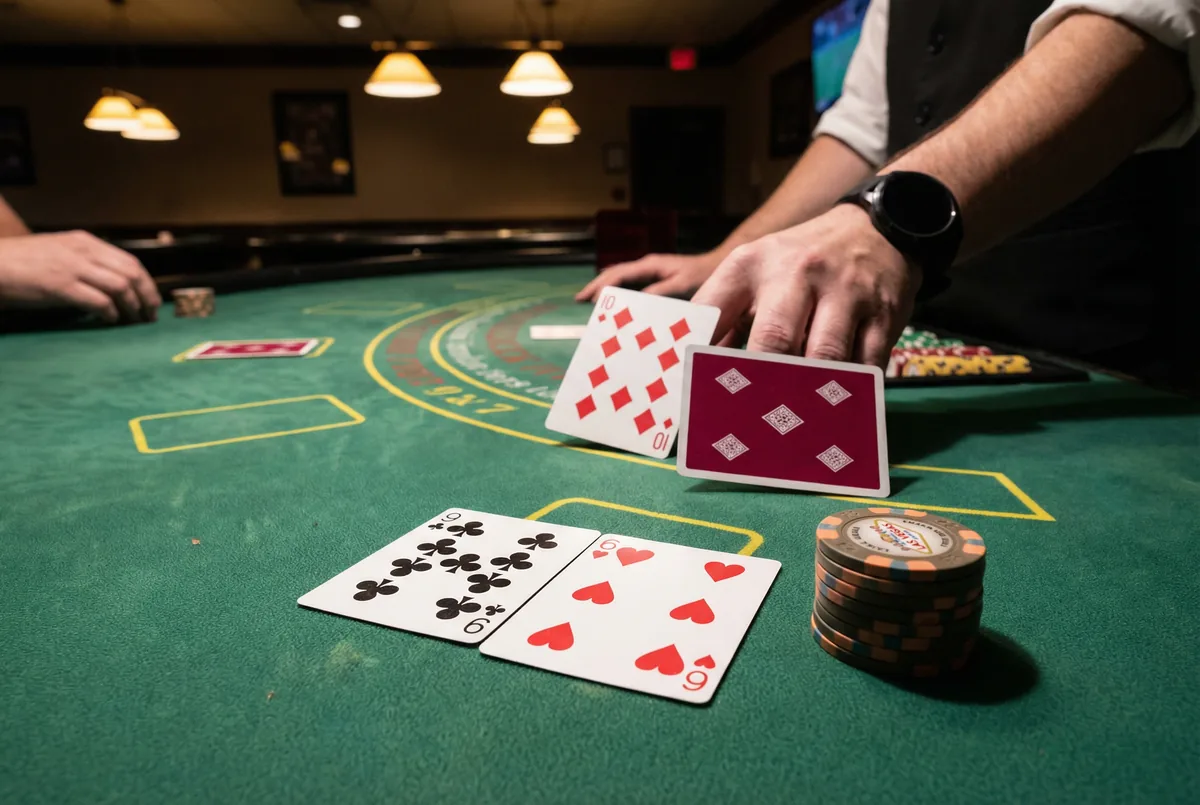
Everyone at the table told me I was wrong for hitting 15 against a dealer 10. The guy to my left shook his head. I took the card, drew a 6, held 21. They still thought I got lucky. Here is the thing: whether I drew a 6 or busted, hitting was the correct play. The dealer busts more than 28% of all hands in a standard 6-deck game, but that number only helps you when you know how to read it. Beating the dealer has nothing to do with chasing 21. Apply correct blackjack basic strategy across 80 hands at a $25 table and the blackjack house edge drops to 0.5%. Play on instinct and it rises to 2%, costing you $30 extra per session. This guide explains how to read the dealer upcard, when standing on 12 is the smartest play at the table, and when hitting a stiff hand is the only move that makes mathematical sense.

Common Myth
“Your goal in blackjack is to get as close to 21 as possible.”
The Reality
Your goal is to beat the dealer's hand without busting. When the dealer shows a 4, 5, or 6, standing on a hard 12 is often the correct play because the dealer busts above 40% of the time in those spots. Hitting when the dealer is already in trouble adds your own bust risk for no gain.
The Dealer’s Structural Disadvantage
The dealer must hit until reaching 17 or higher. That rule is fixed, regardless of your hand and regardless of what the dealer needs to beat you. When the dealer starts with a 5 and holds a 12 in the hole, the dealer must draw again and faces a bust probability above 42%. You do not need to do anything except not bust yourself. The dealer’s mandatory draw rule, the same rule that gives the house its edge when you act first, is also the mechanism that makes standing on stiff hands against weak upcards the correct play.
The blackjack house edge in blackjack comes from one structural asymmetry: you act before the dealer. If you bust first, your bet is collected immediately, even if the dealer would have busted on the same round. That is the entire mathematical source of the house advantage. Against a correct blackjack basic strategy player in a 6-deck game with standard rules, that asymmetry produces a blackjack house edge of 0.5%. Without strategy, the same asymmetry runs the edge up to 1.5% to 2%.
- Dealer 2busts 35.3% of the time
- Dealer 3busts 37.6%
- Dealer 4busts 40.3%
- Dealer 5busts 42.9%
- Dealer 6busts 42.3%
- Dealer 7busts 26.2%
- Dealer 8busts 23.9%
- Dealer 9busts 23.4%
- Dealer 10 / Facebusts 21.4%
- Dealer Acebusts 11.7% (with peek)
How to Read the Dealer Upcard to Make the Right Decision Every Time?
The dealer’s upcard is the single most important piece of information at the table: it tells you whether the dealer is in weak territory (2–6, bust rate 35–43%) or strong territory (7–Ace, bust rate 11–27%). Every correct decision in blackjack basic strategy runs through that number. When the dealer shows a 2 through 6, the dealer is in weak territory. Bust probability ranges from 35% to 43%. Your correct play in those spots is to stand on any hard total of 12 or higher and let the dealer draw into trouble. You are not giving up. You are executing the play that has positive expected value.
When the dealer shows a 7 through Ace, the math shifts. Bust probability drops below 27%. The dealer is more likely to reach a made hand and beat your stiff total. In those spots, standing on 12 through 16 becomes a losing play not because the dealer will always make it, but because the dealer makes it often enough that hitting gives you better average results despite adding your own bust risk. Basic strategy resolves every one of these situations mathematically. Your job is to execute it, not override it.
Dealer Shows
Your Hand
You hold hard 13 against a dealer 6. The dealer is showing their weakest upcard. Do you stand and wait for the dealer to bust, or hit?
Beating the dealer sometimes means doing nothing. When the dealer shows a 4, 5, or 6, the correct play for stiff totals is often to stand and let the dealer self-destruct. This is the core of basic strategy.
When to Hit Against a Strong Dealer Upcard Instead of Standing?
Hard 12 through 16 against a dealer 7 or higher requires hitting even though the bust risk is substantial, because standing on a stiff total against a strong upcard loses more often than hitting does. Standing feels safe. The math says otherwise. When the dealer shows a 10, the dealer reaches 17 or higher approximately 78% of the time. Standing on hard 16 in that spot means losing to a made hand 78% of the time without a fight. Hitting hard 16 against a 10 gives you a bust probability of roughly 62%, but the combined expected value of hitting is still higher than the guaranteed loss rate of standing against a strong upcard.
The same logic applies across the strong upcard range. Hard 12 hits against a dealer 7, 8, 9, 10, or Ace. Hard 13 through 16 hits against 7 through Ace. These are not intuitive plays. They are the mathematically verified correct decisions from blackjack basic strategy, derived from millions of simulated hands. I still feel the tension when I hit 15 against a 10. Years of playing have not made it comfortable. But I have seen the math play out over thousands of hands, and that tension is the signal that you are playing correctly in a difficult spot.
| Your Hand | Dealer 2–3 | Dealer 4–6 | Dealer 7–Ace |
|---|---|---|---|
| Hard 12 | Hit | ||
| Hard 13 | Stand | ||
| Hard 14 | Stand | ||
| Hard 15 | Stand | ||
| Hard 16 | Stand |
How Does Basic Strategy Change Based on What the Dealer Is Showing?
Basic strategy is not one fixed set of rules applied the same way on every hand: it is a decision matrix that shifts systematically based on whether the dealer’s upcard is weak (2 through 6) or strong (7 through Ace). Against a weak upcard, blackjack basic strategy tells you to stand more, double more, and split more. Against a strong upcard, it tells you to hit more stiff hands and surrender when that option is available.
Against a dealer 5 or 6, I double hard 9 and hard 10. Against a dealer 8, I do not double hard 9. That is not gut feel. It is the expected value calculation. Doubling hard 9 against a dealer 5 has a positive edge. Doubling hard 9 against a dealer 8 does not. The upcard is the variable that flips the decision. Once I understood that the upcard was driving every branching point in the chart, strategy stopped feeling like memorization and started feeling like reading the table correctly.
The practical implication: before every decision, your first mental step should be to classify the dealer upcard as weak or strong. That classification tells you whether the blackjack strategy chart is in aggressive mode (double and stand, make the dealer draw) or defensive mode (hit stiff hands, take your lumps against a made dealer hand). Against a weak upcard over 80 hands at $25, missing one double-down adds roughly $4 to $6 to your expected cost per missed opportunity.
Splitting and Doubling to Press Your Edge
Standing and hitting keep you in the game. Splitting and doubling are how you press the mathematical edge when the situation is in your favor. Always split Aces. Always split 8s. Two hands starting at 11 each is dramatically better than a combined soft 12. Two hands starting at 8 each converts the worst starting position in the game, hard 16, into two workable spots. Never split 10-value cards. A 20 is one of the strongest hands in the game. Breaking it into two hands starting at 10 is a strategic error that costs positive expected value.
I did not get comfortable hitting stiff hands by reading about it. I got comfortable by doing it hundreds of times until the chart became instinct. Play a live session and force yourself to follow the blackjack strategy chart on every 12-through-16 decision for 40 hands straight. No gut calls. No adjustments based on streaks. After 40 hands the discomfort fades and the math takes over. Every one of those hands costs real money, so pick a fixed amount before you start that you can lose without it affecting your week.
Frequently Asked Questions
You beat the dealer by finishing with a higher hand total without busting, or by standing and watching the dealer bust. The dealer busts 28% of all hands in a standard 6-deck game. Against weak dealer upcards (4, 5, 6), standing on hard 12 through 16 transfers the bust risk to the dealer. Against strong upcards (7 through Ace), hitting stiff hands gives better expected value than standing and losing to a made dealer hand.
It depends on the dealer upcard. Hard 16 stands against a dealer 2 through 6 and hits against a dealer 7 through Ace. Against a dealer 9, 10, or Ace, surrendering hard 16 is the correct play when surrender is available. The total alone does not determine the play. The dealer upcard is always part of the calculation.
A weak dealer upcard is a 4, 5, or 6. These cards produce dealer bust rates of 40% to 43% because the dealer must draw to 17, and a low upcard frequently pairs with a low hole card, requiring multiple draws and increasing the bust probability. Against a weak upcard, basic strategy calls for standing on stiff totals as low as 12 and doubling down on more hands than you would against a strong upcard.
Before you test these plays at a real table, run them through our free blackjack simulator practice unlimited hands at zero cost until every move becomes automatic.
Know Your Edge Before You Bet
The calculator shows the correct play for any hand total against any dealer upcard under your exact table rules.
Blackjack Academy is an educational resource. All strategy is based on mathematical expectation. Always play within your means.
Learn More
Continue your education with these related lessons.
What Really Happens During a Push or Tie and How to Handle It
A push in blackjack means your bet stays on the table no win, no loss. Here's when ties occur, when…
Why Face Cards are the Most Important Picture Cards in the Deck
Jacks, queens, and kings each count as 10 in blackjack, making them the most frequent 10-value cards in the deck.…
What the Dealer Must Do and How the House Manages the Game
The dealer has zero decision-making authority at a blackjack table. Every action is predetermined by fixed house rules. Understanding exactly…