
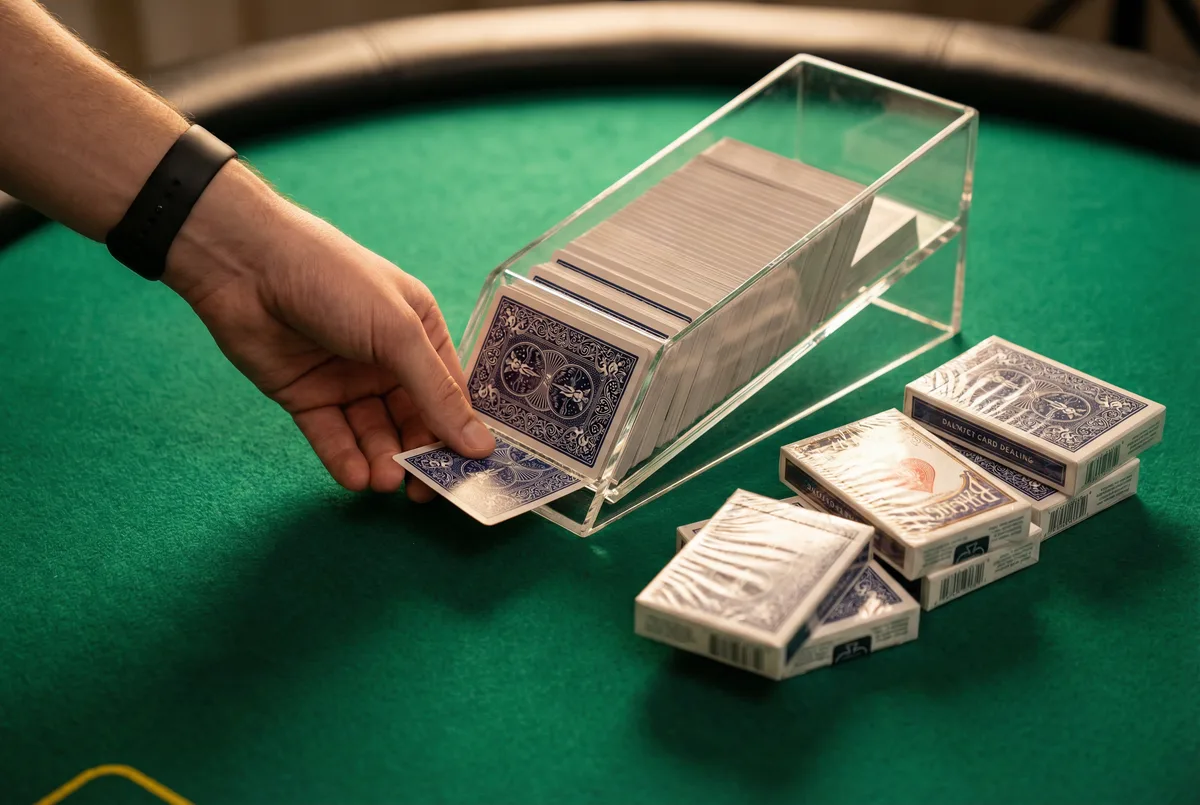
How the Number of Decks in a Shoe Affects Your Winning Odds
The casino that switched from 6 decks to 8 decks added 0.05% to its blackjack house edge. The one that quietly switched from 3:2 to 6:5 payouts added 1.39%. I use that comparison to explain why deck count matters but is rarely the most important variable at your table. Players walk past a 6:5 single-deck game to sit at a 3:2 six-deck shoe, and they are making the correct decision even though it sounds backwards. Deck count is real math. It just tends to be the smallest real math in the building.
Why Deck Count Changes the Mathematics
Deck count affects the game through a principle called the card removal effect. When you remove a card from play, you change the composition of the remaining deck. In a single-deck game, removing one 5 from the 52-card pack eliminates roughly 2% of all 5s available. That absence shifts the probability of every subsequent hand. In a six-deck shoe with 312 cards, removing that same 5 changes the composition by only 0.32%. The shoe absorbs the information. The shoe dilutes every event.
This matters because certain cards have large effects on the blackjack house edge. The 5 is the single most valuable card for the house. Its removal helps the player more than any other card. In a single-deck game, the dealer busts more often when 5s are depleted because the dealer must hit to hard totals and 5s contribute heavily to hands between 16 and 21. With more decks, the removal of any individual card has a smaller effect, which means the shoe is a smoother, more predictable environment for the casino to extract its mathematical edge.
1-Deck House Edge
Best rules: S17, DAS, late surrender
2-Deck House Edge
Same rule set as above
4-Deck House Edge
Same rule set
The numbers above assume identical rules across all deck counts. The jump from 1 deck to 2 decks adds 0.19% to the blackjack house edge, the largest single step in the progression. Each additional deck matters less than the previous one. Going from 4 to 6 decks adds 0.06%. Going from 6 to 8 adds 0.05%. The law of diminishing returns applies to deck count. Beyond 6 decks, the shoe is already so diluted that adding more barely moves the number.
Why Single-Deck Games Usually Disappoint Despite the Lower House Edge?
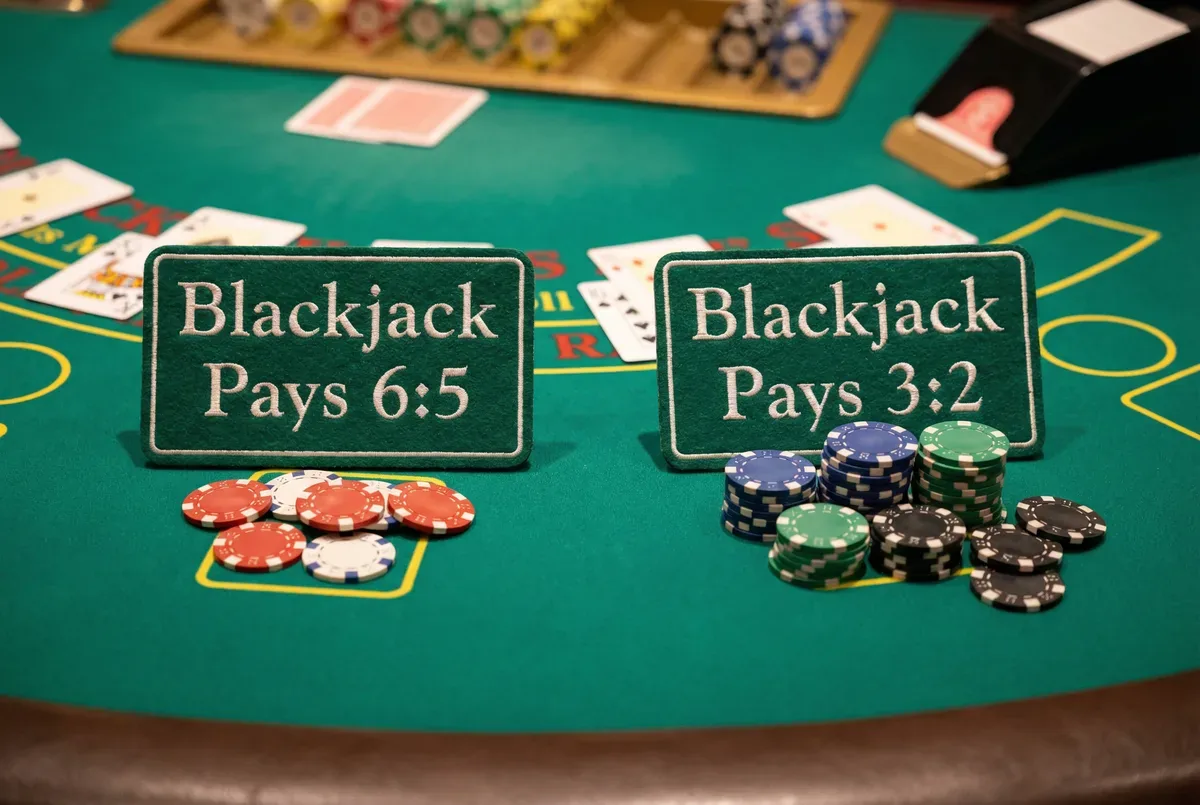
Single-deck blackjack has a 0.17% blackjack house edge under perfect conditions, but those conditions almost never exist because casinos protect the lower deck edge with rule restrictions that more than cancel out the advantage. Those conditions almost never exist. The casino knows that single-deck games attract sophisticated players and card counters, so they protect the edge with rule adjustments that more than cancel out the deck advantage. The most common protection is 6:5 payouts on naturals. A 6:5 payout costs the player 1.39% in blackjack house edge. The single-deck advantage is 0.35% compared to a standard 6-deck game. The casino just made 1.04% net on you.
Other rule restrictions common at single-deck tables include restricting doubles to hard 10 and 11 only, prohibiting doubling after splits, and requiring the dealer to hit soft 17. Each restriction adds 0.1% to 0.3% to the blackjack house edge. Stack four of these restrictions on a single-deck game and you are playing a 1% to 1.5% blackjack house edge game instead of 0.17%. The number of decks on the placard means nothing without reading the full rule set on the table felt.
Common Myth
“Single-deck blackjack always gives the player a better chance than a shoe game.”
Fewer decks mean the card removal effect is stronger, so the deck composition shifts more dramatically with each card dealt.
The Reality
Single-deck tables almost universally offset their deck advantage with 6:5 payouts, hit soft 17, or restricted doubling. A 3:2 six-deck shoe with DAS and S17 typically offers a lower effective house edge than a 6:5 single-deck game.
6:5 single-deck: ~1.56% edge. 3:2 six-deck S17: ~0.52% edge.
The pattern is consistent across every major casino market. Single-deck games with full player-friendly rules exist at a small number of downtown Las Vegas properties and high-limit rooms. Everywhere else, the word “single deck” is used as a marketing tool, not a player advantage. I verify the payout, the soft 17 rule, and the doubling restrictions before I consider sitting at any table regardless of how many decks the shoe holds.
What Is the Card Removal Effect?
The card removal effect is the mathematical reason deck count matters: removing one card from a single-deck game changes the remaining composition by roughly 2%, while removing the same card from a 6-deck shoe changes it by only 0.32%. Each card in a standard deck has a defined impact on the player’s expected return when removed from play. The 5 has the largest positive effect for the player when removed (it hurts the dealer disproportionately). Tens and Aces have a negative effect when removed (their absence hurts the player). Removing a 5 from a single deck changes expected return by approximately +0.67%. Removing a 5 from an 8-deck shoe changes it by +0.083%.
This is why blackjack basic strategy produces slightly different decision thresholds for single-deck versus multi-deck games. The most notable difference is on hard 8: single-deck strategy recommends doubling against a dealer 5 or 6, while multi-deck strategy recommends hitting. In single deck, the effect of the removed cards you have already seen is large enough to shift the expected value of the double. In multi-deck, the effect is diluted to the point where hitting and doubling have nearly identical expected values, and the blackjack basic blackjack strategy chart defaults to the lower-risk option.
Card counters exploit the card removal effect deliberately. By tracking the ratio of high cards to low cards remaining in the shoe, they know when the remaining cards are disproportionately rich in 10s and Aces. Single-deck games are theoretically easier to count because the information content of each observed card is higher. But casinos counter this with rapid reshuffling, some single-deck games reshuffle every two hands, which eliminates the counting edge entirely.
How to Evaluate Deck Count Alongside the Full Table Rule Set?
Deck count is one variable in a multi-variable equation, to correctly evaluate a table you must combine the deck count effect with the cost or benefit of every other rule in play. To correctly evaluate a table, you need to combine the deck count effect with the effects of every other rule in play. I use a mental checklist before sitting down. Each item has an approximate blackjack house edge cost or benefit. A 6:5 payout costs 1.39%. Hit soft 17 costs 0.22%. No late surrender costs 0.08%. No doubling after split costs 0.14%. No resplitting of Aces costs 0.08%.
Add those costs to the baseline deck edge and you have the table’s effective blackjack house edge. A 6-deck game with S17, DAS, and late surrender has an edge around 0.30%. A single-deck game with H17, 6:5, and no DAS has an edge around 1.56%. The six-deck game is more than five times better for the player despite having the raw deck disadvantage. This is why experienced players evaluate the rules before the deck count. The deck count is only meaningful when everything else is equal.
Deck count is a tiebreaker, not a headline. Always read the full rule set on the felt before counting the number of decks in the shoe.
Table Selection Rule
What Deck Count Means for Your Session Planning
For most recreational players, deck count should be the last thing you evaluate at a table. Confirm the natural payout is 3:2. Confirm the dealer stands on soft 17. Confirm doubling after splits is allowed. If a table passes those three tests, the difference between 4, 6, or 8 decks is less than 0.15% in blackjack house edge. At a $25 table over 200 hands, 0.15% is $7.50. That is within the margin of a single hand’s variance. The rule set is where your real money lives.
Where deck count becomes actionable is if you count cards or track the count to identify favorable situations. In that context, lower deck counts amplify the value of every card you track. A true count of +2 means more in a 2-deck game than in a 6-deck game because the same running count represents a larger fraction of the remaining shoe. If you count, seek the lowest deck count with the most player-friendly rules. If you do not count, optimize the rules and accept whatever deck count the best-rules table carries.
The number printed on the placard next to the shoe does not tell you what the table will cost you. The rules printed on the felt tell you that. Watch a live table dealer for 10 minutes before sitting down and verify whether they hit or stand on soft 17, that one observation tells you more about the table’s edge than the deck count does. Every hand at that table involves real money, so confirm you have found the best available rules before committing your session budget to the first bet.
Frequently Asked Questions
Yes. Each additional deck slightly increases the house edge because it dilutes the card removal effect. A single-deck game has roughly 0.35% lower house edge than a 6-deck game under identical rules. However, single-deck tables almost always carry rule restrictions like 6:5 payouts that more than cancel out this advantage.
Most single-deck games use 6:5 payouts on naturals, which adds 1.39% to the house edge. A 3:2 six-deck game with dealer standing on soft 17 has an effective house edge around 0.52%, significantly lower than a typical 6:5 single-deck game at 1.56%.
The card removal effect is the change in expected return when a specific card is removed from play. In single-deck games, each card removed changes the composition of the remaining deck significantly. In multi-deck shoes, the same removal has a proportionally smaller effect because the deck composition is larger and more diluted.
Before you test these plays at a real table, run them through our free blackjack simulator practice unlimited hands at zero cost until every move becomes automatic.
Know Your Exact Edge Before You Sit Down
The calculator computes your expected value for any rule combination across every deck count.
Blackjack Academy is an educational resource. All strategy is based on mathematical expectation. Always play within your means.
Learn More
Continue your education with these related lessons.
Real Blackjack Odds and Your Mathematical Chance of Winning
The house edge in blackjack ranges from 0.28% to over 2% depending on the rules and your strategy. That range…

Why the Name Changed from Vingt-Un to Blackjack in the Gold Rush
The name blackjack is less than 120 years old. The game it describes had been played for over 300 years…
Finding the Best Table Limits for Your Bankroll
Sitting at the wrong table minimum is the most expensive mistake in blackjack. The correct table minimum for your bankroll…