

How the 1956 Baldwin Paper Created the First Winning Strategy
In 1956, four US Army mathematicians published a paper in the Journal of the American Statistical Association titled “The Optimum Strategy in Blackjack.” Roger Baldwin, Wilbert Cantey, Herbert Maisel, and James McDermott had spent two years hand-calculating the correct play for every possible blackjack decision.

The 1956 Baldwin Paper: How Four Mathematicians Solved Blackjack
The Baldwin paper was the first mathematical proof that a player could reduce the blackjack house edge in blackjack to near zero through correct play. It created what is now called blackjack basic strategy. Every blackjack strategy chart printed in every casino in the world descends from this single paper.
- AuthorsRoger Baldwin, Wilbert Cantey, Herbert Maisel, James McDermott
- Published1956, Journal of the American Statistical Association
- Methodmanual calculation using mechanical calculators, no computers
- Resultfirst optimal strategy table for all blackjack decisions
- House edge with their strategyapproximately 0.62% (6-deck equivalent)
- Legacyfoundation for every basic strategy chart published since
How Four Army Mathematicians Calculated Basic Strategy Without Computers?
Baldwin and his colleagues used mechanical calculators and manual computation over approximately two years to derive optimal plays for each hand combination. They built probability tables for every possible player hand and dealer upcard, calculating the expected return for hitting, standing, doubling, and splitting at each decision point.
The computational challenge was immense for the period. A single strategy table requires calculating expected values across thousands of possible card combinations. Working without electronic computers, the team relied on mathematical models, simplifying assumptions, and rigorous verification of each result.
The 1956 paper contained several small errors resulting from the manual calculation process. These were later corrected by Edward Thorp when he re-derived the strategy using the IBM 704 computer in the early 1960s. Despite those corrections, the Baldwin paper’s core findings held: optimal blackjack play reduces the blackjack house edge to near zero.
What the Baldwin Paper Proved About Blackjack?
The paper proved that blackjack is not purely a game of chance. It demonstrated that the correct playing decision for each hand situation can be calculated mathematically, and that following these calculations consistently reduces the blackjack house edge to approximately 0.62% (under the rules available at the time).
This was a revolutionary finding. In 1956, most casino blackjack players operated on intuition, superstition, and observation of other players. The Baldwin team established that correct play was not intuitive. Some decisions that feel safe (standing on soft 18 against a dealer 5) are wrong. Some that feel aggressive (doubling soft totals against bust cards) are correct.
The paper was largely ignored by the public for several years. The Journal of the American Statistical Association had a limited readership. It was only when Edward Thorp read the paper, verified its results, and extended them into blackjack card counting theory that the work reached a mass audience through Beat the Dealer in 1962.
Dealer Shows
Your Hand
The 1956 Baldwin paper proved that doubling soft 17 against a dealer 6 is correct. You hold Ace-6 against dealer 6. What did Baldwin's math say?
This is exactly the type of counterintuitive decision the Baldwin paper revealed. The math, not intuition, defines correct play. That principle is the central lesson of their work and the foundation of every strategy chart that followed.
How Edward Thorp Built on the Baldwin Paper?
Edward Thorp encountered the Baldwin paper in 1958 and used it as the foundation for his own research. Thorp re-derived the optimal strategy using an IBM 704 computer, correcting the minor errors in Baldwin’s manual calculations and confirming the paper’s central findings.
Thorp then extended the research beyond static optimal play. He demonstrated that the composition of the remaining deck changes the optimal strategy and creates situations where the player holds a statistical edge over the house. This extension became blackjack card counting, published in Beat the Dealer in 1962.
The relationship between the two works is clear: Baldwin proved that perfect play can nearly eliminate the blackjack house edge. Thorp proved that dynamic play based on remaining deck composition can create a player edge. Every professional counting system built since then rests on both proofs.
Baldwin, Cantey, Maisel, and McDermott did all their calculations by hand using mechanical calculators, a process that took years. Their paper in the Journal of the American Statistical Association in 1956 introduced the concept of expected value per hand decision to blackjack for the first time. Edward Thorp later verified and extended their work using early IBM computers.
Why the 1956 Baldwin Paper Still Matters to Players Today
The Baldwin paper established that blackjack has correct answers. That finding is what makes blackjack basic strategy more than a suggestion. Every play on the blackjack strategy chart was derived using the same mathematical framework the Baldwin team introduced. The chart is not a recommendation. It is the solution to a proven optimization problem.
Understanding this history changes how players relate to strategy deviations. When a player skips a correct double or stands on soft 18 because it feels safer, they are reversing a calculation that took two years to complete manually and has been verified by computer simulation millions of times since.
The best tribute to the Baldwin paper is to apply its conclusions consistently. Sit at a real-money live table and execute every blackjack strategy chart decision without deviation. The math is 68 years old and still correct. Set your session budget before the first hand and treat it as a firm limit.
Frequently Asked Questions
No. Roger Baldwin, Wilbert Cantey, Herbert Maisel, and James McDermott were US Army personnel stationed at the Aberdeen Proving Ground in Maryland. They developed the blackjack strategy as a mathematical research project using the tools available to them at the time: mechanical calculators and probability theory.
Yes. The manual calculation process introduced several small errors in specific decision points. Edward Thorp corrected these when he re-derived the strategy using an IBM 704 computer. The core finding, that optimal play reduces the house edge to near zero, was confirmed as correct by Thorp's work.
Not immediately. The paper had limited public reach when published in 1956. Casinos began reacting to advantage play only after Edward Thorp's Beat the Dealer (1962) reached a mass audience. The 1964 rule changes by casinos were a direct response to Thorp's book, not the original Baldwin paper.
Before you test these plays at a real table, run them through our free blackjack simulator practice unlimited hands at zero cost until every move becomes automatic.
The Math Is 68 Years Old. It Still Works.
Every strategy decision was derived from the same framework Baldwin proved in 1956.
Blackjack Academy is an educational resource. All strategy content is based on peer-reviewed mathematical research. Always play within your means.
Learn More
Continue your education with these related lessons.
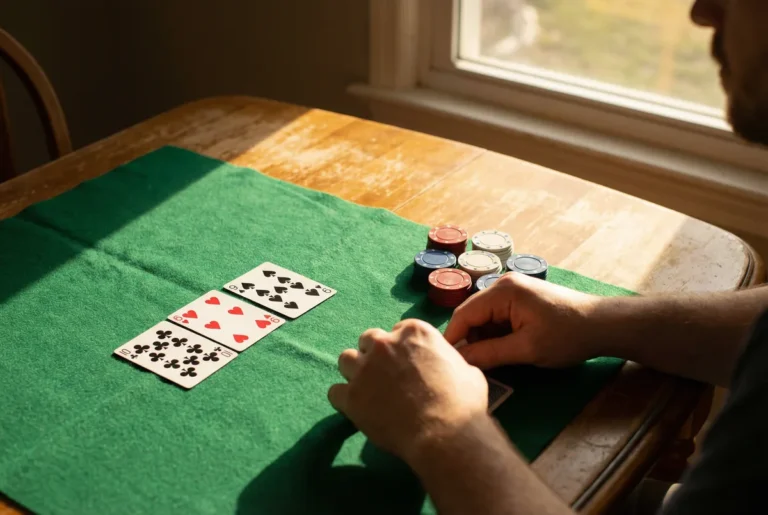
How to Practice Blackjack Before Going to a Casino
Free apps, kitchen table drills, and strategy card repetition can get you casino-ready. Here is a step-by-step practice plan with…

Is Playing Multi Hand Blackjack Actually Better for Your Profit?
Multi-hand blackjack looks like a shortcut to bigger wins but it exposes more money per round. Here is when it…
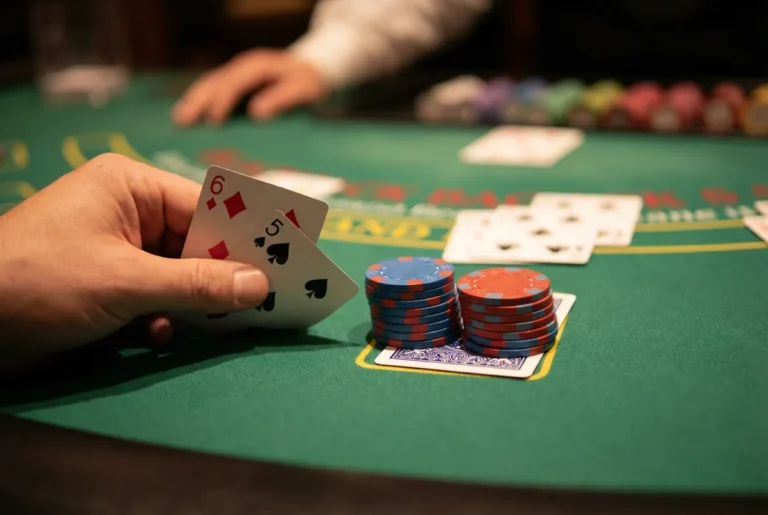
Proven Doubling Down Rules and Exactly When to Take the One-Card Risk
Doubling down is the most profitable move available to a basic strategy player. Hard 11, hard 10, and the right…