
History of French Vingt-et-Un the Ancestor of Modern 21
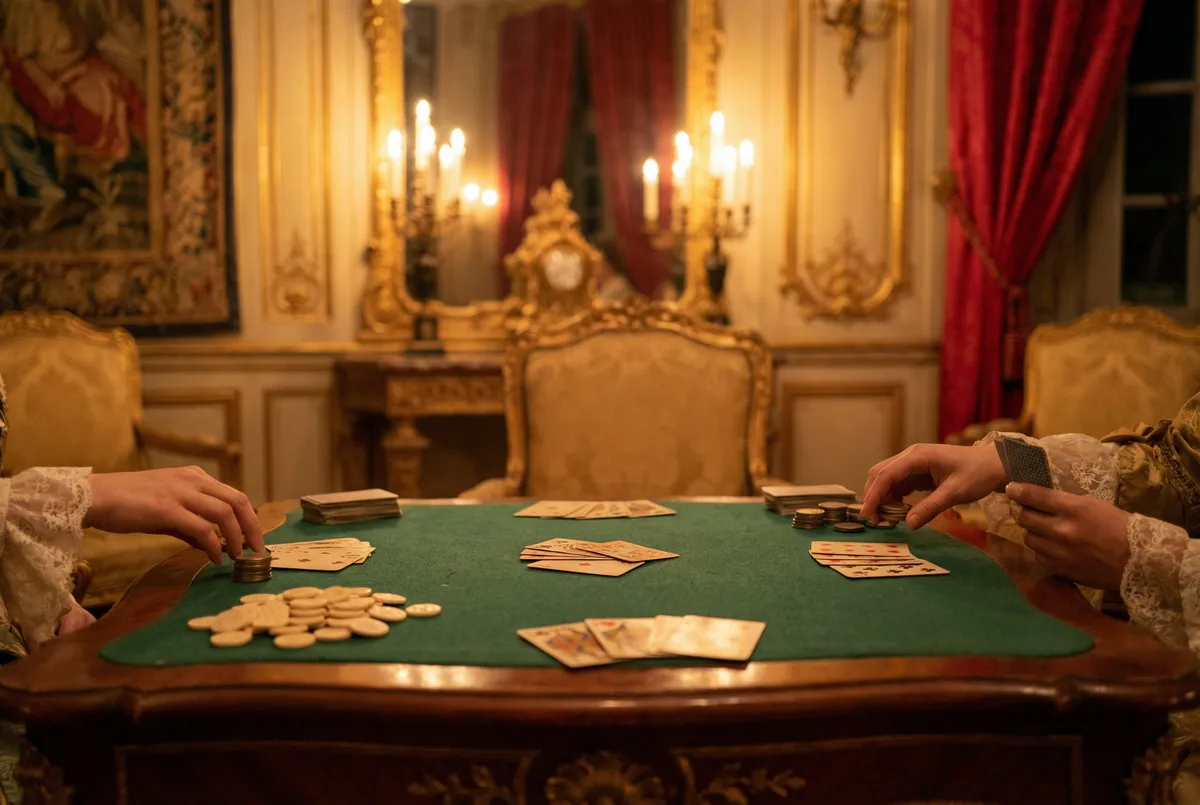
There is something I find fascinating about tracing the game I play every week back to its origins. Vingt-et-un, the French card game that became blackjack, was played in Parisian gambling salons more than 250 years ago. The rules were different from what you see in any modern casino. There was no dealer hole card, no standardized payout, and the role of banker rotated among the players. Understanding how vingt-et-un evolved into the game we play today explains why certain rules exist and why some casinos still experiment with variations that echo the original format.
What Vingt-et-Un Was and How It Worked
Vingt-et-un translates to twenty-one in English. The game appeared in French card game references as early as the 1760s, though informal play likely predates the written record by decades. Players competed to reach a hand total of 21 without exceeding it, the same core objective that defines modern blackjack.
The critical difference was the banking structure. In vingt-et-un, one player served as the banker and the others bet against that player. The banker role rotated, usually passing to whoever received a natural 21. This meant the blackjack house edge was not fixed by the establishment. It shifted based on who held the bank and how much capital they had. I have read accounts of salon games where the bank changed hands six times in a single session.
From French Salons to American Casinos
Early 1700s
Vingt-et-Un in French salons: A card game called Vingt-et-Un appears in French court records. Players bet against a banker, aiming to reach 21 without exceeding it, the core mechanic unchanged for 300 years.
1760s-1778
Rules formalized in print: Vingt-et-Un is documented in French card game collections and a published salon games compendium, establishing standardized rules as a mainstream French pastime.
1790s
Napoleonic era spread: French soldiers and diplomats carry the game across Europe. Versions appear in England as Vingt-Un and in Spain as Veintiuna, each with slight local rule variations.
1820s-1830s
Arrives in America: French settlers and traders bring the game to New Orleans. Early American versions offer bonus payouts for specific combinations including a black Jack with an Ace.
1931
Nevada legalizes gambling: With formal casino regulation, 21 is standardized. The bonus payouts disappear but the name Blackjack becomes the permanent American name for the game.
The natural 21 was special in vingt-et-un, but the payout was not standardized. Some circles paid double, others paid triple. The inconsistency meant your expected value changed depending on which table you joined. Modern casinos eliminated that ambiguity with the fixed 3:2 rule, though the introduction of 6:5 tables has brought a new kind of payout inconsistency back into the game.
Betting in vingt-et-un happened before the deal, just like modern blackjack. But players could also increase their wagers after seeing their first card. This created a primitive version of the double down that would later become one of the most profitable plays in blackjack basic strategy. The French were already recognizing that more information should allow you to risk more money.
Why the Rotating Banking System Changed Everything About the Game?
The rotating banker was the defining feature of vingt-et-un: one player served as the bank, others bet against them, and the mathematical advantage shifted unpredictably depending on who held the bank and how much capital they controlled. When any player could be the bank, the game had no fixed blackjack house edge. The mathematical advantage depended entirely on the banker’s capital and the specific blackjack table rules being used. A well-funded banker could survive variance. A poorly funded one could lose the bank in three hands.
Casinos solved this by making the house the permanent banker. This single change transformed vingt-et-un from a social gambling game into a commercial product with a calculable, consistent house advantage. Every rule that followed, from the dealer standing on 17 to the peek rule to the 3:2 natural payout, was designed to calibrate that permanent blackjack house edge to a level that attracted players while guaranteeing long-term casino profit.
Banker Advantage
Depended on capital and rules
Modern House Edge
With basic strategy, 6-deck, S17
Natural Payout (salon)
Varied by table
I think about the banking change whenever I sit at a table. The dealer is not making decisions. The casino is the permanent bank, absorbing every player’s variance while the math slowly works in its favor. That is the business model vingt-et-un accidentally created, and every casino in the world still runs on it.
How French Rules Differed from Modern Casino Blackjack?
French vingt-et-un dealt all cards face down, had no standardized dealer draw threshold, and offered no splitting, surrender, or double-down options as modern casino blackjack defines them. The banker dealt cards face down, including to themselves. Players looked at their own cards privately and announced their decisions verbally. There were no hand signals, no surveillance cameras, and no standardized dealing procedure. Disputes were settled by the group, not by a pit boss.
Splitting pairs was not part of the original game. Neither was surrender. These options were added later by American casinos to give players more strategic choices, which increased engagement and kept players at the table longer. Every additional option the player receives slightly reduces the blackjack house edge, but it also increases the number of decisions, which means more opportunities for the average player to make mistakes.
French Vingt-et-Un
Modern Casino Blackjack
- Rotating banker among players
- Natural paid 2:1 or 3:1 (varied)
- Cards dealt face down to all
- No splitting, no surrender
- No standardized dealer rules
- Single deck only
- Casino is permanent banker
- Natural pays 3:2 (standard)
- Player cards face up, dealer has hole card
- Split, double, surrender available
- Dealer must hit to 16, stand on 17
- 6-8 deck shoe is standard
Doubling down existed in a crude form. Players could look at their first card and increase their bet before receiving the second. This is closer to the European no-peek style of play where you commit extra money before knowing the full situation. The modern double down, where you see both cards before deciding, gives the player significantly more information and therefore more expected value from the decision.
Why the Game Crossed the Atlantic and Took Root in America?
French colonists brought vingt-et-un to Louisiana in the late 18th century, where it found immediate traction in New Orleans, the gambling capital of North America at the time. New Orleans was the gambling capital of North America at the time, and the game found immediate traction in the city’s card rooms. It was simpler than poker, faster than faro, and accessible to players with minimal experience. Those same qualities make blackjack the most popular table game in casinos today.
The game evolved as it moved west. American gambling houses simplified the rules, introduced the permanent dealer, and standardized the payout for a natural 21. The name shifted from vingt-et-un to twenty-one and eventually to blackjack after a promotional bonus payout in the early 1900s. Each change made the game faster, more predictable, and more profitable for the house. By the time Nevada legalized casino gambling in 1931, the game had been fully transformed from a French salon pastime into a commercial casino product.
I find it useful to understand this history because it reveals that every rule in modern blackjack exists for a commercial reason. The 3:2 payout exists to attract players. The dealer standing on 17 exists to create a calculable blackjack house edge. The shoe exists to prevent blackjack card counting from being too easy. None of these rules are arbitrary. They are the product of 250 years of optimization by people whose job is to keep you playing while maintaining a mathematical advantage.
What the History Means for Your Play Today
Knowing that blackjack evolved from vingt-et-un will not change your blackjack basic strategy on any specific hand. But it changes how you see the game. Every table rule is a descendant of a decision someone made to balance player attraction against house profit. When a casino introduces 6:5 payouts, they are doing exactly what salon bankers did 250 years ago: adjusting the terms to shift the edge. The difference is that modern players can calculate exactly how much that shift costs.
The transition from rotating banker to permanent house bank is the most significant change in the game’s history. It created the fixed, calculable blackjack house edge that makes blackjack basic strategy possible. Without a permanent bank, there is no consistent set of dealer rules to optimize against. Without consistent dealer rules, there is no blackjack basic blackjack strategy chart. The entire framework of correct play depends on the casino being a predictable, mechanical opponent. The French salon game was fun. The modern casino version is solvable. That is what makes it worth studying.
The history of this game spans centuries, and every version taught the next generation something about probability, risk, and human nature. Whenever you are ready, experience the modern game at a live table and notice the rules that 250 years of evolution produced. The permanent dealer, the 3:2 natural, the hit-to-17 rule. Each one has a story. Each one has a number behind it. Every hand you play is backed by real money, so decide what you are willing to invest in the session before the first card is dealt.
Frequently Asked Questions
Vingt-et-un is a French card game meaning twenty-one that originated in the 1700s. It is the direct ancestor of modern blackjack. The core objective of reaching 21 without busting is identical, but the original game used a rotating banker, variable payouts, and no splitting or surrender options.
A permanent house bank creates a fixed, calculable house edge. With a rotating banker, the mathematical advantage shifted unpredictably between players. Casinos needed a consistent edge to operate as a business, and the permanent dealer provided that stability.
No. Payouts for a natural 21 in vingt-et-un varied by table, ranging from 2:1 to 3:1. The standardized 3:2 payout was established by American casinos to attract players while maintaining a profitable house edge.
Before you test these plays at a real table, run them through our free blackjack simulator practice unlimited hands at zero cost until every move becomes automatic.
Know Your Edge Before You Bet
The calculator shows your exact expected value under any rule set.
Blackjack Academy is an educational resource. All strategy is based on mathematical expectation. Always play within your means.
Learn More
Continue your education with these related lessons.
Why Some Casinos Have a No Mid Shoe Entry Rule
No mid-shoe entry rules seem random until you understand exactly what casinos are protecting against. Here is the full story.
What is a Blackjack Calculator and How Does It Lower the House
A blackjack calculator takes a table's rule set as input and returns the exact house edge you will face. Learn…
Why the Discard Tray is Important for Serious Blackjack Players
The discard tray sits at the right side of every blackjack table, quietly holding the used cards. Most players never…