
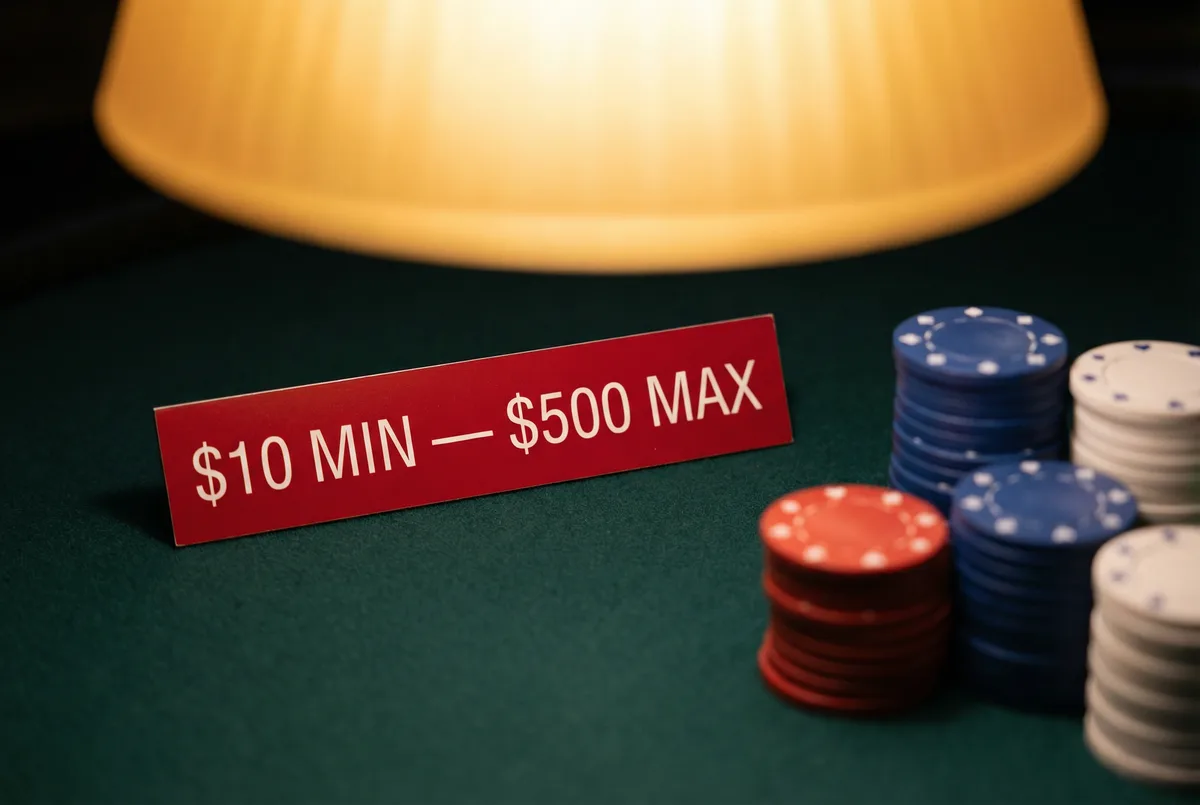
Finding the Best Table Limits for Your Bankroll
Most players lose their entire session budget in under 30 minutes not because the strategy failed, but because they sat at the wrong table. Choosing a table minimum that is too high relative to your bankroll guarantees early bust-out through normal variance alone. Table selection is not optional, it is the first decision you make.
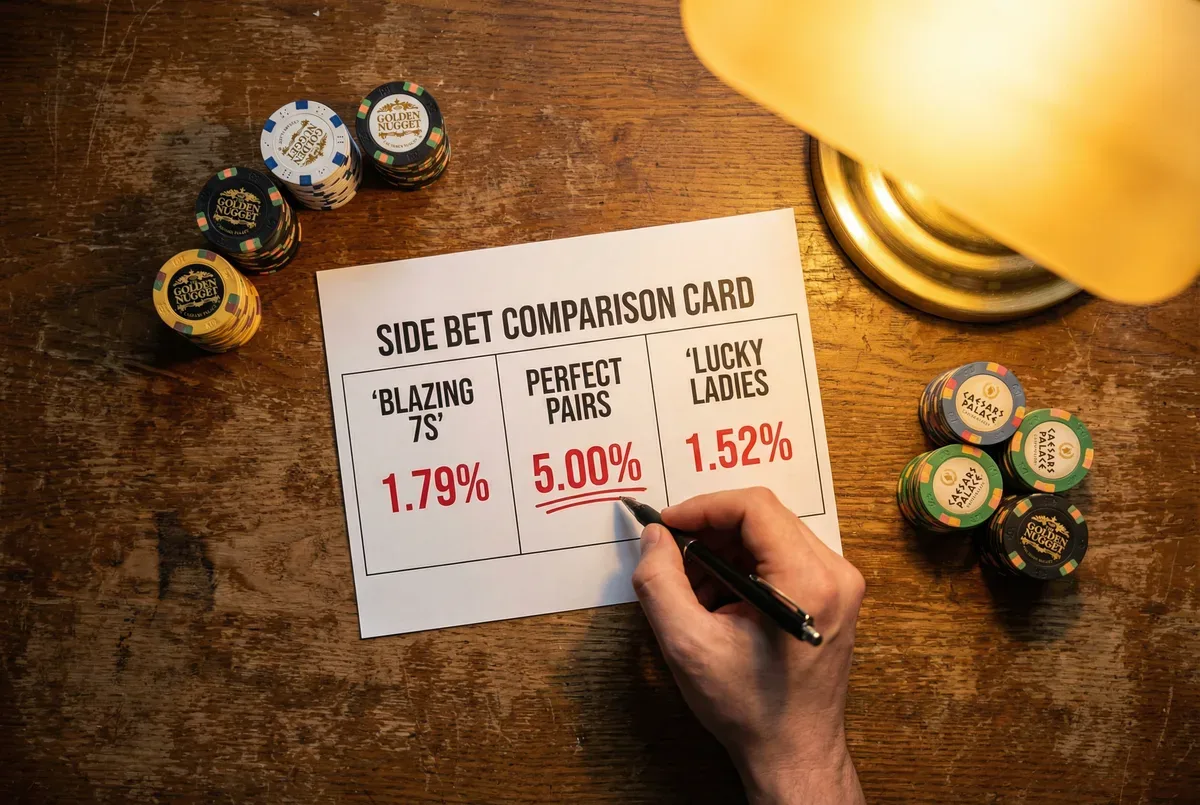
The rule is precise: your session bankroll should be at least 200 times the table minimum you intend to play. That ratio exists for a single reason. It gives you enough units to survive negative swings without going broke before the session has statistical meaning.
200-to-1 Bankroll Rule Explained
Blackjack has a blackjack house edge near 0.5% for a blackjack basic strategy player, but that edge operates over thousands of hands. In any single session of 100 to 200 hands, variance can produce losing runs of 8 to 12 bets in a row. This is normal, not unusual.
If you bring 20 units to a 25-dollar table, one bad run wipes you out. If you bring 200 units, you can absorb multiple losing runs, play through them, and give the statistical edge time to express itself. The 200-unit baseline is the minimum buffer for a meaningful session.
In practical terms: a 200-unit bankroll at a 10-dollar minimum requires 2,000 dollars. If you have 500 dollars, the correct table minimum is 2 dollars or 3 dollars. If your casino’s lowest table is 10 dollars, your 500-dollar session budget creates underbanked risk at that table.
The 200-unit rule applies to your session budget, not your total bankroll. A disciplined player might have a total bankroll of 2,000 dollars but bring only 500 dollars per session, protecting the total roll from single-session ruin.
- $200 budgetmax table minimum $1 (online/free play only)
- $500 budgetmax table minimum $2-3 (hard to find live)
- $1,000 budgetmax table minimum $5
- $2,000 budgetmax table minimum $10
- $5,000 budgetmax table minimum $25
How Does Risk of Ruin Change at Different Bet Sizes?
Risk of ruin (ROR) is the probability of losing your entire session bankroll before winning a target amount or completing a target number of hands. At 100 units, ROR for a blackjack basic strategy player is roughly 40%. At 200 units, it drops to around 13%. At 400 units, it falls below 5%.
These numbers mean that a player with 200 units will go broke in roughly 1 in 8 sessions through variance alone, even playing perfect blackjack basic strategy. Reducing the table minimum relative to bankroll is the only reliable way to reduce that figure without changing the game rules you play under.
Players who double or flat-bet their way through a session at a comfortable unit size see far fewer total busts over a year of play than players who stretch to higher-limit tables for the thrill of bigger swings. ROR is a mathematical reality, not a discipline issue.
Underbanked (50 units)
Properly Banked (200 units)
- ~70%
- 20-40 hands
- Likely bust
- Often impossible
- High
- ~13%
- 80-150 hands
- Comfortably absorbed
- Consistently available
- Manageable
Where to Find Lower Minimum Tables in Casinos?
Lower minimum tables are a function of time of day and casino tier. During off-peak hours, weekday mornings and early afternoons, most casinos open 5-dollar or 10-dollar tables that switch to 25-dollar or higher minimums on Friday and Saturday nights. Arriving earlier in the day gives you access to lower minimums with the same rules.
Smaller regional casinos and riverboats typically maintain lower minimums year-round. Flagship Strip properties in Las Vegas and large urban casinos skew toward 25-dollar and 50-dollar minimums at peak times. If your bankroll suits a 10-dollar minimum, regional properties are often a better fit than premium downtown venues.
Electronic blackjack terminals, also called e-tables, frequently offer 5-dollar or lower minimums alongside better penetration and the same basic rules as the live game. They are a legitimate lower-limit option if the only live tables available have minimums that exceed your bankroll ratio.
Online live dealer tables are the most flexible option for lower minimums. Stakes start at 1 dollar per hand on many platforms, making them the most accessible route to real-card experience at a controlled unit size.
The real-money tables at match your bankroll to the right stake at a live table let you choose your stake carefully. Real funds are at risk on every hand and the blackjack house edge applies at every stake level.
The right table minimum is the one where you can comfortably double down and split without hesitation. If you find yourself skipping a double on 11 vs. a dealer 6 because you cannot afford the extra bet, your minimum is too high. That hesitation is the clearest sign you are underbanked for this table.
Whether Higher Table Limits Mean Better Rules?
Not always. High-limit tables in premium rooms sometimes offer single-deck or double-deck games with 3:2 naturals and liberal doubling rules. That is a genuine improvement over a 6-deck shoe at the main floor. But many high-limit rooms use the same 6-deck shoes and identical rules as the lower-limit floor.
Check the rule placard before assuming a higher minimum buys better conditions. The placard lists number of decks, blackjack payout (3:2 or 6:5), dealer action on soft 17, and doubling restrictions. These rule details determine blackjack house edge, not the table minimum itself.
A 10-dollar table with 3:2 payout and S17 is mathematically superior to a 50-dollar table with 6:5 payout and H17. Minimum stakes are a bankroll decision. Rule quality is a strategy decision. Evaluate both independently when selecting a table.
What to Do When the Table Minimum Exceeds Your Budget
Do not sit down. This is the single clearest decision in table selection. If the posted minimum exceeds your bankroll-to-bet ratio, no amount of strategy or discipline compensates for the mathematical risk of ruin that comes with underbankrolling.
Walk the floor and look for lower-minimum tables. Ask a floor supervisor if any tables will open at lower limits. Check if the casino has an e-table area or a separate low-limit room. Casinos rarely advertise low-limit options, but they exist.
If the entire floor is above your minimum, play a different day. Coming back on a weekday morning when 5-dollar tables are open is a better outcome than burning through a session budget in 20 minutes at a 25-dollar table you should not have sat down at.
Building bankroll discipline takes time, but the compounding effect is significant. A player who consistently finds the right table minimum survives losing sessions, stays in the game longer, and accumulates far more hands of experience than one who regularly outspends their roll chasing a bigger table.
Frequently Asked Questions
Table maximums matter if you plan to spread bets for counting purposes. For basic strategy flat betting, the maximum is irrelevant. What matters is that the minimum is low enough relative to your session bankroll to give you 200 units of cushion.
Yes, if the new minimum pushes you below 100 units of cushion, leave. A mid-session limit increase usually happens when the table fills or during a shift change. You are not obligated to stay at a table whose minimum has moved past your comfort range.
The 200-unit rule applies to online play equally. Online play often has lower variance per unit of time because hands are faster, which actually makes proper bankrolling more important, not less. The same ratio of bankroll to minimum applies regardless of platform.
Before you test these plays at a real table, run them through our free blackjack simulator practice unlimited hands at zero cost until every move becomes automatic.
Table Selection Is a Risk Management Decision
Sitting at the wrong minimum is the most common and most preventable way to end a session early. The 200-unit rule is simple to apply and significantly reduces your session bust-out rate.
Blackjack involves real financial risk on every hand. The house edge applies regardless of session length or strategy quality. Never play with funds you cannot afford to lose.
Learn More
Continue your education with these related lessons.
The 7 Blackjack House Rules That Secretly Change Your Expected Value
S17 vs H17, DAS, RSA, late surrender, number of decks each rule moves the house edge by a measurable number…
Comparison of Spanish 21 vs Classic Blackjack Rules
Spanish 21 looks like blackjack with bonus payouts. But the deck has been modified before a single bonus is added.…

5 Major Differences Between Casino Blackjack Rules and Home Games
Home blackjack and casino blackjack look like the same game. They are not. The dealer rules, the payouts, the deck…