

Exactly Where to Place Your Wagers in the Blackjack Betting Box
Do you know what tripped me up the first time I sat at a blackjack table? It was not the strategy. It was not the math. It was figuring out where to put my chips. The betting box is a small circle or rectangle printed on the felt, one per seat, and every chip you wager must go inside it before the dealer starts the round. 92% of first-time players hesitate at this exact moment, and the dealer has to point to the box. Once you understand the layout, you never think about it again. But those first few seconds of confusion set the tone for your entire session.

What the Betting Box Is and Where to Find It
The betting box is a marked area on the table felt positioned directly in front of each seat. It is typically a circle about 4 inches in diameter, though some tables use a rectangle or a rounded square. The box sits between the player and the dealer, roughly 8 to 12 inches from the table edge. Every standard blackjack table has 5 to 7 betting boxes, one for each playing position.
The box serves a simple purpose: it tells the dealer which wagers belong to which player and confirms that bets are placed before the deal begins. Once cards are in the air, you cannot touch your chips in the betting box. Moving or adding chips after the deal starts is called past posting and it will get you warned or removed from the table. I have seen it happen twice, both times to players who genuinely did not know the rule.
At a multi-hand table, the first player to the left of the dealer owns the primary betting position. If that seat is empty and a second player wants to act on it, they must get permission from the primary bettor if one exists. This matters because some split and double decisions can be made independently by the secondary bettor, which creates friction at busy tables.
The betting box also defines your relationship to the hand. If you have chips in the box, you are in the round. If the box is empty when the dealer starts, you sit out that hand. Some casinos require you to place a minimum bet to hold your seat, even if you want to skip a round. The specific policy varies by casino and by table, so check with the dealer if you plan to sit out.
At tables with multiple betting boxes per seat, you can play more than one hand simultaneously. Each box is treated as a separate hand with a separate wager. Most casinos require you to bet at least the table minimum in each box you use, and some require double the minimum in your second box. Playing two hands increases your exposure to variance but does not change the blackjack house edge on any individual hand.
How to Place Your Chips Correctly to Avoid Delays at the Table?
Stack your chips in a single column with the highest denomination on the bottom and the lowest on top, this is how the dealer reads your bet, and an inverted or scattered stack will be corrected before dealing begins. A $25 green chip goes on the bottom, a $5 red chip goes on top. This is not optional etiquette. It is how the dealer reads your bet. The bottom chip tells them the minimum denomination at a glance. If your stack is inverted or scattered, the dealer will ask you to restack before dealing.
Place the stack in the center of the box, not on the edge. Chips that sit on or outside the line of the betting box create ambiguity about whether they are part of the wager or the player’s general chip stack. The dealer needs a clean read. One stack, centered, highest on the bottom. I do this automatically now, but I remember fumbling with my chips the first few times.
Dealer Shows
Your Hand
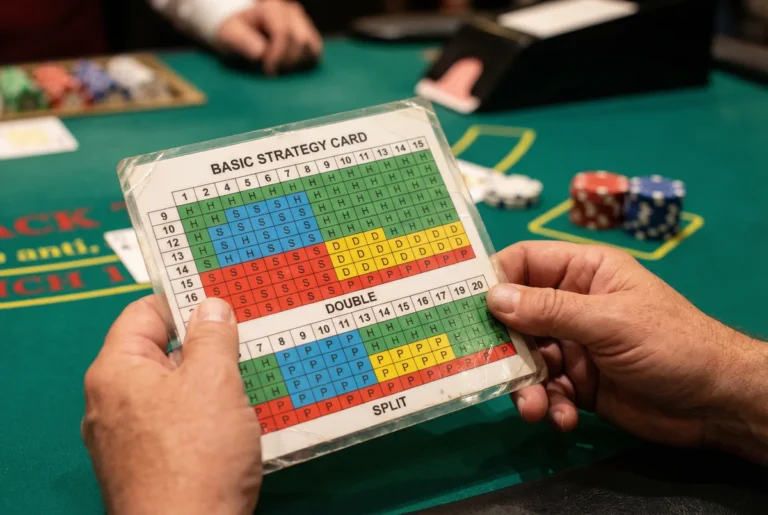
You hold a pair of 5s against a dealer 5. What is the correct play: split, double, or hit?
Knowing the correct play is half of table confidence. The other half is knowing where to put the chips. When you double, both chips go inside the betting box side by side.
When you double down, place the additional chips next to your original bet, not on top of it. The dealer needs to distinguish your original wager from the double. When you split, place a second stack equal to your original bet beside the first, and the dealer separates the cards into two hands. In both cases, the additional chips go inside the same betting box. You never move chips to a different box unless you are playing multiple hands.
Side bets, if the table offers them, have their own smaller marked areas near or overlapping the main betting box. Common side bet positions include a circle for insurance (directly above the main box on the dealer’s side), a marked area for Perfect Pairs, or a 21+3 zone. These are separate wagers with separate odds, and placing chips in a side bet area does not affect your main hand. I avoid side bets entirely because they carry blackjack house edges between 2% and 11%, but knowing where they go prevents accidental placement.
What Are Table Minimums and Maximums?
Every blackjack table posts a minimum and maximum bet on a placard at the table: the minimum is the smallest wager allowed per hand and the maximum is the largest, with both limits applying to each betting box separately. The minimum is the smallest wager you can place in the betting box for any single hand. The maximum is the largest. Standard minimums range from $5 to $25 at most casinos. High-limit rooms may start at $100 or $500.
The minimum applies to each hand separately. If you play two boxes, you must meet the minimum in each one. A $25-minimum table requires $50 total if you play two spots. Some casinos raise the second-box minimum to double the posted amount, so a $25 table becomes $50 per box when you play two hands. Always ask the dealer before spreading to a second box.
- Standard box shapeCircle or rounded rectangle, ~4 inches
- Chip stackingHighest denomination on bottom
- Double down placementNext to original bet, not on top
- Split placementEqual stack beside original, inside same box
- Side bet zonesSeparate marked areas, usually above main box
- Table min/maxPosted on placard or printed on felt
The maximum bet matters less for most recreational players but becomes relevant for card counters spreading their bets. A table with a $25 minimum and $500 maximum gives you a 1-to-20 spread ratio. A table with a $10 minimum and $500 maximum gives you 1-to-50. The wider the spread you can use, the more profit potential a positive count offers. But the maximum also limits your upside on any single hand, which is exactly what the casino intends.
How Do Most Common Betting Box Mistakes New Players Make?
The most common mistake is touching your chips after the deal begins: once the first card leaves the shoe, your bet is locked and cannot be added to, removed, or rearranged. Once the first card leaves the shoe, your bet is locked. You cannot add chips, remove chips, or rearrange your stack. The only time you add chips during a hand is when you double down or split, and those additions follow specific rules the dealer will guide you through.
Another frequent error is placing chips outside the box entirely. I have watched players stack chips on the felt near their drink or behind the box, and the dealer had to clarify whether those chips were a bet or just storage. Keep your playing chips in your rail (the groove at the table edge) and only move chips into the box when you are ready to bet. Clear separation between your bankroll and your wager prevents confusion and keeps the game moving.
Placing a bet that is below the table minimum is a third mistake that dealers catch immediately. If the sign says $25 and you put a single $5 chip in the box, the dealer will point to the placard and wait for you to add chips. This is not a penalty. It is a correction. But it draws attention and slows the table. Check the minimum before you sit down, not after.
Why Bet Placement Matters for Your Game
Correct bet placement is not strategy. It is infrastructure. When your chips are stacked correctly, the dealer reads your bet instantly, deals without delay, and the round moves smoothly. Sloppy placement slows the table, invites dealer questions, and can make you look like a first-timer to the pit boss. None of that affects the math, but it affects your comfort and your ability to focus on the decisions that actually matter.
For card counters, clean bet placement is even more important. Spreading your bet from $25 to $150 needs to look natural. A practiced player slides a neat stack into the box without fumbling. An obvious counter stacks, restacks, hesitates, and draws attention. I practiced chip handling at home before I ever tried a spread at a real table. The mechanics should be invisible so your brain stays on the count.
The betting box is where every hand begins. It is the first thing you interact with at the table and the last thing you think about once you know the rules. Try placing your first wager at a live table and notice how quickly the mechanics become automatic. After 10 hands, you will stack your chips without thinking. After 50, you will wonder why it ever felt confusing. Every chip in the box is real money, so know your session limit before you slide that first stack into the circle.
Frequently Asked Questions
Place your chips inside the betting box, a printed circle or rectangle on the felt directly in front of your seat. Stack them in a single column with the highest denomination chip on the bottom. Center the stack inside the box before the dealer begins the round.
No. Once the dealer starts dealing, your bet is locked. You cannot add, remove, or rearrange chips in the betting box. The only time you add chips during a hand is when doubling down or splitting, and those go next to your original bet, not on top.
The dealer will point to the minimum bet placard and wait for you to add chips to meet the requirement. It is not a penalty, but it delays the round. Always check the posted minimum before sitting down at any table.
Before you test these plays at a real table, run them through our free blackjack simulator practice unlimited hands at zero cost until every move becomes automatic.
Know Your Edge Before You Bet
The calculator shows your exact expected value for every hand combination.
Blackjack Academy is an educational resource. All strategy is based on mathematical expectation. Always play within your means.
Learn More
Continue your education with these related lessons.
Why Blackjack Is a Skill Game, Not Luck
Blackjack's house edge drops to 0.5% with correct play and climbs past 4% without it. That gap is the proof…
Key Differences Between British Pontoon and American Blackjack
British Pontoon and American blackjack share a common ancestor but diverged into distinct games with different rules, terminology, and strategy.…

Why Dealers Must Draw to 16 and Stand on All 17s
The dealer is not a player. They are an algorithm. They must hit any total of 16 or below and…