
Complete Glossary of Blackjack Terms Every Player Should Know
- Core Hand Value Terms Every Blackjack Player Must Know
- What Is Hit, Stand, Double Down, Split, and Surrender?
- What Are First Base, Third Base, Upcard, Hole Card, and Other Table Position Terms?
- What Are Shoe, Penetration, Burn Card, True Count, and Other Counting Terms?
- Taking These Terms from the Page to the Table
Does blackjack vocabulary trip you up at the table? Every term in the game describes something precise: a hand type, a rule, a positional role, or a counting metric. Knowing the language exactly separates players who communicate clearly with dealers and partners from those who guess at meaning mid-hand.
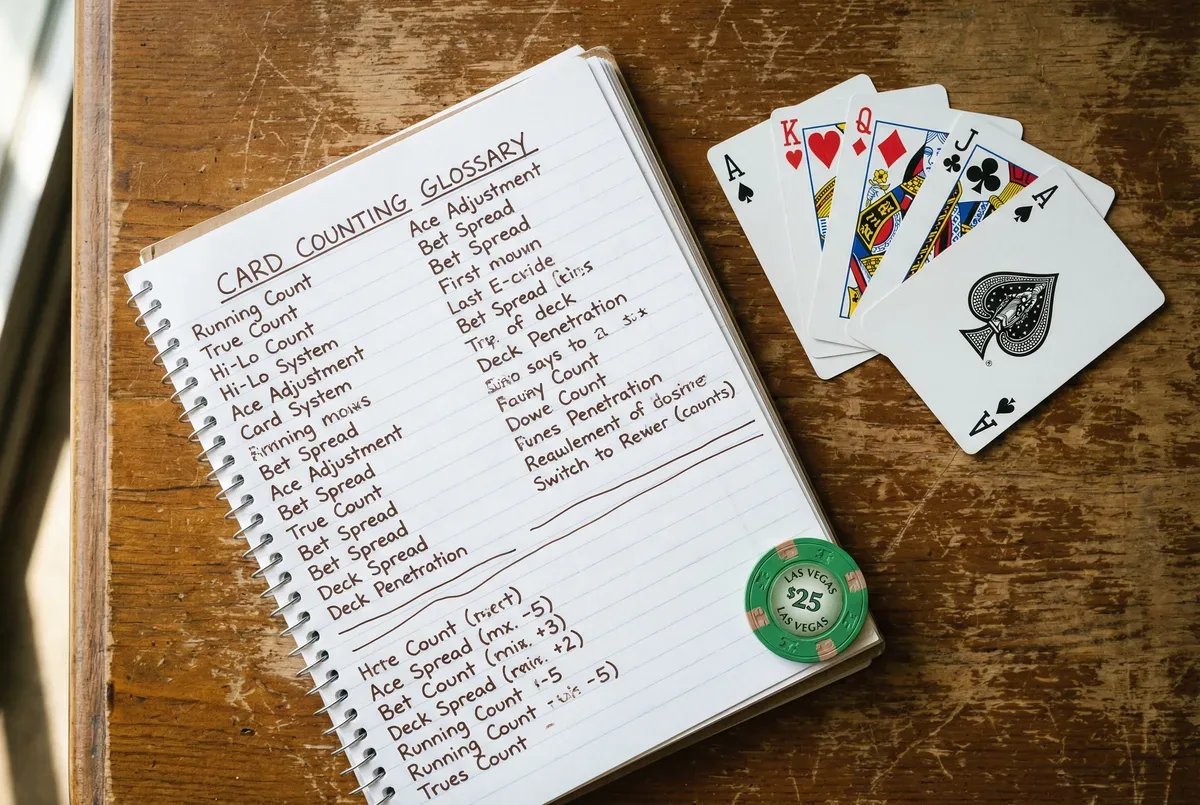
This glossary covers more than 20 essential blackjack terms organized by category. Each definition includes why the term matters strategically, not just what it means literally. Start with hand values if you are new. Jump to the counting section if you are building toward blackjack card counting.
Core Hand Value Terms Every Blackjack Player Must Know
A natural is a two-card hand totaling 21: an ace plus any ten-value card. It pays 3:2 at well-run tables and is the highest-value single outcome in the game. Accepting a 6:5 payout for a natural instead of 3:2 costs the player roughly 0.5% in blackjack house edge on its own.
A hard hand is any hand that does not include an ace counted as 11. Hard 16 means your two or more cards total exactly 16 with no flexible ace. Hard hands constrain your options because exceeding 21 ends your hand immediately.
A soft hand contains an ace counted as 11. Soft 18 means ace plus 7. The ace can drop to 1 if you draw a card that would otherwise bust you. This flexibility makes soft hands play differently from hard totals of the same number. Basic strategy treats soft 18 and hard 18 as entirely different hands.
A bust means exceeding a total of 21. Any hand over 21 loses immediately, regardless of what the dealer holds. A push is a tie between your total and the dealer’s. Pushes return your bet with no gain or loss. Neither counts as a win or a loss in EV calculations but both affect session variance.
- Naturalace + ten-value card = 21, pays 3 to 2
- Hard handno ace counted as 11
- Soft handace counted as 11, can flex to 1
- Busttotal exceeds 21, hand loses immediately
- Pushtie with dealer, bet returned
What Is Hit, Stand, Double Down, Split, and Surrender?
Hit means requesting an additional card from the dealer. Stand means you take no more cards and play your current total. These are the two base decisions every blackjack hand requires. All other actions are extensions of this binary choice.
Double down means doubling your original bet in exchange for exactly one more card. You cannot hit again after doubling. The strategy value of doubling comes from doing it only when your hand and the dealer’s upcard make one card enough to win most of the time.
Split applies when your first two cards are a pair. You divide them into two separate hands, each with its own bet equal to the original. Aces and eights are the most commonly split pairs. Basic strategy has specific rules for every pair combination against every dealer upcard.
Surrender means forfeiting half your bet before drawing any cards. Late surrender (the common type) is available after the dealer checks for a blackjack. Early surrender, which is rare, is available before that check. Surrender is valuable on specific high-risk hands and saves roughly 0.08% in blackjack house edge when used correctly.
Dealer Shows
Your Hand
You hold soft 17 (Ace-6). The dealer shows a 6. You have heard the term soft hand but are not sure what to do with it. What does basic strategy say?
Understanding soft versus hard totals is the foundation of correct doubling and hitting decisions. Soft 17 doubles against a dealer 2 through 6 in standard rules. Hard 17 never doubles, because the ace is no longer flexible.
What Are First Base, Third Base, Upcard, Hole Card, and Other Table Position Terms?
The upcard is the dealer’s face-up card visible to all players before any hand decisions are made. It is the single most important piece of information in blackjack. Every blackjack basic strategy decision is structured around the dealer’s upcard combined with your hand total.
The hole card is the dealer’s face-down card. In standard American-style blackjack, the dealer checks the hole card for a natural before players take action. In European-style games, the hole card is not dealt until all players complete their hands. The difference affects when surrenders and doubles are resolved.
First base is the seat at the far left of the table from the dealer’s perspective, which receives cards first. Third base is the seat at the far right, acting last before the dealer. Neither seat position changes your mathematical edge. The third base myth (that the last player affects card flow) has been thoroughly disproved by simulation.
A pit boss is the casino supervisor overseeing several tables from a central position. They watch for rule violations, unusual bet patterns, and signs of blackjack card counting. Knowing what a pit boss is matters practically: unusual bet spreads draw their attention faster than almost any other behavior at the table.
The upcard is the single input that changes more basic strategy decisions than any other factor. If you are unsure of a play, look at the dealer's upcard first. Most strategy mistakes happen when players focus on their own total and forget what the dealer is showing.
What Are Shoe, Penetration, Burn Card, True Count, and Other Counting Terms?
A shoe is the device that holds multiple decks of cards and dispenses them one at a time to the dealer. Most modern casino blackjack is dealt from a 6-deck or 8-deck shoe. Single-deck and double-deck games are dealt by hand and offer better conditions for counters when penetration is good.
Penetration is the percentage of the shoe dealt before the cut card triggers a reshuffle. A 6-deck shoe with 75% penetration deals roughly 4.5 decks before reshuffling. High penetration is critical for card counters. A shoe cut with only 50% penetration eliminates most of the counting edge by resetting too early.
The burn card is the first card of the new shoe, removed from play face-down before dealing begins. It is a minor randomizing element and is noted by counters who track it. Most blackjack basic strategy players can safely ignore it.
The running count is the cumulative card count maintained by adding and subtracting values as each card is dealt. The true count adjusts the running count for decks remaining. Dividing the running count by decks left produces the true count. This is the operative number for bet sizing and index play decisions.
Wonging, named after Stanford Wong, describes the technique of counting from the sidelines without betting and entering the game only when the count turns positive. Casinos have responded to Wonging by posting mid-shoe entry restrictions at many tables. Where it is still permitted, it is among the most powerful solo advantage techniques available.
Taking These Terms from the Page to the Table
RTP (Return to Player) is the inverse of blackjack house edge. A game with a 0.5% blackjack house edge has a 99.5% RTP. EV (Expected Value) is the calculated dollar value of a decision or session, expressed as positive or negative.
Both terms describe the same mathematical reality in different frames. RTP is the player’s long-run return percentage. EV translates that percentage into absolute dollar terms for a specific bet size and decision. Counters think in EV. Regulators and game designers think in RTP.
Insurance is a side bet offered when the dealer shows an ace. It pays 2:1 if the dealer holds a natural. The blackjack house edge on insurance is approximately 7.7% in a 6-deck game. Basic strategy players should always decline it.
Counters take insurance only at very high true counts, where the remaining shoe is loaded with tens. At a true count of +3 or higher, the math shifts in favor of taking it. At neutral or negative counts, insurance is a bad bet at any bankroll level.
These terms form the working vocabulary for everything else in advantage play. The fastest way to test your command of them is at a live game where pacing is fast and every decision counts.
A live dealer table puts every term in this glossary into immediate context. Real money is on the line from hand one, so set a hard session budget before you sit and treat it as an absolute ceiling.
Frequently Asked Questions
A hard hand contains no ace, or contains an ace that can only count as 1 without busting. A soft hand contains an ace that currently counts as 11. Soft hands cannot bust on the next card, which changes the correct strategy significantly soft hands are generally played more aggressively.
Penetration is the percentage of cards dealt before the shoe is reshuffled. A 6-deck shoe dealt to 75% penetration means 4.5 decks are seen before reshuffling. Higher penetration is better for counters more cards dealt means more accurate true count calculations and more hands played at high positive counts.
The running count is the raw sum of all card tags seen since the last shuffle. The true count adjusts the running count by dividing by the number of decks remaining. True count normalizes the count signal across different deck depths and is used for all betting and strategy decisions in multi-deck counting.
Before you test these plays at a real table, run them through our free blackjack simulator practice unlimited hands at zero cost until every move becomes automatic.
Vocabulary Is the Entry Point. Strategy Is What Pays.
Knowing every term in this glossary is step one. Applying them correctly under pressure at a real table is the skill that translates to mathematical edge.
Blackjack Academy is an educational resource. All strategy content is based on mathematical expectation. Play within your means and set session limits before you begin.
Learn More
Continue your education with these related lessons.
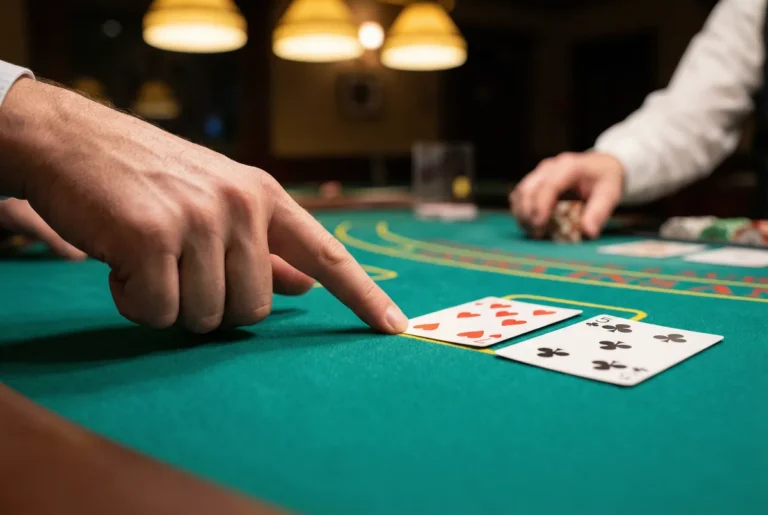
Master Every Official Blackjack Hand Signal for Hitting and Standing
Every blackjack table requires hand signals. Verbal requests alone are not enough. The casino needs a visual record for its…
What Happens When You Bust in Blackjack and How to Avoid It
A bust ends your hand immediately and forfeits your bet even if the dealer busts afterward. Understanding which hands bust…
How to Overcome Anxiety the First Time You Play Blackjack
Every first-time blackjack player feels it. The dealer moves fast, other players seem to know exactly what to do, and…