
Best Times to Split Pairs in Blackjack to Double Your Profit
Most players hesitate before splitting pairs because the move feels like doubling their risk. That instinct is correct for some pairs and completely wrong for others. Splitting pairs in blackjack is not a gamble when applied correctly. It is a calculated play that reduces the blackjack house edge on the hands where the math supports it.
Splitting Pairs in Blackjack: The Mathematical Case for Creating Two Hands
The correct pairs to split are determined entirely by your two cards and the dealer’s upcard. Nothing else. A player who splits every pair indiscriminately makes errors just as costly as the player who never splits at all. The blackjack strategy chart has exact answers for every combination.
- Always splitAces and 8s (no exceptions)
- Never split10s, face cards, or 5s
- Situational splits2s, 3s, 4s, 6s, 7s, 9s (depends on dealer upcard)
- Splitting requiresequal second bet placed on the new hand
- Doubling after split (DAS)check the table rules before sitting
What Is the Pairs to Always Split in Blackjack?
Aces and 8s are the only two pairs that blackjack basic strategy requires you to split against every dealer upcard. These are unconditional splits, applied regardless of what the dealer shows, regardless of table conditions, regardless of prior results.
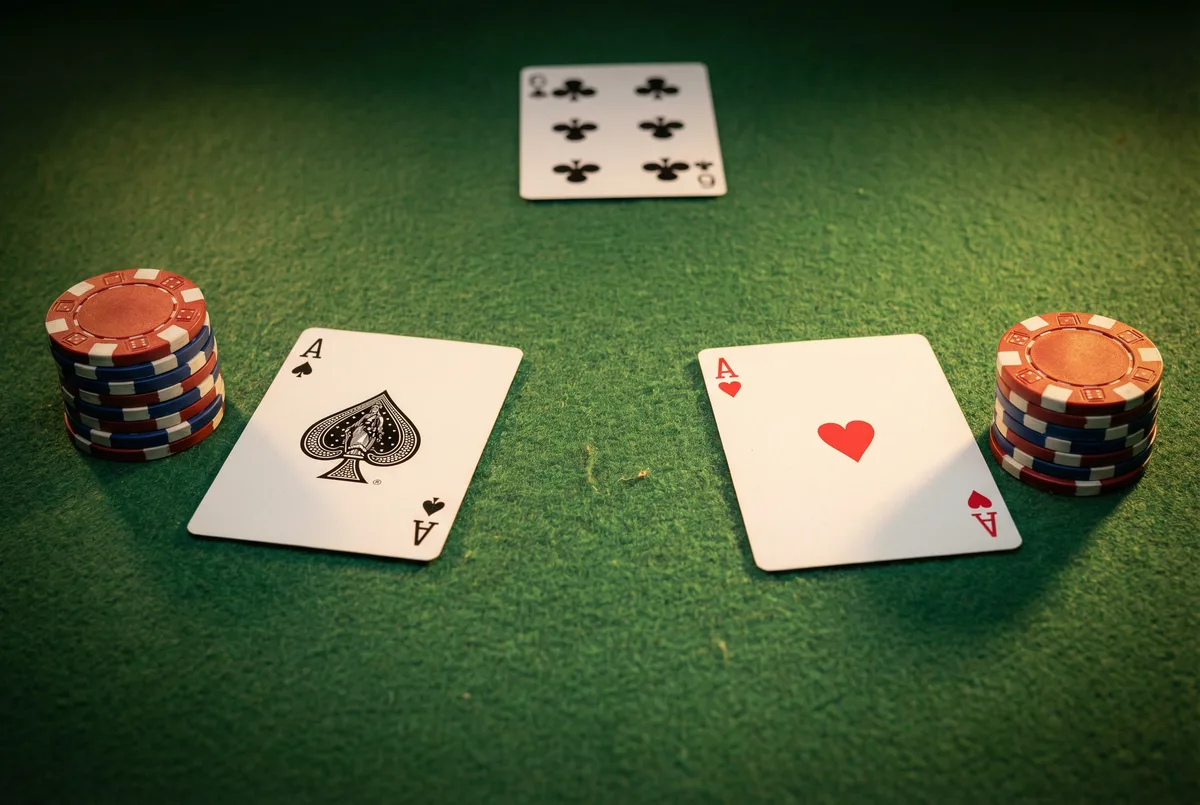
Aces are split because a pair of aces totals either 2 or 12: both weak starting hands. Splitting creates two hands each starting with the strongest card in the deck. Each ace has a 30.8% chance of pairing with a 10-value card, turning one weak total into two potential 21-value hands.
8s are split because a hard 16 is the worst hand in blackjack. Standing on 16 loses more often than any other total. Hitting 16 busts at a high rate. Splitting converts one guaranteed weak hand into two starting positions of 8, each with a 30.8% chance of reaching 18.
What Is the Pairs to Never Split in Blackjack?
Three pairs should never be split: 10s or face cards, 5s, and 4s in most configurations. These are hands where the combined total is already strong, and splitting converts a winning position into two weaker starting hands.
A pair of 10s totals 20. Standing on 20 wins the vast majority of hands. Splitting 10s produces two hands each starting with a 10-value card, a good starting point, but worse than the 20 you already hold. No edge justifies trading a near-guaranteed win for two uncertain outcomes.
A pair of 5s totals 10, which is one of the best doubling hands in the game. Doubling on 10 against a dealer 2 through 9 is the correct play. Splitting 5s converts one excellent doubling opportunity into two hands starting at 5: mediocre starting positions that lose the doubling edge entirely.
Split
Do Not Split
- Always split
- Always split
- Never split
- Never split
- Only with DAS vs dealer 5 or 6
- Never stand on A,A
- Never keep hard 16
- Always stand on 20
- Double on 10 instead
- Otherwise hit
How Does the Dealer’s Upcard Change Your Pair Splitting Decision?
For situational pairs (2s, 3s, 6s, 7s, 9s), the dealer’s upcard is the determining factor. The general pattern is to split low pairs against dealer bust cards (2 through 6) and to hold against dealer strong cards (7 through ace).
A pair of 9s totaling 18 requires a precise decision. Against dealer 2 through 6 and dealer 8 or 9, splitting 9s is correct. Against dealer 7, 10, or ace, standing on 18 is correct.
The 9 vs. dealer 7 stand is counterintuitive: the dealer likely holds 17, and your 18 beats it. Splitting introduces uncertainty where you already have the advantage.
2s and 3s are split against dealer 2 through 7 when DAS (doubling after split) is available. Without DAS, the split range narrows to dealer 4 through 7. The difference is meaningful across a session because 2s and 3s appear frequently and the DAS rule affects dozens of hands per shoe.
Dealer Shows
Your Hand
You hold a pair of Aces vs dealer 8. What is always the correct play in every casino, every rule set?
Aces are the only pair where the rule is absolute: always split, regardless of dealer upcard, DAS availability, or number of decks. The EV gain over not splitting is significant at every dealer upcard.
Applying the Split Rules Without Hesitation at the Table
Pair splitting hesitation is one of the most visible signals of an uncertain player. The rule for aces and 8s is not a close call. It does not require reading the table or assessing the current session. It is unconditional and applies regardless of context.
For situational pairs, the process is equally mechanical: identify your pair, identify the dealer’s upcard, apply the chart. No table-reading required. The correct decision for 9s vs. dealer 8 is the same whether you have won the last five hands or lost them.
The mechanics are simple: place a second bet equal to your original wager adjacent to the first, signal the split, and wait for the dealer to separate the cards. Each hand is then played independently from left to right.
The fastest way to build confidence on split decisions is through real-stakes reps. Take a seat at a live table for 20 hands with the blackjack strategy chart open and make every split by the book. Real money is in play from the first bet, so set your session budget before the first deal.
Frequently Asked Questions
Aces. Playing A-A as a soft 12 or hard 2 is deeply negative EV. Splitting into two separate hands, each starting with an Ace, is significantly positive. The EV gap between splitting and not splitting Aces is the largest of any pair in standard blackjack.
No. A total of 20 is the second-strongest hand in blackjack. Splitting 10s converts a near-certain winner into two hands that will frequently end in totals lower than 20. The EV loss from splitting 10s is severe regardless of dealer upcard.
Minimally for most pairs, but meaningfully for 2s, 3s, and 7s in marginal situations. In single-deck games, some borderline split decisions shift due to composition effects. In 6 and 8 deck games, standard basic strategy split rules apply without modification.
Before you test these plays at a real table, run them through our free blackjack simulator practice unlimited hands at zero cost until every move becomes automatic.
Know Every Split Before You Sit
The strategy chart removes every guessing decision from pair splitting.
Blackjack Academy is an educational resource. All strategy is based on mathematical expectation. Set a session budget before you play.
Learn More
Continue your education with these related lessons.
How to Beat the Dealer in Blackjack Without Going Over 21
The dealer busts more than 28% of all hands in a standard 6-deck game. That number is the foundation of…

Best Blackjack Books for Learning Professional Strategy
Four books define the canon of serious blackjack strategy. Beat the Dealer started it. Basic Blackjack refined it. Professional Blackjack…
How the Number of Decks in a Shoe Affects Your Winning Odds
Moving from a 6-deck shoe to a single-deck game saves you roughly 0.35% in house edge unless the casino compensates…