

Best Blackjack Books for Learning Professional Strategy
Four books separate players who understand blackjack mathematically from players who approach it by feel. Each one addressed a different gap in the available knowledge at the time of its writing. Together, they form the complete foundational library for anyone who wants to reduce the blackjack house edge to its mathematical floor.
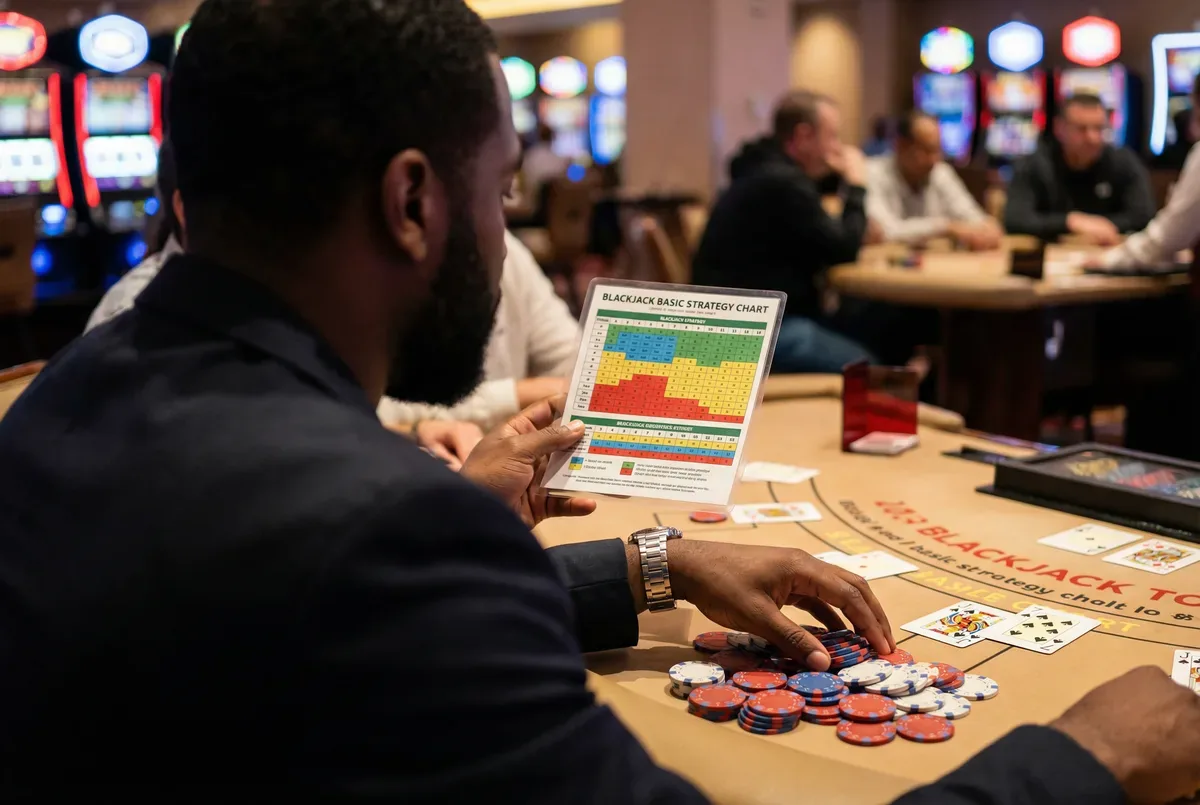
The Four Books That Define Serious Blackjack Study
Reading one of these blackjack books does not make you a professional player. But failing to read any of them guarantees you will pay for knowledge that someone else proved decades ago. The information cost is a few hours. The EV benefit is permanent.
- Beat the Dealer (Thorp, 1962)first proof that counting beats the house
- Basic Blackjack (Wong, 1994)definitive basic strategy reference by rules variation
- Professional Blackjack (Wong, 1975)complete Hi-Lo counting system with indices
- Blackbelt in Blackjack (Snyder, 1983)camouflage, team play, and practical application
- Bringing Down the House (Mezrich, 2002)MIT team story, narrative not technical
- Theory of Blackjack (Griffin, 1979)advanced math, for serious students only
Why Beat the Dealer Is the Most Important Blackjack Book Ever Written?
Beat the Dealer by Edward Thorp (1962) is the book that proved the house could be beaten. Thorp, a mathematics professor at MIT, used an IBM 704 computer to simulate millions of blackjack hands and demonstrate that a player tracking the ratio of high to low cards holds a statistical edge over the house.
The first edition introduced the Ten Count, Thorp’s original counting system. The 1966 revised edition added the Point Count, which is the conceptual ancestor of the modern Hi-Lo system. Beat the Dealer sold 700,000 copies and is credited with forcing casinos to change their rules in 1964, before quickly reversing those changes when handle collapsed.
The book is not a modern strategy guide. Some of its specific counting recommendations have been superseded by more efficient systems. Its value today is foundational: it explains why counting works, why the game is beatable, and how the mathematics of card removal creates predictable advantages. Every subsequent serious blackjack text builds on Thorp’s proof.
What Are the Essential Stanford Wong Books for Serious Players?
Stanford Wong wrote two essential texts. Professional Blackjack (1975, updated multiple times) contains the complete Hi-Lo counting system, including the strategy indices (deviations from blackjack basic strategy based on the running count) that Wong called the Illustrious 18. This book established the Hi-Lo as the industry standard for professional counting.
Basic Blackjack (1994) is the definitive rules-variation reference. It contains complete blackjack basic strategy tables for dozens of rule combinations: 1 deck vs 6 decks, H17 vs S17, with and without DAS, with various surrender rules. Players who want the exactly correct strategy for the specific game in front of them use Basic Blackjack as the source.
Wong also coined the term “Wonging” for the practice of back-counting and entering a shoe only when the count is favorable. His writing across both books covers theory, practical application, and the operational reality of playing professionally against modern casino countermeasures.
Dealer Shows
Your Hand
Stanford Wong uses this hand as a teaching example in Professional Blackjack. You hold soft 18 against a dealer 10. What does basic strategy say?
Reading strategy texts deepens your understanding of why the chart says what it says. Wong, Thorp, and Snyder all explain the EV calculations behind decisions like this one, which is why reading beyond the chart accelerates mastery.
What Are Blackbelt in Blackjack and What It Teaches?
Blackbelt in Blackjack by Arnold Snyder (first edition 1983, updated multiple times) shifted the focus from pure mathematics to practical application. Snyder covered shuffle tracking, team play structures, casino camouflage techniques, and the mental game required for sustained professional play.
Snyder introduced the Red Seven Count, an unbalanced counting system designed for players who find the Hi-Lo’s running-to-true-count conversion difficult to execute in fast casino conditions. The Red Seven is less powerful than the Hi-Lo but significantly easier to maintain accurately, making it the preferred entry point for many beginning counters.
Where Thorp proved the theory and Wong built the operational system, Snyder documented the human side of professional play: how to act at the table, how to manage casino heat, and how to construct a team structure that allows multiple advantage players to operate simultaneously without triggering countermeasures.
Beat the Dealer by Edward Thorp is the founding text of modern card counting, but it's not the best first read for strategy players. Thorp writes for a technical audience. If you're building basic strategy fluency before moving to counting, Blackjack Blueprint by Rick Blaine or Professional Blackjack by Stanford Wong are more accessible starting points.
Moving from the Book to the Table
For blackjack basic strategy players, read Beat the Dealer for the conceptual foundation, then use Basic Blackjack to extract the exact strategy for your local game. These two cover everything needed to reduce the blackjack house edge to its mathematical floor without counting.
For players pursuing blackjack card counting, follow those two with Professional Blackjack for the Hi-Lo system and index plays, then Blackbelt in Blackjack for practical application and camouflage. This sequence matches the logical progression: theory, correct play, counting mechanics, live application.
Theory of Blackjack by Peter Griffin is recommended only for players with a serious interest in the underlying combinatorics. It contains the most rigorous mathematical treatment of any blackjack text but is not a practical guide. Read it last, after the four core books are fully absorbed.
The fastest way to make book knowledge tangible is to test it under real conditions. Play a live dealer session after finishing each book and apply what you just studied. Real money creates the pressure that converts theory into instinct. Set a session budget before you sit.
Frequently Asked Questions
Yes. Beat the Dealer remains essential reading because it explains the mathematical foundation that makes all subsequent strategy work. The specific counting system Thorp introduced has been superseded, but the proof that card counting creates a player edge is the basis for every professional system published since.
No. A printed basic strategy card contains all the information needed for correct basic strategy execution. Books become valuable when you want to understand why each decision is correct, learn counting systems, or understand how rule variations change the optimal play.
No. Bringing Down the House by Ben Mezrich is a narrative account of the MIT Blackjack Team, not a strategy guide. It is an entertaining story about advantage play but contains no technical content that would improve a player's decisions at the table. Read it for entertainment after the four technical books.
Before you test these plays at a real table, run them through our free blackjack simulator practice unlimited hands at zero cost until every move becomes automatic.
Build the Knowledge Base Before You Build the Bankroll
Understanding why basic strategy works is what makes you trust it when it's hardest to follow.
Blackjack Academy is an educational resource. All strategy recommendations are based on published mathematical research. Always play within your means.
Learn More
Continue your education with these related lessons.
Major Differences in Skill Between Blackjack and Poker
Most people assume poker requires more skill than blackjack. The reality is more complicated. Both games reward skill at the…
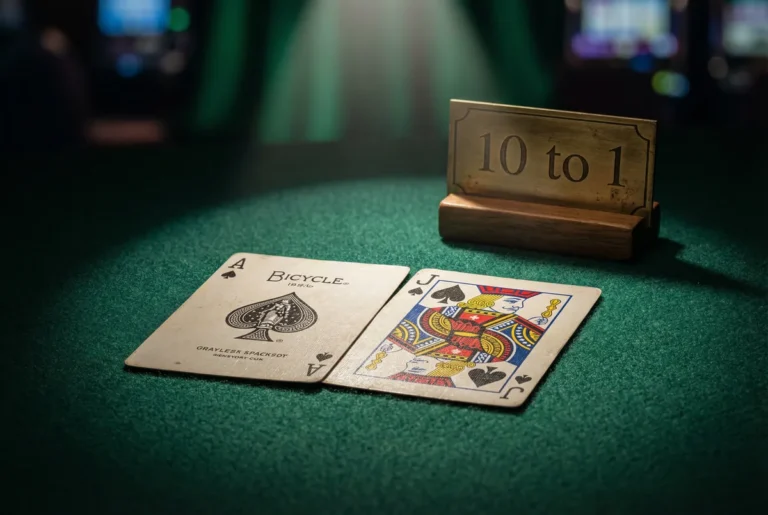
The Truth About the Original Black Jack Bonus Legend
The original black jack bonus paid 10:1 for one specific two-card combination. Modern casinos pay 3:2 for any natural and…
How Casino Shuffles Work and Their Effect on Blackjack Play
Hand shuffles, shuffle machines, cut card placement, and penetration every shuffle decision a casino makes has a direct effect on…