
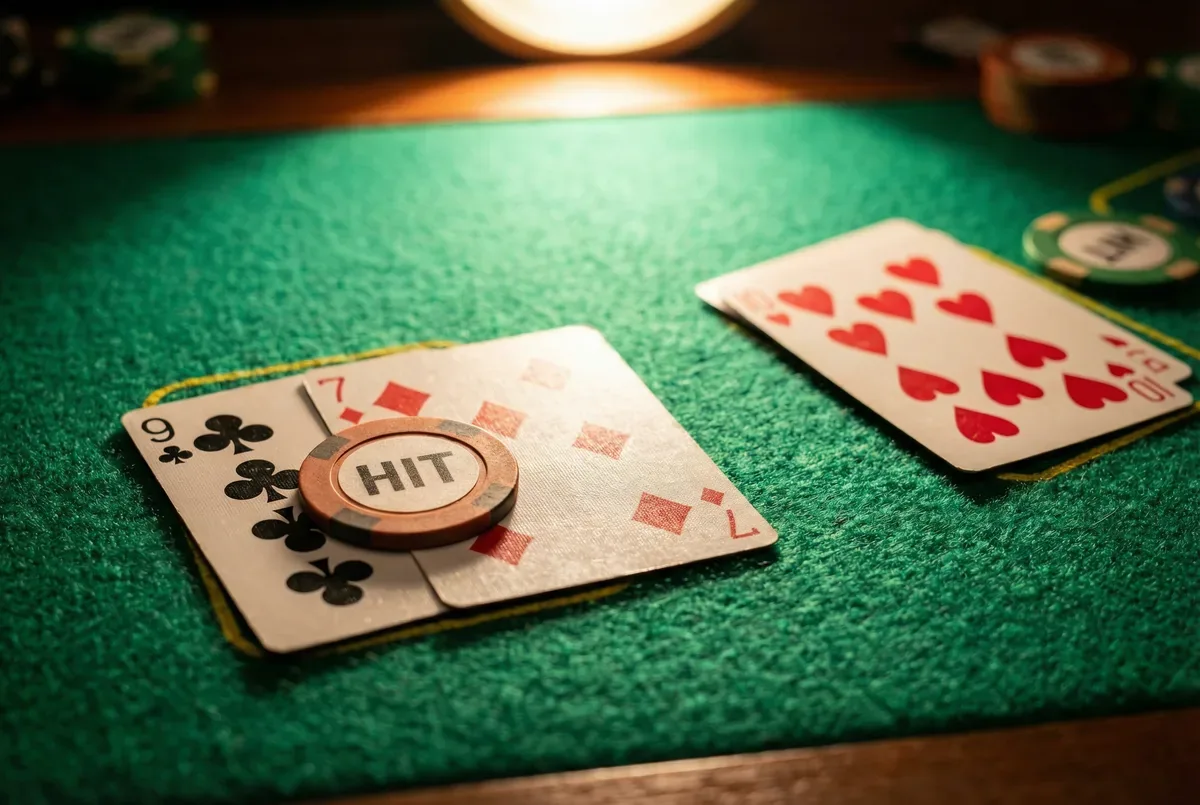
Why You Must Hit 16 Against a 10 Every Single Time
Hard 16 against a dealer showing 10 is the most contested decision in blackjack strategy. Players stand because they fear busting. They reason that the dealer might bust too, so why risk it. This reasoning sounds plausible but it’s mathematically wrong in a way that costs you money across thousands of hands. The expected value of standing on hard 16 against a 10 is approximately -0.54. The expected value of hitting is approximately -0.54 as well but fractionally less negative in most deck configurations. More importantly, in four-deck, six-deck, and eight-deck games, the EV gap favors hitting by a small but consistent margin. In single and double deck games the gap narrows but still favors hitting. The correct play is always to hit.
Hard 16 Against a Dealer 10 Is a Losing Hand Either Way But Hitting Loses Less
Dealer Shows
Your Hand
You hold hard 16. Dealer shows a 10. What is the mathematically correct play?
The dealer has a powerful up-card and will make a standing hand (17-21) roughly 77% of the time. Standing and hoping for a dealer bust is a losing passive strategy. Hitting gives you a chance to improve your total and captures a fractionally better expected value.
What Is the Math Behind the Decision?
When the dealer shows a 10, their most likely full hand (including the hole card) is 20, since any ten-value hole card produces 20. In a six-deck game, approximately 30% of the remaining deck is ten-value cards. That means the dealer starts with a 10 showing and has roughly a 30% chance of holding 20 before taking any additional cards. Add in the probability of drawing to 17 through 21 without busting around 77% and you understand why this is a brutal spot for a 16.
The bust argument is the most common reason players cite for standing. Hit a 16 and you bust with any card 6 through King that’s 23 out of 52 unique card values, or roughly 44% of the deck. So hitting a 16 carries a 44% bust rate. That sounds terrible. But standing with 16 against a dealer 10 means you lose every time the dealer ends between 17 and 21 which is 77% of outcomes. A 44% active bust rate beats a 77% passive loss rate decisively. Hitting is not a reckless play. It’s the lower-loss play.
The composition-dependent exception matters for single-deck games. If your 16 is made of three small cards say 5-6-5 the deck is slightly depleted of low cards, which marginally increases the probability of drawing a ten-value and busting. In single-deck play, this composition shift is enough that some strategy systems call for a stand on this specific hand. In multi-deck games, the composition effect is diluted to the point of irrelevance. Standard blackjack basic strategy always hits 16 against 10 regardless of composition in shoe games.
- Standing EV (6-deck)approximately -0.540
- Hitting EV (6-deck)approximately -0.535
- Correct playHIT (marginal but consistent advantage)
- Bust rate when hitting~44% of draws
- Dealer makes 17-21 from 10 up-card~77% of hands
When Surrender Changes the Answer?
Late surrender, available at some tables, and fundamentally changes this spot. If surrender is offered, surrendering hard 16 against a dealer 10 saves half your bet instead of losing approximately 54 cents per dollar. The surrender EV is -0.50, which beats both hitting (-0.535) and standing (-0.540) in a six-deck game. If your table offers late surrender, always surrender hard 16 against a 10. If no surrender is available, always hit. Standing is never the correct answer on this hand at any competent table configuration.
Advantages
Disadvantages
- Bust rate is approximately 44% on the draw
- Emotionally difficult to pull cards against a 10
- Single-deck exception for specific compositions
Why the Mathematics Never Changes Regardless of Recent History?
Players who rationalize standing on 16 against a 10 often invoke recent outcomes the last three times they hit they bust, so this time they will stand and see if the dealer breaks. The mathematics does not recognize this reasoning. Each hand resets to the same probability distribution. The correct play is not informed by what happened five minutes ago; it is informed by the fixed composition of the remaining deck and the known bust rates. Discipline means executing the correct move every time, independent of session narrative.
Training This Decision Until It’s Automatic
The hard 16 vs 10 decision is a test of discipline under pressure. Every instinct says stand. The math says hit. Drilling this decision in free play until the action is reflexive is the only way to ensure you execute it correctly at the table when money is on the line. At commit to hitting 16 against a 10 at a live dealer game you’ll face this hand in a real live-dealer game and real money consequences make the emotional pressure authentic. Only move to real money play after this decision requires zero conscious deliberation.
Frequently Asked Questions
The correct play is hit in all multi-deck games (4, 6, or 8 deck). In single-deck play, the basic strategy call is still to hit on hard 16 vs 10 except for specific three-card compositions where composition-dependent strategy may call for a stand.
Hit hard 16 against a dealer 9 as well. Surrender if available. The dealer's 9 is the third strongest up-card and the EV logic is similar hitting captures a fractionally better expected value than standing.
Not according to standard basic strategy in any multi-deck game. Some players stand to avoid the embarrassment of busting in front of others, but that social consideration has no mathematical basis and costs real money over time.
Before you test these plays at a real table, run them through our free blackjack simulator practice unlimited hands at zero cost until every move becomes automatic.
Correct Decisions Don't Guarantee Wins
Hitting hard 16 is mathematically right but you will still bust regularly. Correct basic strategy minimizes losses over time it doesn't eliminate variance. Manage your bankroll accordingly.
Blackjack Academy is an educational platform. All gambling involves risk. Play within your financial limits.
Learn More
Continue your education with these related lessons.

How Professional Players Use Simulation Tools to Stay Sharp
Professional blackjack players do not simply play more hands to stay sharp. They use targeted simulation tools to stress-test their…
How the Double After Split Rule Adds Value to Your Game
Double after split (DAS) is a table rule that adds approximately 0.14% to the player's expected value. Understanding which splits…
When Double After Split Makes Splitting 4s Profitable
Splitting 4s is wrong in standard blackjack but add double after split (DAS) and the calculation flips against specific dealer…