
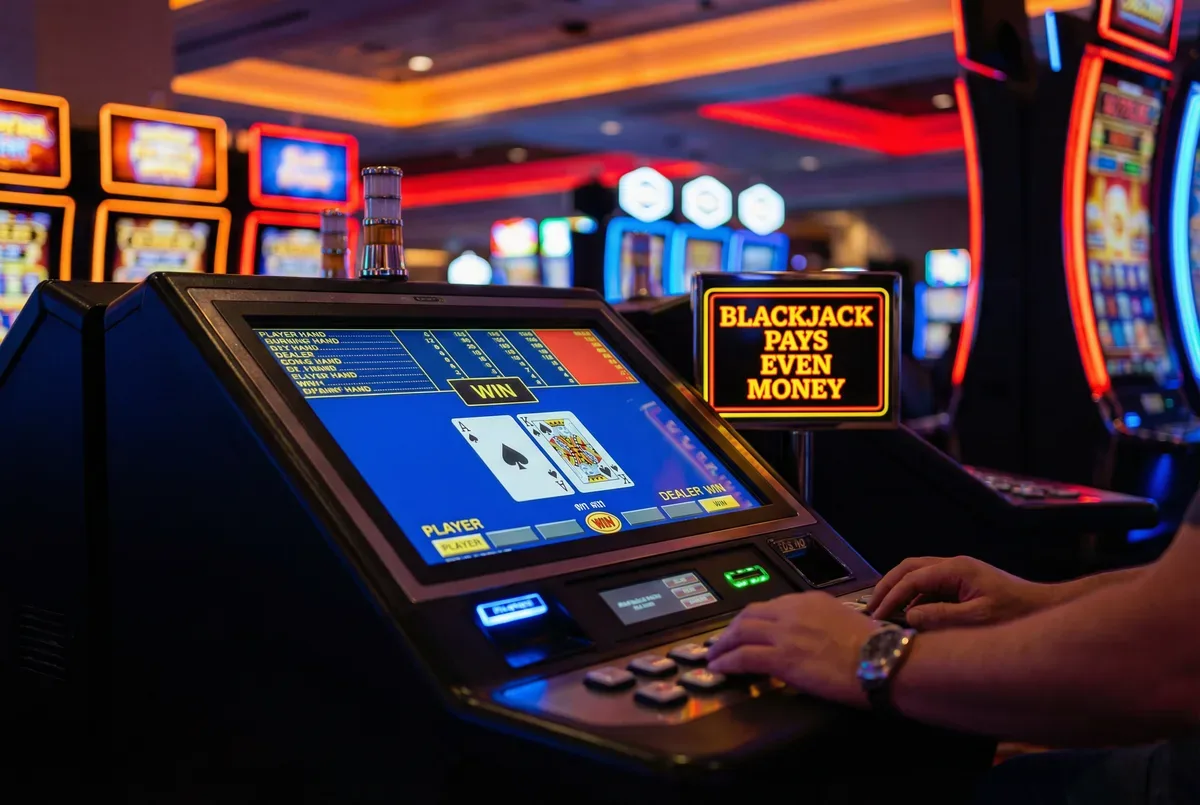
Why Video Blackjack with 1 to 1 Payouts is a Losing Game
A blackjack that pays 1 to 1 instead of 3 to 2 adds exactly 2.27% to the blackjack house edge in a standard six-deck game and that single rule change transforms a game where skilled players can hold the house to under 0.5% into a slot machine with card graphics. Video blackjack machines sitting on casino floors are the most common delivery vehicle for this payout gutting. They look like blackjack, they play like blackjack in most mechanical respects, and they sit next to table games in the same room but the payout schedule makes them fundamentally different. This article breaks down exactly why, and what it costs you per hour to ignore the distinction.
The 1 to 1 Blackjack Payout Is the Worst Rule in the Casino
House edge added by 1:1 BJ payout
%
Why the Blackjack Payout Carries So Much Weight?
Blackjack is the only hand in the game where a player wins more than they bet without any optional action. It occurs roughly once every 21 hands which is where the game got its name. At a 3 to 2 payout, a $10 blackjack returns $15. At 1 to 1 even money, that same hand returns $10. The difference is $5 per occurrence. Multiply that by the frequency and the bet size and you get an annualized drain that surprises most casual players when they see it quantified.
The math is stark: in 1,000 hands at $10 per hand with a natural frequency of 4.75%, you expect approximately 47 blackjacks. At 3 to 2 those earn you $705 in bonus payout. At 1 to 1 they earn $470. That’s $235 extracted from your session purely by the payout rule before accounting for any other strategic variable. Against a video machine running 300 to 400 hands per hour, that gap compounds quickly.
Some video blackjack machines add cosmetic rule concessions to offset the payout cut early surrender, re-splitting Aces, or expanded double opportunities. These concessions are real and do reduce the edge, but they rarely come close to recovering the full 2.27%. If the payout is 1 to 1 and the game is multi-deck, the game is worse than a European no-hole-card table with standard rules. The concessions are marketing.
Common Myth
“Video blackjack machines are basically the same as table blackjack”
They use the same card values, the same dealer rules, and the same table layout, so players assume the core game is identical
The Reality
The 1:1 blackjack payout alone adds 2.27% to the house edge, making most video BJ machines worse than roulette
At a $10 minimum, even-money BJ costs players roughly $50-70 more per hour than a 3:2 table game
What Is Single Deck Video Blackjack?
Single-deck video blackjack is a particularly effective marketing trap. Players know that single-deck games with proper rules are the best blackjack on the floor. Casinos exploit that knowledge by offering single-deck video games that pay 1 to 1 on blackjack. The single-deck advantage roughly 0.48% over a six-deck shoe with identical rules is completely overwhelmed by the 2.27% even-money penalty. The net result is a game worse than a six-deck table with 3 to 2 payouts by close to two full percentage points.
When evaluating any blackjack game, check the payout sign first. If it says 'Blackjack pays 1 to 1' or 'Blackjack pays Even Money', walk away without sitting down. No rule combination in a standard game can compensate for that payout.
What Are the Better Alternatives to Video Blackjack for Serious Players?
Skilled players build systematic routines around this principle. Each decision becomes automatic through deliberate practice, and the sessions where discipline holds produce consistent results over hundreds of hands. The professional edge is not just knowing the rule it is executing it without hesitation under casino conditions.
What to Play Instead When Tables Are Full
If the table games are occupied and you want to play blackjack, the correct alternative is to wait or move to a different casino floor section not to settle for a video machine. Many live dealer online platforms now offer blackjack at real table minimums with full 3 to 2 payouts. If you want to see real card behavior without sitting at a physical table, avoid the video machine and play a live dealer game for real money gives you a genuine live dealer experience but remember that real money is at stake from the moment you join the table, so treat it with the same discipline as a casino floor session.
Frequently Asked Questions
Occasionally. If a video blackjack machine pays 3:2 on blackjack and offers full late surrender with proper multi-deck rules, it can be comparable to a live table. These machines exist but are rare always read the payout schedule before inserting money.
No. Most video blackjack machines use an RNG that shuffles after every hand, which eliminates the deck depletion that makes card counting possible. Even machines that simulate a shoe typically shuffle far more frequently than live games.
A 6:5 payout adds approximately 1.39% to the house edge still devastating, but slightly less than the 2.27% penalty from even-money 1:1 payouts. Both are to be avoided. The correct baseline is 3:2 and anything below it represents a worse game.
Before you test these plays at a real table, run them through our free blackjack simulator practice unlimited hands at zero cost until every move becomes automatic.
Every Hand You Play at Even Money Costs You Extra
A 1:1 blackjack payout is a structural disadvantage you cannot overcome with strategy. The house edge is baked in before the first card is dealt. Only play games that pay 3:2 on blackjack.
Blackjack Academy content is for educational purposes. Always gamble responsibly within your financial limits.
Learn More
Continue your education with these related lessons.
Future of VR Casinos and Virtual Blackjack Technology
Virtual reality casinos are transitioning from novelty demos to playable platforms with real money tables. Here's what the current technology…

Ex Dealer Reveals 5 Ways Casinos Trick You Into Losing
A former casino dealer breaks down the five most effective psychological and structural mechanisms casinos use to erode your bankroll…
Best Move for Your Worst Hand Surrendering 16 vs Ace
Hard 16 against a dealer Ace is the worst hand in blackjack. Surrendering is the correct play and understanding exactly…