

What Professional Blackjack Players Actually Earn
Professional blackjack players earn money through a mathematical edge, not skill in the traditional sense. A competent card counter operating a Hi-Lo system with a 1-to-12 bet spread can achieve an edge of roughly 0.5% to 1.5% over the house depending on game conditions. At a $25 minimum table playing 80 hands per hour with an average bet of $75 (due to spread), the theoretical win rate is approximately $30 to $90 per hour. Real-world results, adjusted for table unavailability, casino restrictions, and travel overhead, typically settle into a range of $25 to $50 per hour for a serious solo counter. The ceiling exists because higher bets trigger scrutiny, and no casino offers unlimited access to favorable conditions.
The Honest Numbers Behind Professional Play
Typical hourly edge for a counter
%
How Bankroll Size Determines Everything?
Hourly rate is inseparable from bankroll size. The Kelly Criterion dictates that optimal bet sizing is a fraction of your total bankroll typically 1% to 2% per unit for blackjack to keep risk of ruin below 5%. A $10,000 bankroll supports maximum bets in the $50 to $100 range. A $50,000 bankroll supports $250 to $500 maximum bets. Because win rate scales with average bet size, the player with $50,000 at risk earns five times as much per hour as the player with $10,000 same skill level, same game, different financial output.
This relationship explains why professional players treat bankroll building as a prerequisite to professional income, not a parallel activity. You cannot earn professional wages from a recreational-sized bankroll. Many aspiring counters plateau at $20 to $30 per hour simply because their capital base does not support larger spreads. The game rewards capital as much as it rewards skill.
$10K Bankroll
$50K Bankroll
- $100
- $500
What Is Variance?
Standard deviation for blackjack runs approximately 1.15 units per hand. For a player betting between $25 and $300 with an average bet of $75, the single-session standard deviation over 500 hands is roughly $1,825. That means even a technically perfect counter can realistically lose $3,000 to $5,000 in a bad day’s work without any error purely from variance. Professional players understand this intellectually but managing it emotionally is a separate challenge. Sessions with significant losses are not evidence of failure; they are expected outcomes that every serious player must be capitalized to absorb.
The question is never whether you will have a 50-unit downswing. You will. The question is whether your bankroll can survive it, your psychology can process it, and your discipline can prevent it from triggering bet-size changes that destroy your edge. Build for 300 units before you call yourself a professional.
Why Does the Real Lifestyle Economic of Professional Play?
Beyond hourly rate, professional players absorb costs that salaried workers do not: travel and accommodation to access favorable games, no employer health benefits, self-employment tax obligations, inconsistent cash flow, and the compounding stress of income tied to variance. A counter earning $40 per hour for 1,200 logged hours per year grosses $48,000 before these expenses. After travel, healthcare, and tax, net income often falls below what a skilled technician earns with far less stress. The players who sustain professional careers long-term typically combine blackjack with other advantage play methods, team structures, or transition into consulting and training as their primary income.
Closing the Gap Between Theory and Sustainable Income
The gap between theoretical win rate and real income is closed by two factors: game selection and volume discipline. Playing only games with 75%+ penetration, S17 rules, and 3:2 payouts adds materially to long-run results. Maintaining consistent bet sizing during both winning and losing sessions prevents the variance spikes that cost players months of edge. If you want to stress-test your own bet-sizing math against live conditions before committing serious money, use this with real money on the table immediately gives you a real-money environment where every decision costs something the cheapest tuition available before scaling to professional stakes.
Frequently Asked Questions
A competent solo counter with a $25,000+ bankroll and access to good games can realistically earn $25–$50 per hour adjusted for downtime, travel, and variance. Theoretical win rates can be higher, but real-world constraints cap sustainable income significantly below peak theoretical figures.
A minimum of 300 units is the standard professional threshold. At a $25 minimum table with a 1:12 spread, that means $7,500 to $10,000. But to earn a living wage, you need a bankroll that supports average bets of $100–$200+, which requires $30,000–$60,000 in dedicated gambling capital.
Yes. Most skilled counters with correct strategy still experience downswings of 50–100 units purely from statistical variance. Without adequate bankroll, these swings force bet reductions or exits from the game. Managing variance psychologically and financially is what separates professional players from skilled amateurs.
Before you test these plays at a real table, run them through our free blackjack simulator practice unlimited hands at zero cost until every move becomes automatic.
Mathematical Risk Warning
Even professional-grade play carries substantial downside risk. A 100-unit downswing is statistically expected over any counter's career. Without a dedicated bankroll of 300+ units and strict Kelly bet sizing, the risk of ruin over a year of play can exceed 40%.
Blackjack Academy is an educational resource. All strategy is based on mathematical expectation. Always play within your means.
Learn More
Continue your education with these related lessons.
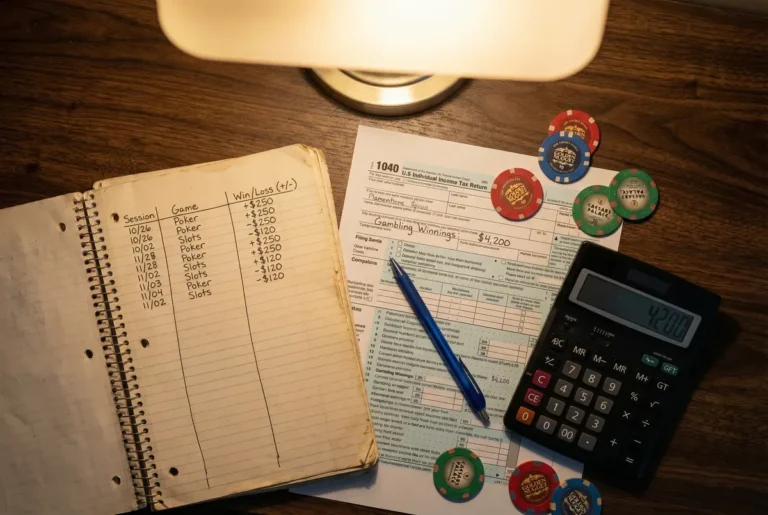
Pro Player’s Essential Guide to Managing Blackjack Taxes on Winnings
Gambling winnings are taxable income in most jurisdictions. Professional blackjack players who ignore this reality face significant legal and financial…

Arnold Snyder’s Proven Math Method for Advanced Shuffle Tracking
Arnold Snyder developed the analytical framework for shuffle tracking a technique that goes beyond card counting to track clumps of…

What Reading Other Players at the Table Reveals About Your True Edge
How other players at the blackjack table actually affect your game the third-base mythology, why their decisions don't change your…