
The Real Truth About Dealer Tells and How Smart Players Read Hole Cards
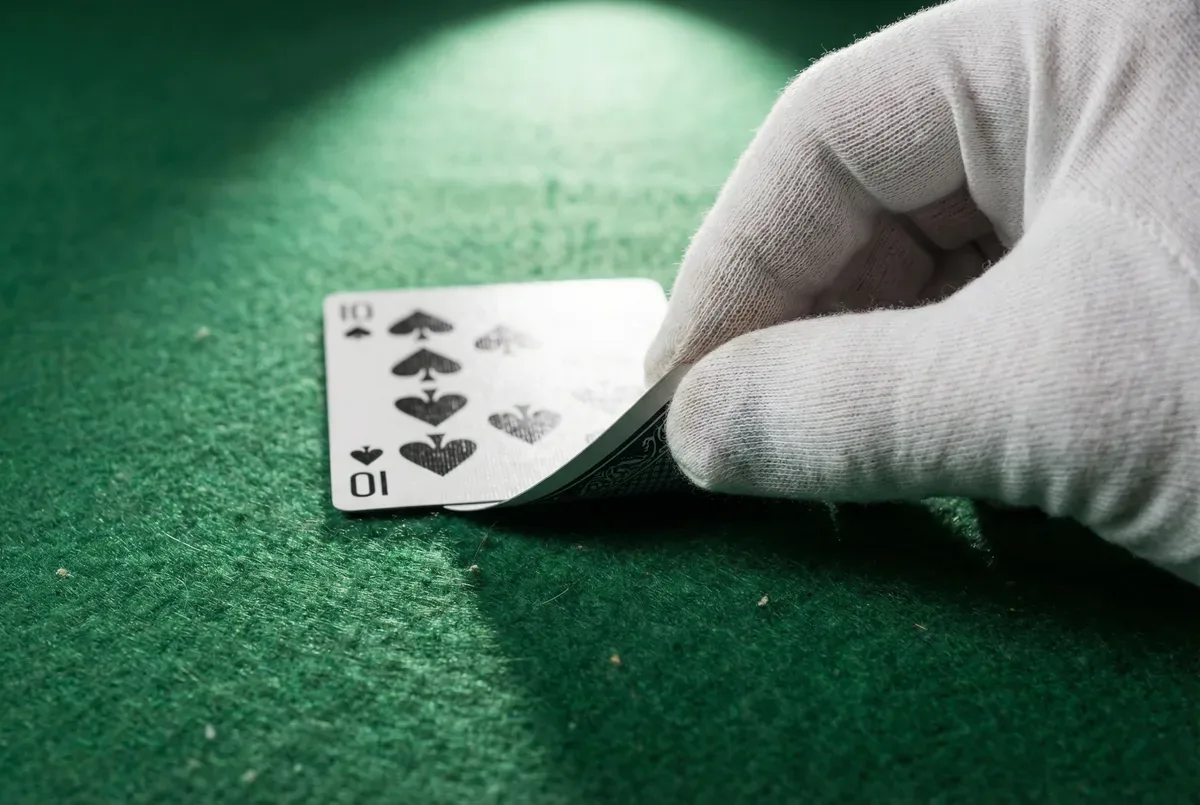
A dealer tell is any observable behavior or mechanical pattern that reveals information about the dealer’s hole card beyond what the rules entitle you to know. Genuine tells are almost always mechanical they arise from the physical act of peeking for a natural blackjack when the upcard is an ace or ten-value card. A dealer who bends the hole card slightly differently when checking a ten versus a low card is producing a tell through habit, not intention. When consistently observable, this gives the player partial information about the hole card’s rank range, which can shift EV on borderline decisions. This is called hole-card play or first-basing (reading the card from the third-base seat angle).
What Dealer Tells Actually Are
- Genuine tellsmechanical peek inconsistencies (rare, disappearing)
- Myth tellsdealer 'feeling', unconscious betting alignment, eye contact
- Tell edge when usable2–13% advantage swing on affected hands
- Casino countermeasurespeek mirrors, training, rotating dealers
- Tell-based play availabilitynear zero in modern trained casinos
Which Tells Are Real and Which Are Myth?
The genuine category of dealer tells is narrow. Physical peek mechanics bending angle, glance duration, finger position can reveal partial rank information to an attentive observer seated at first base or third base with a clear sightline. These are real and have been documented by multiple advantage players. The edge gain on affected hands can reach 10% or more when you know the hole card is a ten versus a small card.
The mythological category is vast. Dealers do not unconsciously change their bet-settlement rhythm based on their hole card. They do not signal through posture, eye contact, or chip handling. Stories about dealers who “feel” good or bad and tip off skilled players are overwhelmingly false. The human nervous system does not leak information through these channels reliably under casino lighting and time pressure. Players who believe they can read dealers through intuition are pattern-matching noise and usually paying for it with their EV.
Common Myth
“Skilled players can read dealer tells through body language and intuition”
Confirmation bias amplifies memorable instances where apparent tells predicted the hole card correctly
The Reality
Reliable tells are mechanical peek inconsistencies only not body language or behavioral patterns
Acting on false tells can cost 1–5% in EV per affected hand by overriding correct basic strategy decisions
Why Reliable Tell-Based Play Is Nearly Impossible Today?
Modern casinos have essentially eliminated traditional peek-based tells through two countermeasures. First, peek mirrors angled reflective devices built into the table layout that allow the dealer to check their hole card without lifting or bending it. The player sees nothing of the peek process. Second, mandatory dealer training specifically addresses physical consistency during the peek. Dealers are trained to perform identical peek mechanics regardless of hole card value. Combined with surveillance systems that review dealer behavior for inconsistency, the era of the exploitable mechanical peek tell has largely ended in professional casino environments.
Advantages
- When genuine tells exist, the edge swing on affected hands can be 10%+
- Hole-card play is legal it requires no deception
- One skilled reader can signal a team for coordinated play
Disadvantages
- Modern peek mirrors eliminate the physical tell almost entirely
- Training and surveillance close remaining mechanical windows
- False-tell chasing costs EV by overriding correct strategy
- Cameras capture sustained angle-watching from fixed positions
Where Tell-Based Play Stands for the Modern Advantage Player?
Tell-based play is worth understanding as part of the complete advantage play landscape, but it cannot anchor a professional strategy in 2026. The practical approach is to maintain basic awareness if something genuinely consistent and mechanical catches your attention over multiple rounds, note it and test it carefully before acting. Never override a clear blackjack basic strategy decision based on a suspected tell without strong confirming evidence across many repetitions. The cost of acting on a false tell is real and immediate. If you want to test how strategy deviations correct or incorrect affect your results over large sample sizes, apply what you have learned at a live table lets you run real-money sessions where the cost of every deviation is instantly visible in your bankroll, no mythology required.
When Tell-Watching Helps and When It Hurts
Applying this knowledge in live play requires consistent execution.
Frequently Asked Questions
Genuine tells are almost exclusively mechanical peek inconsistencies subtle differences in how a dealer bends or angles the hole card when checking for a natural blackjack. These are rare in modern casinos due to peek mirrors and targeted dealer training.
No. Stories about reading dealers through posture, eye contact, or behavioral rhythm are mythology. Confirmation bias makes memorable hits feel systematic. Acting on false tells by overriding basic strategy decisions is an EV-negative behavior.
Peek mirrors built into the table layout allow dealers to check their hole card without any visible physical movement. Combined with standardized dealer training and surveillance review of dealer mechanics, the exploitable tell has been nearly eliminated from professional casino environments.
Before you test these plays at a real table, run them through our free blackjack simulator practice unlimited hands at zero cost until every move becomes automatic.
Mathematical Risk Warning
Attempting to play based on unverified dealer tells by deviating from basic strategy is an EV-negative behavior. Each unsubstantiated strategy override adds to your expected loss. Tells must be verified over large samples before any deviation is justified intuition alone is not sufficient.
Blackjack Academy is an educational resource. All strategy is based on mathematical expectation. Always play within your means.
Learn More
Continue your education with these related lessons.

How to Look and Act Like a Casual Tourist at the Table
Camouflage the art of appearing to be a recreational player while executing professional-level advantage play is a learnable skill that…
Ex Dealer Reveals 5 Ways Casinos Trick You Into Losing
A former casino dealer breaks down the five most effective psychological and structural mechanisms casinos use to erode your bankroll…
Saving Money by Surrendering Hard 15 Against a 10
Surrendering hard 15 against a dealer 10 saves half a bet on a hand you will lose nearly 60% of…