

Master the Psychological Edge That Separates Professional Blackjack Players
The mathematics of advantage play are not complicated. Learn blackjack basic strategy, learn a counting system, apply correct bet spreads, find favorable rules, and the edge is real and documented. Yet the majority of people who learn these skills accurately never generate a sustained profit. The failure point is almost never technical. It is psychological. A counter who deviates from correct play during a losing streak, bets above their bankroll during a hot run, or abandons session limits because they “feel” the shoe turning is not an advantage player they are a gambler who happens to know the count. The gap between knowing the right play and executing it under pressure, in a loud casino, after losing six hands in a row, is where professional players are made.

Why Most Technically Skilled Players Still Lose Long-Term
Advantage players who fail
% cite variance mismanagement
What Is Variance Tolerance?
Standard deviation in blackjack is roughly 1.1 units per hand at flat betting. With a 1-to-12 spread and a realistic 0.8% edge, you will experience losing sessions lasting 15, 20, or even 30 hours of play. These are not statistical anomalies they are expected events built into the math of the game. A professional’s relationship with variance is fundamentally different from a recreational player’s. Professionals do not interpret a losing streak as evidence that their system is broken. They understand it as the natural noise surrounding a positive signal.
Building variance tolerance is not a passive process. The most effective training method is running a detailed session log not to track wins and losses emotionally, but to compare actual results against expected value at the session bankroll level. When you can look at a 15-hour losing run and identify it as a statistical event that your simulation predicted, rather than as a catastrophe requiring a strategy change, you have developed genuine variance tolerance. Without that log, every losing session feels like proof of failure.
The mental model that separates professionals is time horizon. A recreational player evaluates their strategy based on the last session. A professional evaluates it across a minimum of 10,000 hands. Edge does not manifest reliably in 200-hand samples. The variance swamps the signal. Professionals live in long-run thinking and treat short-run outcomes as largely irrelevant data.
Recreational Player
Professional Player
- Last session result
- 10,000+ hand sample
What Is the Decision Discipline Under Pressure?
Tilt in blackjack does not look like poker tilt. It is subtle. It is doubling a 9 against a 7 when you normally would not because you have been losing small. It is taking insurance on a big bet because the dealer has an ace and you cannot afford another loss right now. It is standing on 16 against a 10 because you have been busting all session. Each of these decisions feels logical in the moment because the emotional brain is constructing a narrative around the recent past a past that is statistically irrelevant to the next hand.
The professional countermeasure is a pre-committed decision framework. Before every session, review your blackjack basic strategy deviations for the current count system. Remind yourself of the three or four spots where emotional pressure is most likely to corrupt your play typically insurance, soft doubles, and 16 vs. 10. The decision has already been made before you sit down. Your job at the table is execution, not deliberation.
Dealer Shows
Your Hand
You've lost seven of the last nine hands. The count is neutral. What do you do with 16 vs a dealer 10?
Standing on hard 16 vs a dealer 10 wins approximately 23% of the time. Hitting wins approximately 26%. The correct play is hit. Every time. Session history does not change the cards remaining in the shoe.
What Are Bankroll Psychology and the Ruin Spiral?
The most destructive psychological pattern in advantage play is betting above bankroll to recover losses faster. The logic is emotionally coherent: if I bet bigger, I get back to even sooner. Mathematically, it is a disaster. Risk of ruin increases non-linearly with bet size relative to bankroll. A player with a 1% edge and a 100-unit bankroll betting 1 unit per hand has approximately a 13% risk of ruin. The same player betting 2 units has a 40% risk of ruin. Doubling bet size does not double risk it triples it.
Professionals maintain a hard rule: maximum bet size is always set by bankroll, never by session result. A stop-loss limit typically 20 to 25 units per session provides a mechanical override for the emotional brain. When the stop-loss is hit, the session ends. Not renegotiated, not extended for one more shoe. Ended. The discipline to leave the table when the math says to leave is worth more than any playing skill.
Reinforcing the Mental Game Between Live Sessions
The psychological skills described here degrade without practice exactly as technical skills do. Playing at test the math at a live real-money table immediately under self-imposed session rules with a defined stop-loss and no deviation allowances is one of the few environments where you can stress-test your decision discipline against real variance. Real-money live games involve genuine financial risk; only use them as part of a structured training protocol with funds you can afford to allocate to that purpose.
Frequently Asked Questions
Most experienced advantage players report that variance tolerance and tilt control take 6–12 months of consistent session logging to internalize. Technical accuracy can be reached in weeks. The mental game takes longer because it requires repeated exposure to real losing runs.
Yes. A player with 99% decision accuracy who bets above bankroll during losing runs, ignores stop-loss rules, or deviates during negative variance can still reach ruin. Bet sizing and session discipline account for a substantial portion of long-run results.
Keep a detailed session log from day one. Record hands played, result in units, and any deviations from correct play. The habit of confronting actual data, rather than memory, is the fastest path to variance tolerance and honest self-assessment.
Before you test these plays at a real table, run them through our free blackjack simulator practice unlimited hands at zero cost until every move becomes automatic.
Mathematical Risk Warning
Even with a proven edge, blackjack involves significant short-term variance. Psychological errors overbetting, tilt, and stop-loss violations are the leading cause of bankroll ruin among technically skilled players.
Blackjack Academy is an educational resource. All strategy is based on mathematical expectation. Always play within your means.
Learn More
Continue your education with these related lessons.
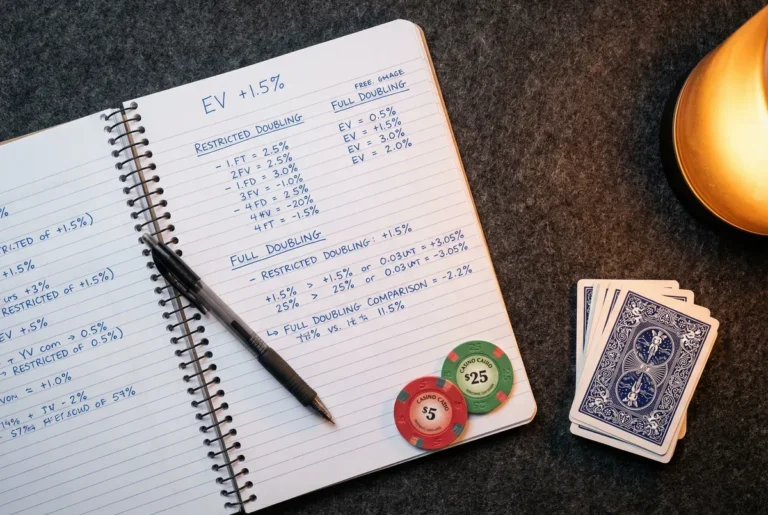
How Restricted Doubling Drains Your Total Return
Games that restrict doubling to totals of 9, 10, and 11 only cost players up to 0.25% in expected return.…
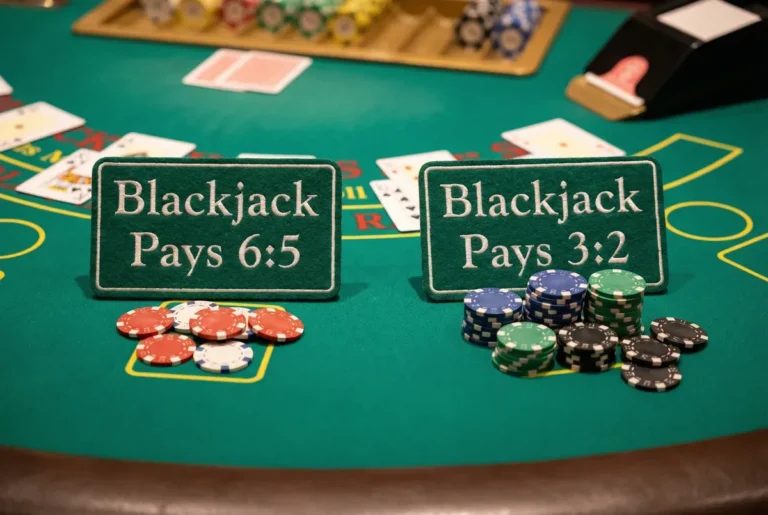
Avoiding 6 to 5 Games and Demanding 3 to 2 Payouts
The 6:5 blackjack payout adds 1.39% to the house edge in a single rule change. It is the single most…

How Ken Uston Popularized Professional Blackjack Teams
Ken Uston took Al Francesco's team blackjack concept and turned it into a global operation transforming the game, winning millions,…