
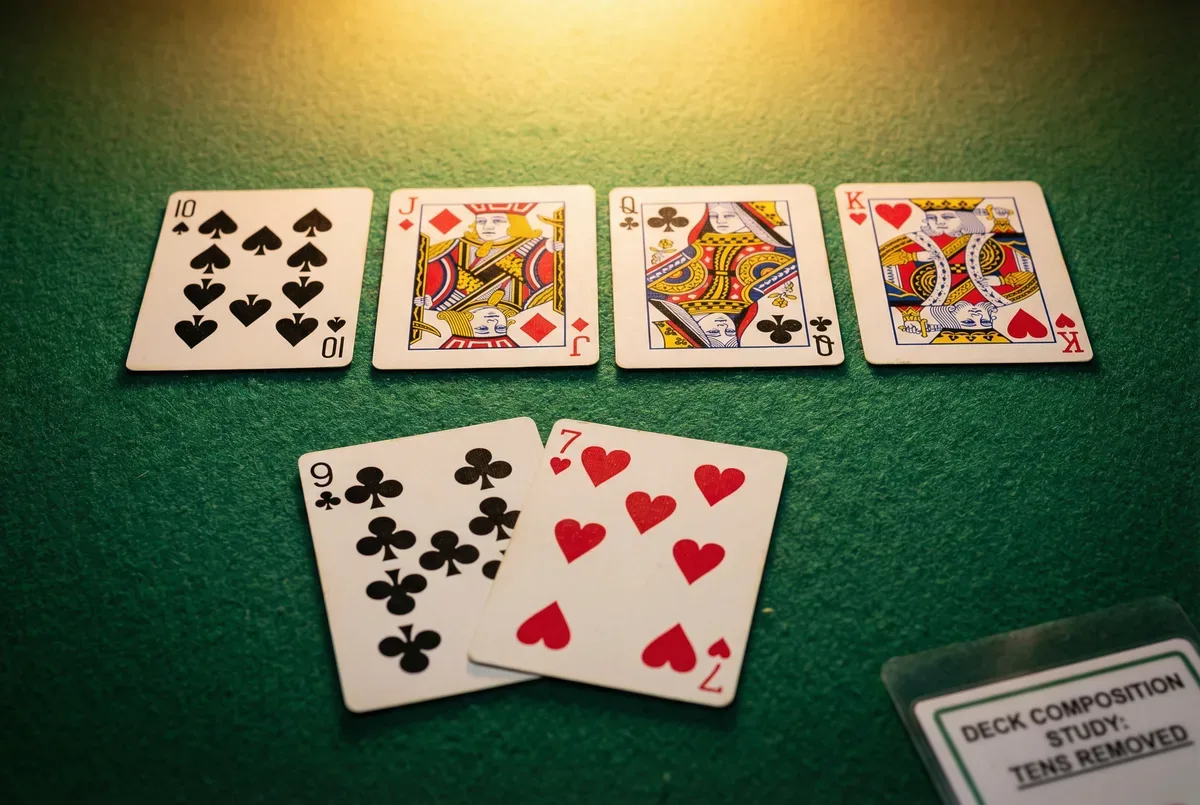
How to Play Strategy When There are No 10s in the Deck
Tens, the 10, Jack, Queen, and King, and make up 30.8% of a standard deck. When those cards are disproportionately absent from the remaining shoe, everything about optimal blackjack strategy shifts. Your double downs become weaker because the tens that would have completed strong two-card totals are gone. Your standing decisions on stiff hands become more aggressive because the dealer is also less likely to bust without tens to create the double-bust traps that standard strategy exploits. Insurance becomes even more clearly wrong than usual. Understanding precisely how strategy changes in a ten-poor deck what card counters call a deeply negative true count is the difference between a player who adapts intelligently and one who mechanically applies a strategy that was calibrated for a balanced deck.
A Ten-Poor Deck Fundamentally Changes Which Plays Are Correct
This is not an academic exercise. Card counters who play negative counts either through poor game selection, team assignments, or waiting for the shoe to recover need to know these adjustments. And any player who has sat at a long shoe where the tens have clearly run out early knows the intuitive sense that something is different. That intuition is correct. The question is how to act on it precisely rather than simply.
In a ten-depleted shoe, you are playing a different mathematical game. The decisions that maximize expected value in a balanced deck do not maximize it when a third of the high cards have already been dealt.
Deck Composition Reality
How a Negative Count Signals Ten Scarcity?
In Hi-Lo counting, tens are assigned a value of -1 (removing them from the running count decreases it when they are dealt). When your running count is significantly negative and a large portion of the shoe remains, the remaining deck is rich in low cards (2-6) and depleted of tens. A true count of -3 or below is the threshold at which strategy adjustments become meaningful enough to affect decisions in measurable ways. Below -4, a substantial number of blackjack basic strategy plays reverse their expected value direction entirely.
The mechanism is straightforward for doubling decisions. You double down on hard 9, 10, and 11 in part because ten-value cards complete those totals into 19, 20, and 21. In a ten-poor shoe, that completion is less likely. The expected value of your double bet drops because you are more frequently completing your hand with small cards, producing hands like 14 or 15 from a doubled 9 totals that frequently lose. At true counts below -3, many of the standard doubling hands that are correct in a balanced deck become hits instead.
Soft doubling decisions are similarly affected. Soft 13 through soft 17 doubles depend on ten-completion to produce strong hands. In a ten-poor deck, these soft doubles generate weaker results more frequently and should often become hits. Conversely, your hard standing decisions tighten: you should hit more stiff hands because the dealer, also lacking tens, is less likely to bust. A dealer showing 4, 5, or 6 in a balanced deck busts roughly 40-42% of the time in a profoundly ten-poor deck, that bust frequency drops significantly, weakening the stand-on-stiff strategy.
- Double 9 vs 2-6shifts toward hit at TC -3 or below
- Double 10 vs Aalways a hit in any significantly negative count
- Double soft 15-17convert to hit at TC -2 and below
- Hard 16 vs 7-10hit becomes more clearly correct (dealer less likely to bust)
- Insuranceeven more wrong than usual fewer tens means even lower probability
What Are the Specific Decisions That Reverse in Deep Negative Counts?
The most important reversal involves pairs. Pair splitting strategy assumes approximately balanced deck composition. In a ten-poor shoe, specific pairs that are normally splits become questionable. Splitting 8s against a dealer 9, 10, or Ace depends on the probability of completing each 8 into a strong hand with fewer tens available, both resulting hands are more likely to complete into weak totals. The split still has strategic merit in most configurations, but the margin narrows considerably, and at extreme negative counts it can approach the value of simply hitting the 16.
Surrender decisions also shift in a ten-poor deck, but in a nuanced direction. Surrendering 15 or 16 against a dealer 10 is generally correct at neutral counts because the dealer’s likelihood of turning 10 into 20 is high. In a ten-poor shoe, the dealer’s ten-in-the-hole probability drops meaning your surrender is giving up 50 cents on the dollar to avoid a loss that is now slightly less likely. Some surrender decisions at moderately negative counts should revert to hits or stands.
Dealer Shows
Your Hand
True count is -4. Six-deck shoe, half remaining. You have 9-9 vs dealer 6. Normally you split. Is this still a split?
Not every decision reverses at negative counts. Some splits remain correct because the underlying dealer vulnerability persists even with fewer tens. The key is knowing which specific decisions flip and which do not which requires studying negative count indices, not applying a blanket rule about all decisions changing.
What Is the Practical Response?
The most powerful response to a ten-poor shoe is not better strategy adjustment it is leaving the table. Stanford Wong popularized the concept of back-counting: watching a shoe until the count becomes favorable before entering play, and leaving (or reducing to table minimum) when the count turns significantly negative. A true count below -2 signals conditions that are materially worse than the house’s base edge. Continuing to play at full bet size when the shoe has gone negative is a choice to donate expected value at an accelerated rate.
The legitimate strategy adjustment question arises when leaving is not practical when you are mid-session, the shoe is running negative, and you are choosing between table minimum bets (to minimize exposure) and implementing the precise adjustments that reduce the damage of playing through bad conditions. In these situations, knowing the key negative-count index deviations lets you at minimum stop making positive-count plays that are now incorrect.
Understanding Composition Before Real Counts Demand It
Recognizing the feel of a ten-depleted deck is a skill that develops through deliberate practice. The live dealer environment at experience this rule variation with real money immediately lets you observe card distribution patterns in a realistic multi-hand format, though as with all real-money live gambling, the financial risks are genuine and every session demands the same discipline you would bring to a casino floor.
Frequently Asked Questions
Basic strategy is optimized for a full, balanced deck. It provides the correct average play across all possible deck compositions, but individual compositions deviate from that average. The index plays used by card counters are the strategy adjustments that become correct as the composition shifts significantly from baseline they cannot be derived from basic strategy alone.
You cannot know precisely without counting. Intuitive assessment 'I haven't seen many face cards recently' is unreliable over the short sample sizes visible in a shoe game. The only reliable tool is a running and true count. If you are not counting, the practical advice is to apply basic strategy consistently and not make ad hoc adjustments based on perceived card patterns.
No. Beginners should master basic strategy, then a solid counting system with positive-count indices, before investing time in negative count adjustments. The negative count situations reduce your expected loss slightly but occur when you should ideally be at table minimum or walking away. The return on learning negative indices is lower than any other skill investment for a developing player.
Before you test these plays at a real table, run them through our free blackjack simulator practice unlimited hands at zero cost until every move becomes automatic.
Deck Composition Mastery Takes Time Build It Systematically
Negative count strategy adjustments are advanced tools that require solid foundational counting skills to deploy correctly. Master the basics before adding this layer.
Strategy adjustments described here are based on probability calculations for standard blackjack configurations. Individual results will vary significantly. All blackjack carries financial risk.
Learn More
Continue your education with these related lessons.
When Double After Split Makes Splitting 4s Profitable
Splitting 4s is wrong in standard blackjack but add double after split (DAS) and the calculation flips against specific dealer…

Master the Art of Table Selection for Maximum Advantage Play Edge
Table selection as a professional skill: S17 vs H17 value, deck penetration scouting, how to leave a table without drama,…
Aggressive Pro Play Doubling Soft 19 Against a 6
Doubling soft 19 against a dealer 6 feels reckless but carries positive expected value in hit-soft-17 games. This is one…