
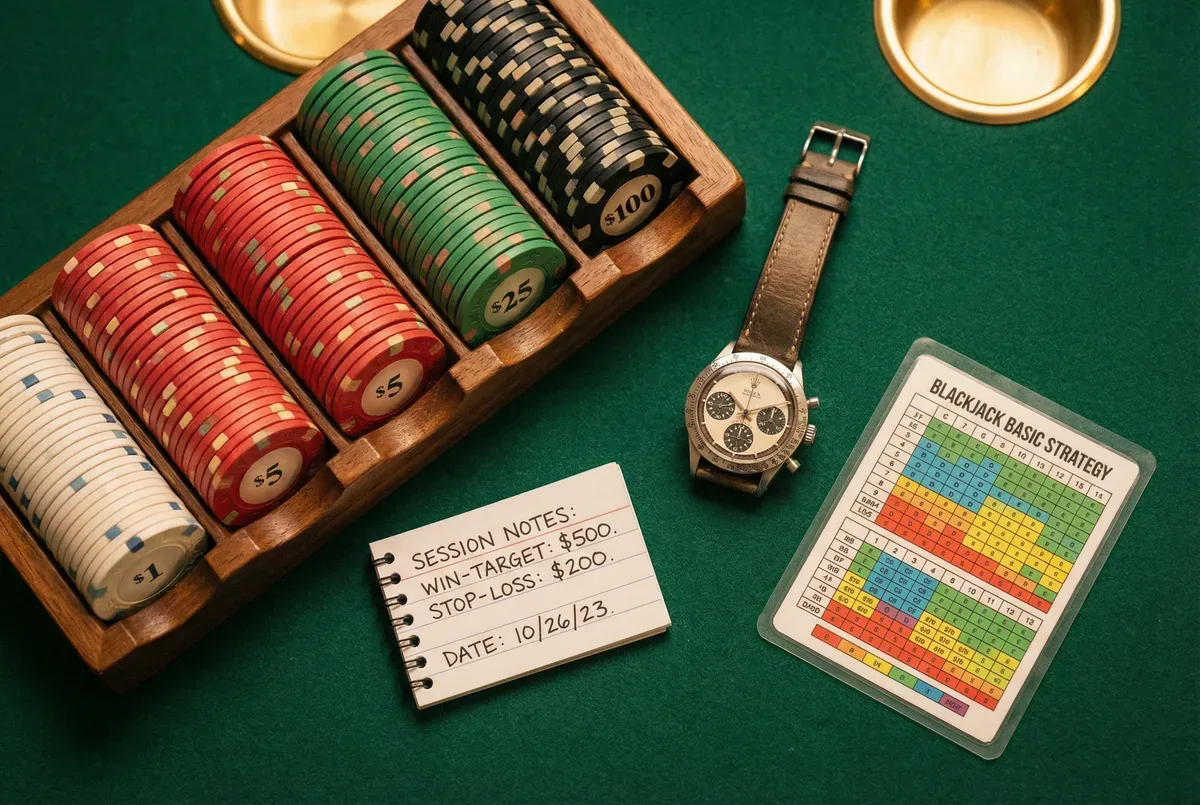
How to Manage a Blackjack Session Like a Professional
Professional session management starts before you enter the casino. A pre-session checklist exists not for superstition but to create a consistent psychological baseline. Physical state matters: fatigue and alcohol are the two biggest drivers of strategy errors in blackjack. A player who slept poorly, drank, or is emotionally activated by outside events enters the session with a measurable cognitive disadvantage. Professionals treat these as no-play signals. The financial cost of playing while impaired, even slightly, and is real and compounding. Beyond physical state, the checklist includes confirming bankroll availability, game rule verification for the target casino, and a clear session stop-loss figure confirmed before the first bet is placed.
The Pre-Session Checklist That Professionals Use
Timeline
Pre-session
Confirm physical state: rested, sober, focused|Game scouting|Verify rules: S17, penetration, 3:2 payout, no side bet pressure|Buy-in|Set stop-loss limit: typically 20–30 units max per session|Mid-session|Run tilt check every 30 minutes or after 3 consecutive losses|Session end|Log results, count accuracy, and any rule deviations observed
How Do You Identify and Responding to Mid-Session Tilt?
Tilt in blackjack is not just an emotional state it is a set of specific measurable behaviors. The professional definition of tilt is any deviation from pre-planned bet sizing or strategy driven by session outcome rather than game conditions. Increasing your bet after a loss to recover classic tilt. Decreasing your bet after a win to protect a lead also tilt. Skipping a correct double-down because you are afraid to commit more money tilt. The common thread is that the decision is driven by the P&L of the session rather than the mathematical expectation of the hand.
The professional mid-session check is a simple binary: am I making every decision based on blackjack basic strategy and count, or am I making decisions based on how the session is going? If the answer is the latter even once, a mandatory 10-minute break is the correct response. Not a lecture, not self-criticism a physical break away from the table that resets the decision loop.
Dealer Shows
Your Hand
You are down 18 units in this session and hold hard 11 against a dealer 6. You feel reluctant to double because you cannot afford another loss. What is the correct play?
The reluctance to double due to session losses is textbook tilt. The correct play is always determined by the mathematical expectation of the hand in isolation not by how the session is going. Skipping this double costs you 0.68 units of EV.
What Is the Post-Session Review Process?
Every professional session ends with a structured review. The review covers four questions: Did I play every hand correctly? Did I maintain my bet spread as planned? Did my count track match plausible true count distributions for this shoe? Did any external events floor attention, table changes, player behavior affect my decisions? This is not about whether you won or lost. A losing session with perfect decisions is a good session. A winning session where you broke discipline three times is a bad one. The post-session review enforces this distinction and prevents the outcome bias that causes most recreational players to mislearn from results.
- Strategy accuracyany deviations from basic strategy?
- Bet disciplineany spread changes driven by session outcome?
- Count trackingplausible distribution for game conditions?
- Physical stateany tilt signals observed and addressed?
- Game qualityrule set, penetration, and table conditions logged
How Do You Treat Every Session Identically: The Core Discipline?
The single most valuable professional skill in session management is psychological symmetry the ability to approach a session identically regardless of yesterday’s result. The professional does not play more aggressively after a winning run to press momentum. They do not play conservatively after a loss to protect their dignity. They execute the same pre-session checklist, the same bet spread, the same decision process, every time. This sounds straightforward and is psychologically very difficult. Variance produces long streaks in both directions that feel causally meaningful. The professional knows the streak will end and the edge will express itself but only if the process remains unchanged. If you want to stress-test your own session discipline with real financial stakes before casino play, apply this at a live professional table under pressure is the closest simulation available real money, real dealer, real decisions that cost you actual cash when your discipline wavers.
The Post-Session Review Process
Applying this knowledge in live play requires consistent execution.
Frequently Asked Questions
Physical state check (rested, sober, mentally clear), game rule verification (S17, 3:2, penetration), bankroll availability confirmation, and a defined stop-loss limit. Playing without a confirmed stop-loss is the most common professional error for newer players.
Tilt is any bet sizing or strategy decision driven by your current session outcome rather than game conditions. If you increase bets after losses, skip doubles because of session fear, or change your spread because you are ahead, you are tilting. The fix is always a physical break.
Outcome in any single session is dominated by variance and tells you almost nothing about your actual skill level or edge. Post-session review measures process quality strategy accuracy, bet discipline, and count consistency which predicts long-run results far better than whether you won or lost tonight.
Before you test these plays at a real table, run them through our free blackjack simulator practice unlimited hands at zero cost until every move becomes automatic.
Mathematical Risk Warning
Even perfectly managed sessions carry substantial variance. A 30-unit stop-loss means a disciplined player can lose $750 at a $25 table in a single session without any error. Professional session management controls process it does not control outcomes. Set limits before every session without exception.
Blackjack Academy is an educational resource. All strategy is based on mathematical expectation. Always play within your means.
Learn More
Continue your education with these related lessons.

Arnold Snyder’s Proven Math Method for Advanced Shuffle Tracking
Arnold Snyder developed the analytical framework for shuffle tracking a technique that goes beyond card counting to track clumps of…
How Common Draw Rules Work in Infinite Blackjack Games
Infinite Blackjack uses a common draw rule that changes how every player at the table receives cards. Understanding this mechanic…

Surviving the Brutal Mental Grind of a Long Blackjack Losing Streak
Losing streaks in blackjack are mathematically inevitable. The difference between players who survive them and players who go broke is…