
How to Beat the Dealer Profitably When Both Cards Are Face Up
Double Exposure Blackjack is the formal name for the variant in which both dealer cards are dealt face up before any player action. The strategic implications appear enormous at first: you know exactly what the dealer is working with before you make a single decision. No more guessing on a dealer 2, no more second-guessing against a dealer ace. The information advantage is real. What most players fail to account for is the set of compensating rule changes that virtually every casino deploys alongside the exposed cards rule changes that are specifically designed to recover the player advantage and then add margin on top. Playing this game without understanding those compensators means giving away more than the information visibility saves.

When Both Dealer Cards Are Visible and What It Actually Means
- Both dealer cards dealt face up before player acts
- Dealer wins all ties except player blackjack
- Blackjack pays even money (11) instead of 3:2
- Player may only split pairs once in most versions
- Dealer hits soft 17 in most Double Exposure games
Why Does the Three Rule That Take Back the Edge?
The information value of seeing both dealer cards is roughly 3.7% in player favor an enormous swing that would make the game trivially beatable if deployed in isolation. Casinos are aware of this arithmetic. The standard compensation package for Double Exposure includes three rule modifications that together recover that 3.7% and deliver a blackjack house edge of approximately 0.7% with optimal play.
The first and most expensive rule change is dealer-wins-ties. In standard blackjack, a push (tie) returns your bet. In Double Exposure, the dealer wins all pushes except when the player holds a natural blackjack. Ties occur on approximately 8% of hands. At those hands, you lose instead of breaking even. That single rule change costs the player approximately 8.5% in edge more than wiping out the information advantage entirely. The game would be a disaster if the information advantage did not exist to partially offset it.
The second compensator is the even-money blackjack payout. Natural blackjacks pay 1:1 instead of 3:2. Since naturals occur approximately once every 21 hands and the 3:2 premium is worth approximately 2.3% in edge, stripping the premium to even money recovers roughly that 2.3% for the house. Combined with dealer-wins-ties, these two rules alone create a blackjack house edge that exceeds the information benefit the game is already in the casino’s favor before any other rule is applied.
The third compensator is split restriction. Most Double Exposure variants restrict re-splitting or limit pairs to one split per hand. The value of liberal splitting in standard blackjack is approximately 0.14% a small number, but meaningful in a game where every fraction of a percent matters for long-run results.
Common Myth
“Seeing both dealer cards in Double Exposure Blackjack gives the player a strong advantage.”
Players correctly identify that knowing both dealer cards is valuable information, but do not account for the compensating rule package.
The Reality
The tie rule alone costs more than the information is worth. With full compensating rules, the house edge is approximately 0.7% worse than a well-rules standard shoe game.
A standard 6-deck 3:2 shoe with S17 and late surrender has approximately 0.28% house edge. Double Exposure at 0.7% costs the player nearly 2.5 times as much per hand.
How Basic Strategy Changes When Both Cards Are Visible?
The strategy adjustments for Double Exposure are substantial because you always have complete information about the dealer’s hand. In standard blackjack, you make decisions based on the probability distribution of dealer hole cards. In Double Exposure, there is no probability distribution you know the dealer’s total. This collapses several strategy regions into deterministic decisions.
Hard totals: when the dealer shows a hard total that cannot reach 21 without hitting (totals of 12 through 16), you always stand if your total exceeds the dealer’s, since the dealer must continue hitting and risks busting. When the dealer shows 17 through 20, you must try to beat that total which means hitting aggressively in situations where standard strategy might suggest standing. The goal in Double Exposure is always to beat the specific dealer hand you can see, not to play against a probability distribution.
Doubling and splitting: because ties lose to the dealer, doubling down becomes riskier in Double Exposure than in standard play. A double down that results in a tie which would return your money in standard blackjack is now a loss. This compresses the optimal doubling range. You should only double when your mathematical edge over the specific dealer hand is substantial, not on marginal two-card totals. The same logic applies to splits: splitting into ties is losing money in this game.
Dealer Shows
Your Hand
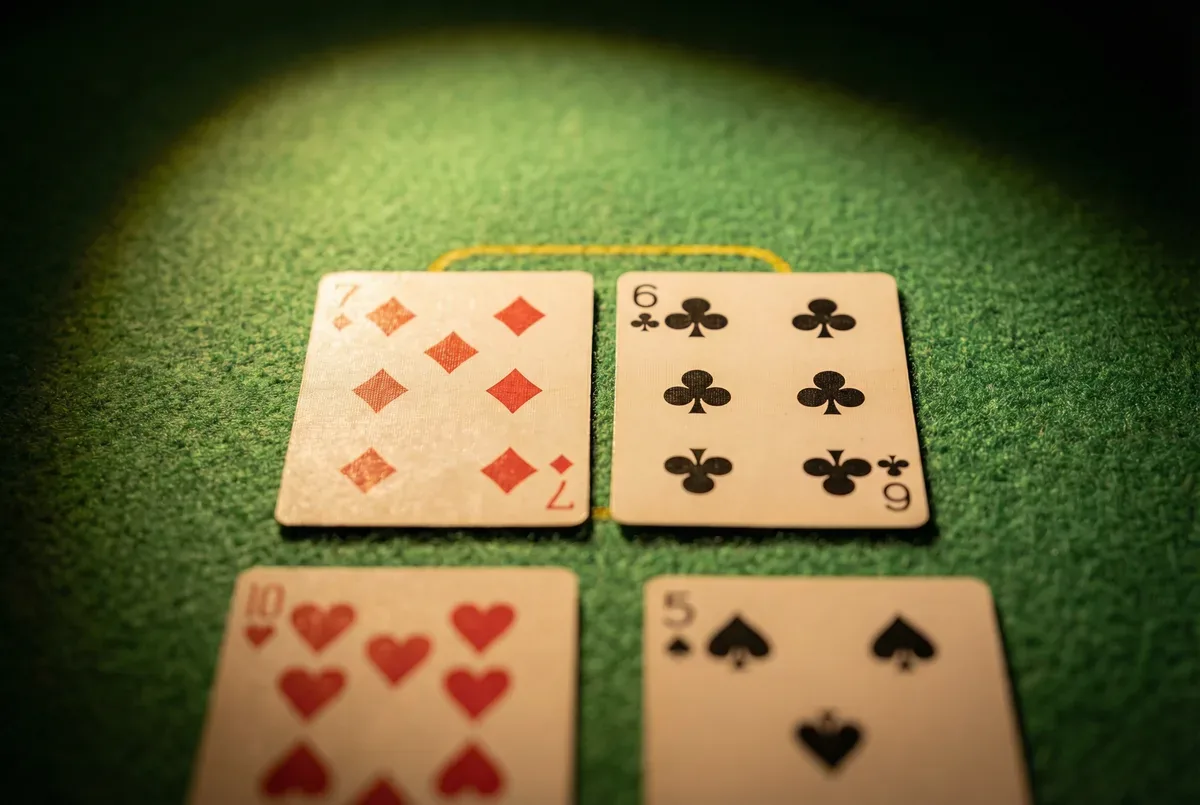
Double Exposure: dealer shows 8-5 (hard 13). You hold 7-5 (hard 12). The dealer must hit. What is the optimal play?
The dealer must hit 13 and can reach 14-17 safely or bust on any 10-value card. Your 12 is weak but standing is correct here because the dealer carries the bust risk and ties lose to the dealer, making aggressive hitting riskier than in standard play.
What Is the Double Exposure Worth Playing?
At approximately 0.7% blackjack house edge under standard conditions, Double Exposure is a worse game mathematically than a well-rules standard shoe. However, some casinos deploy it with rule modifications that improve the player’s position particularly looser splitting rules or the option of late surrender, which can bring the edge closer to 0.4%. If you encounter Double Exposure with genuinely liberal rules, it can be a reasonable game. At typical Strip or online casino deployments, the standard rules make it inferior to seeking out a conventional 3:2 six-deck game.
Build Variant Awareness Before Playing for Real
The strategy adjustments for Double Exposure require real practice before they become automatic. At bring this to a live dealer with real stakes this week you can reinforce the decision habits needed for variant games remember that any real-money live casino environment carries genuine financial exposure, and variant games with unfamiliar rules demand extra preparation before you commit real funds.
Frequently Asked Questions
Ties occur on approximately 8% of hands and each converted from push to loss costs you the full bet. The information advantage from seeing both dealer cards is worth approximately 3.7% in edge substantially less than the 8%+ cost of dealer-wins-ties. The rule package is designed so the house retains the edge.
You already know the dealer's hole card. If the dealer shows ace and any card, and that combination makes blackjack, the hand is already resolved. Insurance as a side bet becomes irrelevant because the information asymmetry that makes insurance a decision in standard blackjack does not exist.
Yes. A Double Exposure-specific basic strategy chart is available from multiple academic sources. The key principles: stand when your total exceeds the dealer's and the dealer must hit, hit aggressively when the dealer shows strong totals, and reduce doubling to high-confidence situations only.
Before you test these plays at a real table, run them through our free blackjack simulator practice unlimited hands at zero cost until every move becomes automatic.
Mathematical Risk Warning
Double Exposure Blackjack's rule compensation package results in a higher house edge than standard games for most players. Variant games require dedicated strategy study before real-money play.
Blackjack Academy is an educational resource. All strategy is based on mathematical expectation. Always play within your means.
Learn More
Continue your education with these related lessons.
The Real History of Casino Surveillance Against Professional Counters
For sixty years, casinos and advantage players have been locked in an escalating arms race. Understanding that history reveals what…
The Deadliest Casino Blackjack Myths That Keep Costing Players Real Money
The most expensive blackjack myths and their actual EV cost: dealer wins ties, third base controls outcomes, hot and cold…
Master the Psychological Edge That Separates Professional Blackjack Players
Technical skill gets you to the table. Psychology keeps you at the table profitably. Professional blackjack players spend as much…