
How Restricted Doubling Drains Your Total Return
- Doubling Only on 9-10-11 Costs Players up to 0.25% of Expected Return
- Which Double Opportunities Are Lost Under Restrictions?
- What Are European Blackjack and the No-Hole-Card Interaction?
- How Do You Select Games Based on Doubling Rule Liberality?
- Evaluating Games Before You Sit and Testing Decisions Live
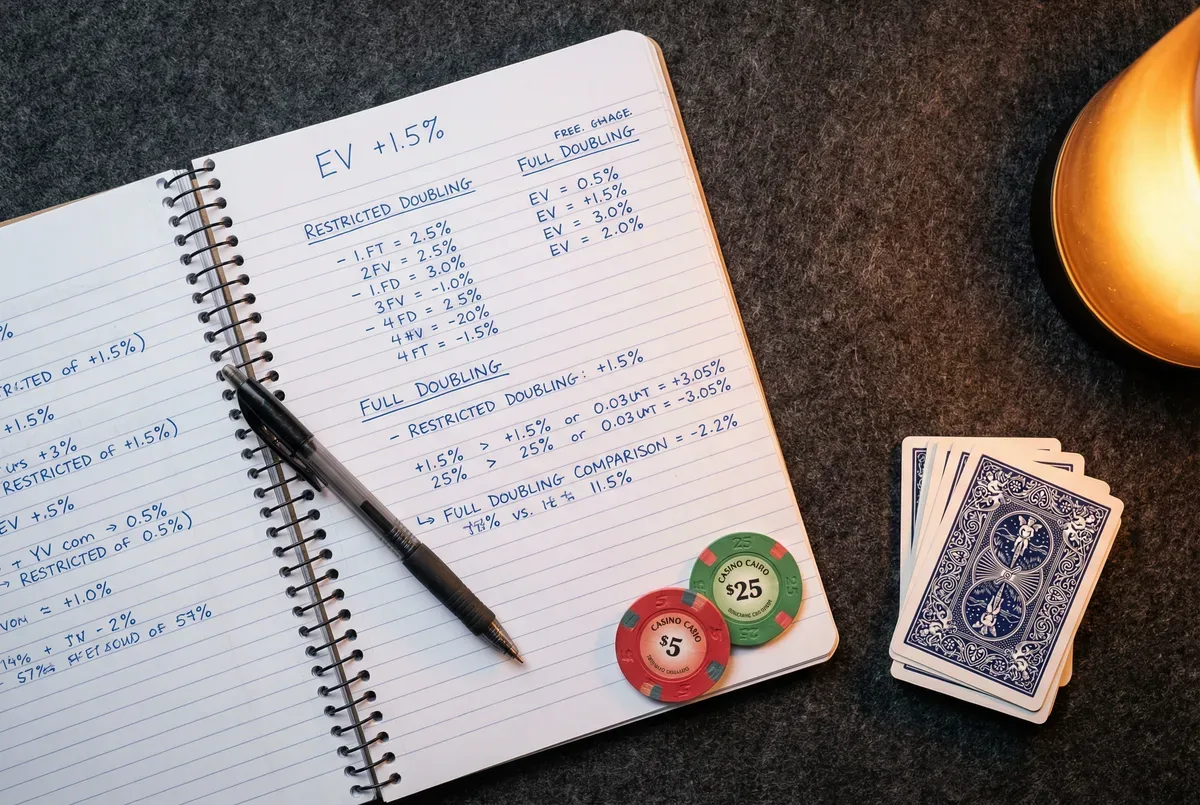
Standard blackjack permits doubling down on any initial two-card total. This means you can double 8 against a dealer 5, or soft 18 against a dealer 3 hands where the math supports investing additional capital because the dealer’s vulnerability makes the extra bet profitable. When a casino restricts doubling to specific totals commonly 9, 10, and 11 only, or 10 and 11 only it cuts off a range of profitable doubling opportunities that collectively cost the player between 0.09% and 0.25% of expected return depending on the specific restriction. These rules appear frequently in European blackjack formats, certain online variants, and some land-based properties attempting to offer single-deck games without giving away too much player edge.
Doubling Only on 9-10-11 Costs Players up to 0.25% of Expected Return
| Restriction Type | Edge Cost | Hands Affected |
|---|---|---|
| Double 10 and 11 only | ||
| ~0.25% | ||
| Soft hands, hard 8 and 9 | ||
| Double 9 through 11 only | ||
| ~0.09% | ||
| Soft hands, hard 8 | ||
| Double any two cards | ||
| 0% (baseline) | ||
| No restrictions | ||
| European no-hole-card | ||
| ~0.11% additional | ||
| Hole card interaction |
Which Double Opportunities Are Lost Under Restrictions?
The most damaging category of doubling restrictions is the elimination of soft doubles. Soft doubles, doubling on hands containing an Ace, and are profitable in many configurations because the Ace eliminates bust risk on the double draw while the dealer’s weak up-card makes increased investment worthwhile. Soft 13 through 18 against dealer 3 through 6 all contain double opportunities under unrestricted rules. When soft doubling is prohibited, every one of those opportunities converts to a simple hit producing significantly lower EV on hands that should generate meaningful profit.
Hard 8 doubles represent the second major loss category. Hard 8 against dealer 5 and 6 is a genuine double-down opportunity under unrestricted rules. The dealer is highly likely to bust, and drawing a 10-value card produces 18 a competitive total. Restricting doubles to 9-11 eliminates this play entirely. The EV loss per occurrence is meaningful and these hands appear regularly enough that the cumulative impact over a session is noticeable.
Doubling soft 15 and soft 16 against dealer 4, 5, or 6 produces small but positive expected values that are permanently foreclosed under restricted doubling. Players who have studied comprehensive blackjack basic strategy memorize these opportunities and reflexively lose them against restricted-doubling tables without always realizing the rule has been triggered. This is why reading the blackjack table rules actively, rather than assuming standard rules, is a non-negotiable discipline for any player who has studied strategy seriously.
Every doubling restriction converts a profitable player opportunity into a simple hit. The casino is not removing a bad option for you it is removing a profitable one for itself.
Restriction Logic
What Are European Blackjack and the No-Hole-Card Interaction?
European blackjack commonly pairs doubling restrictions with a no-hole-card rule the dealer does not take a second card until all player hands are complete. This combination creates a specific strategic problem: if you double against a dealer Ace or 10-value and the dealer then reveals a natural blackjack, you lose both your original bet and your double bet. Under American-style rules with a hole card, you would lose only your original bet in most implementations. The no-hole-card interaction means some doubles that are marginally correct in American rules become incorrect in European formats specifically against dealer Ace and 10 in certain configurations.
Any Two Cards
9-11 Only
- Double (correct)
- Hit only
How Do You Select Games Based on Doubling Rule Liberality?
Skilled players build systematic routines around this principle. Each decision becomes automatic through deliberate practice, and the sessions where discipline holds produce consistent results over hundreds of hands. The professional edge is not just knowing the rule it is executing it without hesitation under casino conditions.
Evaluating Games Before You Sit and Testing Decisions Live
Any table listing “double on 9, 10, and 11 only” or “double on hard totals only” should trigger immediate game evaluation. These restrictions are most common in European blackjack variants, older online blackjack implementations, and some land-based carnival games. The rule appears in the game summary panel online or on the felt placard at a physical table. Cross-reference: an S17 game that restricts doubles to 9-11 only effectively cancels out the S17 benefit and produces a game roughly equivalent to a standard H17 multi-deck game with unrestricted doubling. Always calculate the combined rule package before committing. If you want to practice evaluating double-down opportunities under live conditions with real stakes, execute this double at a live table provides live dealer access treat every session as a real financial commitment and verify the doubling rules before placing your first bet.
Frequently Asked Questions
Restricting doubles to hard 9, 10, and 11 is the most common restriction, often appearing in European blackjack variants. Some games restrict further to 10 and 11 only. Any restriction beyond 'any two cards' costs the player measurable EV.
Yes. Card counters adjust bet sizes and strategy at high counts partly to capitalize on doubling opportunities. A game that restricts which hands can be doubled reduces the profitability of high-count deviation plays specifically the soft double deviations that become highly profitable when the deck is ten-rich.
No. Table rules are fixed by house policy. If a table restricts doubles to 9-11 only, that restriction applies to every player at every hand. The only option is to play at a different table or casino with more liberal rules.
Before you test these plays at a real table, run them through our free blackjack simulator practice unlimited hands at zero cost until every move becomes automatic.
Restricted Doubling Is a Hidden House Advantage
Players who don't read table rules miss profitable double opportunities they've drilled in practice but can't execute in the actual game. Know your table's rules completely before your first hand.
Blackjack Academy is an educational resource. All gambling involves financial risk. Responsible play requires understanding the rules you're playing under.
Learn More
Continue your education with these related lessons.

Turning Free Casino Offers into Guaranteed Cash Profits
No-deposit bonuses, free spins, and matched deposit offers can be turned into mathematically guaranteed profits when you understand bonus conversion,…
Why Professional Players Never Play Side Bets
Why professional blackjack players avoid all side bets: house edge on Perfect Pairs, 21+3, and Lucky Ladies, the per-hand EV…
Why the 2 and 3 are Historically Strong Cards for the Dealer
The 2 and 3 look weak but they are trap cards. Discover why these small upcards historically produce strong dealer…