
Arnold Snyder’s Proven Math Method for Advanced Shuffle Tracking
Arnold Snyder, inducted into the Blackjack Hall of Fame in 2002, is one of the most analytically rigorous contributors to the canon of professional blackjack. His work in Blackbelt in Blackjack and his writing through Blackjack Forum established the mathematical framework for shuffle tracking an advanced technique that extends the principles of blackjack card counting to predict where clusters of favorable cards will land after a casino shuffle. Shuffle tracking operates on a fundamental insight: casino shuffles are not perfectly random. They are deterministic procedures that move identifiable groups of cards to predictable regions of the reshuffled deck.
Arnold Snyder Turned Casino Shuffles Into a Mathematical Opportunity
A casino shuffle is not randomization it is a deterministic rearrangement. The player who can map that rearrangement gains information the casino assumes does not exist.
Snyder's Core Insight
How Shuffle Tracking Works The Mathematical Foundation?
Standard blackjack card counting assigns a value to each card as it is played and maintains a running count that represents the current favorable or unfavorable composition of the remaining deck. When the shoe is exhausted and reshuffled, the count resets to zero and the advantage accumulated through counting is lost. Shuffle tracking extends the counting information past the shuffle by tracking where specific groups of cards particularly high-count clumps end up after the dealer’s shuffle procedure.
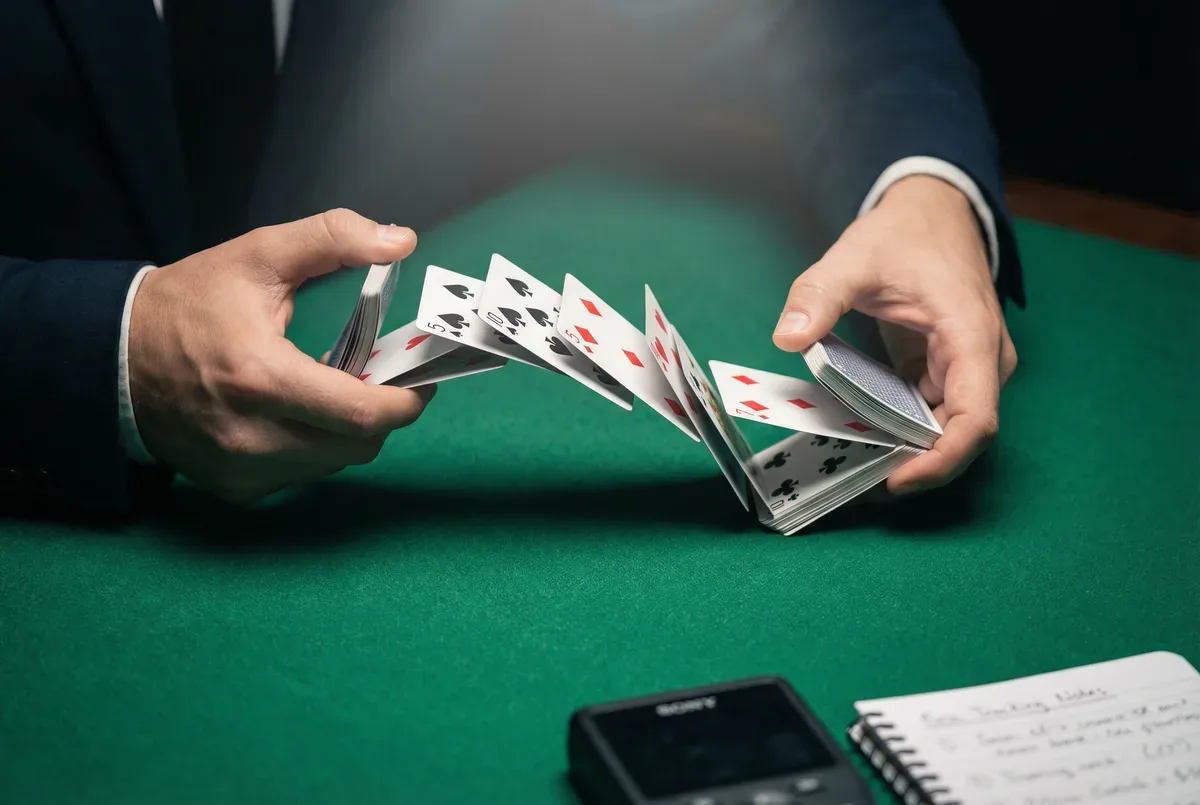
The practical method involves identifying segments of the shoe that, during play, became rich in tens and Aces high-count clumps. When the shoe is collected and shuffled, the tracker watches the shuffle procedure closely, noting the mechanical sequence of cuts, riffles, and stripes used by the dealer. Most casino shuffles involve a specific and repeatable sequence typically a fixed number of riffles and cuts. By mapping which pile sections go where during each step, the tracker can estimate where the original high-count clump has migrated in the new shoe order.
Snyder’s mathematical contribution was the analysis of how many riffles are required to fully randomize a deck and how far from randomness most casino shuffles actually operate. A standard riffle shuffle does not achieve true randomization until seven or more complete riffles are performed a number casino dealers rarely reach in a standard multi-deck shoe procedure. Two or three riffles per deck section leaves identifiable clump structures. A tracker monitoring those procedures gains advance knowledge of approximately where the favorable segments will appear in the next shoe.
Riffles required for true randomization
complete riffles per deck
Typical casino shoe shuffle riffles
per section
EV improvement vs. pure counting
% on favorable hands
What Makes a Shuffle Trackable?
Not all casino shuffles are equally trackable. The most trackable procedures are those with a consistent, repetitive structure the same number of riffles, the same cut and stripe sequence, executed in the same order every time. A dealer who performs a mechanical shuffle identically on every shoe presents a predictable pattern the tracker can map. A dealer who varies their shuffle procedure, mixes up the sequence, or uses a random number of riffles creates far more uncertainty in the clump destination analysis.
Shuffle machines further complicate tracking. Continuous shuffling machines (CSMs) essentially eliminate the possibility of shuffle tracking by recirculating cards constantly. Standard shuffling machines with defined procedures are somewhat trackable but require different analytical approaches than hand shuffles. The decline in hand-shuffled games in major casino markets has reduced the availability of trackable shuffles significantly which is one reason Snyder emphasized learning the technique in venues where hand shuffles are still standard procedure.
Clump quality also affects the value of tracking. A high-count clump a section of shoe rich in tens and Aces identified with 80% confidence in a specific zone of the new shoe is valuable. A medium-count section tracked with 50% confidence provides much less actionable information. Experienced trackers develop a feel for which clumps are robust enough to act on and which are too diffuse to provide reliable betting signals.
Card Counting
Shuffle Tracking
- Moderate
- Limited
- Yes
- Current deck composition
- Yes
- Higher count = bigger bet
- Moderate
- Very high
- No
- Yes
- Future deck structure
- Even more critical
- Zone entry with maximum bet
- Lower if executed correctly
What Is the Snyder’s Contribution to Blackjack Literature?
Beyond shuffle tracking, Snyder’s work in Blackbelt in Blackjack was among the first to rigorously analyze the relationship between shuffle penetration and counter profitability. He demonstrated mathematically that penetration how far through the shoe the dealer deals before reshuffling is as important as the counting system used. A counter using a basic Hi-Lo count in a game with 75% penetration outperforms a counter using a more sophisticated system in a game with 50% penetration. This insight redirected professional player attention toward game selection criteria that included penetration depth, not just rule conditions.
Taking Shuffle Tracking to a Live Game
Shuffle tracking is not an entry point into advantage play it is an advanced layer on top of solid blackjack card counting skills. Before attempting to map shuffle procedures, a player needs automatic, error-free counting under pressure, excellent game awareness, and significant experience reading shoe compositions. Building those foundations starts with the kind of structured practice the test your count at a real money table environment provides drilling the basic skills that all advanced techniques, including Snyder’s shuffle methods, are built upon.
Frequently Asked Questions
Shuffle tracking is an advanced technique where a player monitors where high-count card clumps migrate during a casino shuffle. By mapping the shuffle procedure, the tracker can estimate which zone of the new shoe contains the favorable clump and increase bets when that zone is reached.
Yes. Shuffle tracking, like card counting, is a mental skill that uses no devices or outside assistance. It is legal but may result in casino banning if detected. Casinos can exclude any player for any reason in most jurisdictions.
Snyder's analysis of penetration as a critical game quality metric is arguably his most widely applicable insight. His mathematical proof that penetration depth significantly outweighs counting system sophistication in determining profitability changed how serious players evaluate games.
Before you test these plays at a real table, run them through our free blackjack simulator practice unlimited hands at zero cost until every move becomes automatic.
Advanced Play Starts With Fundamental Mastery
Shuffle tracking is built on flawless counting. Master the foundation before attempting to layer advanced techniques on top of an incomplete skill base.
Blackjack involves real financial risk. Advanced techniques require extensive practice and do not guarantee profits. Casino countermeasures may limit their effectiveness.
Learn More
Continue your education with these related lessons.

Why Relying on Intuition Drains Your Blackjack Bankroll
Gut instinct feels reliable at the table, but the math says otherwise. This article dissects the cognitive traps that make…

How to Find an Expert Blackjack Profit Coach
A qualified blackjack profit coach can compress years of trial-and-error learning into months. Here's what separates legitimate coaches from scammers,…
How to Beat the Dealer Profitably When Both Cards Are Face Up
Double Exposure Blackjack shows both dealer cards face up before you act. It sounds like a massive player advantage and…