
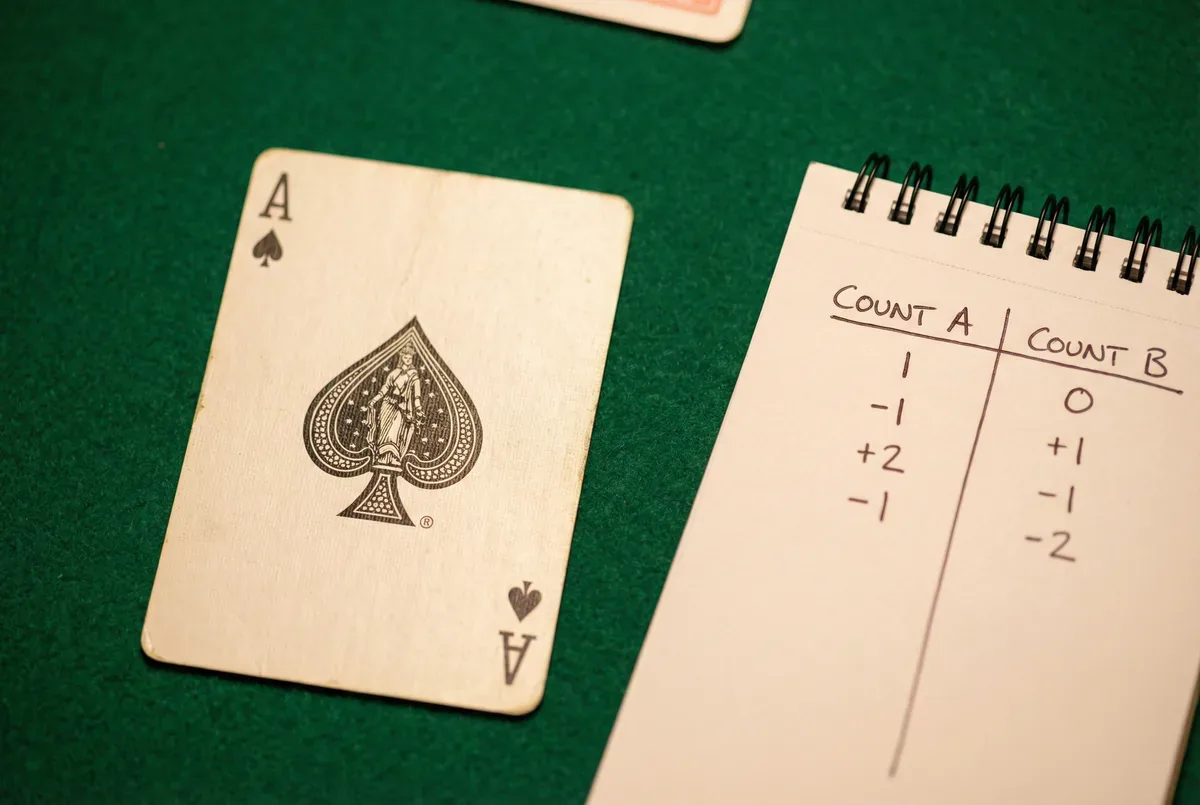
Why Ace-Reckoned Counting Systems Beat Ace-Neutral for Professional Play
Every blackjack card counting system assigns a point value to each card rank. Aces receive special treatment because they serve two conflicting roles: they are high cards that favor the player’s betting decisions (more aces remaining = more naturals), but they are not reliably good for strategic playing decisions (hitting, standing, doubling). Ace-neutral systems like Hi-Lo assign aces a value of zero they are ignored in the running count. Ace-reckoned systems like Omega II count aces as -1, incorporating them directly into the main count. The choice between these approaches is not cosmetic. It changes the system’s betting efficiency, its playing efficiency, and the mental workload required to use it accurately at a live table.
What Ace-Neutral and Ace-Reckoned Mean in Card Counting
Hi-Lo (Ace-Neutral)
Omega II (Ace-Reckoned)
- 0 (ignored)
- −1 (counted)
Why Hi-Lo Assigns Zero to Aces?
Hi-Lo is a balanced system: every card from 2–6 is +1, every card from 10–Ace is -1, and 7–9 are 0. Aces are counted as -1 in the raw Hi-Lo framework. But experienced Hi-Lo players often run an ace side count alongside the main count, tracking aces separately, precisely because aces affect betting decisions differently than 10s. A shoe rich in 10s and poor in aces is not as favorable for betting up as a shoe rich in both yet the main Hi-Lo count would show the same positive value in both cases.
This is why Hi-Lo’s betting efficiency score of 0.97 is so high: the system’s tag for aces aligns well with what matters most for bet sizing. The trade-off is that playing efficiency the accuracy of index plays like whether to hit or stand in marginal situations suffers, landing at 0.51. For most recreational counters, that is a worthwhile exchange because betting decisions contribute far more to total EV than individual playing deviations.
Common Myth
“Counting aces in the main count always produces a better system.”
It seems logical that more information in one count would produce better decisions across the board.
The Reality
Aces affect betting and playing decisions differently. Including them in the main count improves playing efficiency but slightly reduces betting efficiency and betting is where most of the counter's edge originates.
Hi-Lo's 0.97 betting efficiency vs. Omega II's 0.92 demonstrates that ace-neutral systems retain an edge where it matters most.
How Omega II Uses Ace-Reckoned Tags?
Omega II is a two-level balanced system: 2s, 3s, and 7s are +1; 4s, 5s, and 6s are +2; 8s and aces are 0; 9s are -1; and 10s through kings are -2. Wait that places aces at zero in standard Omega II as well. The more nuanced ace-reckoned version, sometimes called Omega II with ace side count, adds a separate ace adjustment. The point is that Omega II’s higher level tags (using +2 and -2 values) give it superior playing efficiency (0.67 vs. 0.51 for Hi-Lo), at the cost of higher mental demand and slightly lower betting efficiency.
Systems that are genuinely ace-reckoned in the main count include the Uston APC and some versions of the Halves count. In these systems, aces receive a negative tag inside the primary running count, which improves playing accuracy for specific index decisions but requires the user to separately adjust for betting purposes sometimes via an ace side count used to modify the betting signal. The net result is more accurate play but more moving parts.
Hi-Lo Betting Efficiency
BE score
How Do You Choose Based on Your Goals?
If your primary goal is maximizing bet spread edge in a 6-deck shoe game, an ace-neutral or high-BE system like Hi-Lo is the correct choice. The 0.97 betting efficiency means nearly all available betting edge is captured. If you are playing a game with frequent playing decisions where index plays matter more a single-deck game with high penetration where you are making many marginal calls a system with higher playing efficiency offers a genuine gain. For most players, the incremental EV from higher PE systems does not offset the accuracy cost of running a harder count under casino conditions. Errors in a complex system eat gains that simpler systems preserve.
Apply System Knowledge Under Live Conditions
Understanding the theory of ace treatment is only half the equation. The other half is executing your chosen system at speed, under social pressure, without errors. The verify the ace count at a live real-money table environment is where system knowledge becomes muscle memory you can drill Hi-Lo or practice Omega II’s multi-level tags in a real-deal setting before your technique is tested in a casino where real money hangs on every count decision. Never risk funds you cannot afford to lose while building this skill.
Frequently Asked Questions
Hi-Lo is optimized for betting efficiency, not playing efficiency. Aces are powerful for betting (they produce naturals) but their playing effect is complex and bidirectional. By treating them as neutral in the running count, Hi-Lo keeps the system simple while preserving its 97% betting efficiency.
Roughly 0.03 to 0.07% additional edge for ace-reckoned systems, depending on conditions. This advantage only materializes with near-perfect execution. For most players, the added complexity of ace-reckoned systems costs more in error rate than it gains in theoretical precision.
Only when a player has fully mastered their primary counting system and plays 500 or more hours per year in favorable conditions. The side count adds roughly 0.1% edge but requires tracking a separate running total while maintaining the main count, cover behavior, and bet sizing simultaneously.
Before you test these plays at a real table, run them through our free blackjack simulator practice unlimited hands at zero cost until every move becomes automatic.
Mathematical Risk Warning
Switching to a more complex counting system mid-session or without adequate practice increases error rate and can turn a theoretical edge into a practical disadvantage. Master one system fully before evaluating another.
Blackjack Academy is an educational resource. All strategy is based on mathematical expectation. Always play within your means.
Learn More
Continue your education with these related lessons.

How Ed Thorp Invented Card Counting and Wrote Beat the Dealer
Ed Thorp proved in 1962 that blackjack was mathematically beatable. His book Beat the Dealer changed the game forever and…

The Omega II Count Delivers Advanced Accuracy for Serious Counters
The Omega II count uses multi-level values (+2/-2) to achieve 0.67 playing efficiency well above Hi-Lo's 0.51. Learn whether the…

How to Practice Card Counting at Home
Card counting skill is built at home, not at the casino. This four-stage practice framework takes you from flipping single…