

What Card Counting Actually Is and Why Most Players Get It Wrong
Card counting does one thing: it tells you when the remaining deck composition favors the player over the dealer. That is the entire mechanism. When the shoe contains a higher-than-normal proportion of 10-value cards and Aces, the player has a mathematical edge. Card counting is the system that tracks when that condition exists and how strong it is.

What Card Counting Actually Does to Your Blackjack Edge
Without counting, a player using perfect blackjack basic strategy faces a blackjack house edge of roughly 0.5%. With a well-executed counting system and proper bet spread, that edge flips to approximately +0.5% to +1.5% in the player’s favor during positive counts. The player loses less during negative counts by betting minimum, and wins more during positive counts by betting maximum. That asymmetry produces the long-run advantage.
The mechanism works because a deck rich in high cards benefits the player more than the dealer. Players receive 3:2 on naturals; dealers do not. Players can double and split when the deck is hot; dealers cannot. High cards cause the dealer to bust more often when forced to hit stiff totals. These asymmetries are built into the game’s rules counting simply tells you when the deck is in the state that exploits them.
Common Myth
“Card counting means memorizing every card that's been played”
Most people believe card counting requires perfect memory of all dealt cards. This misconception makes counting seem impossible.
The Reality
Card counting tracks a single running number the count which rises and falls based on high and low card categories. No memorization of specific cards is required. The count is a running aggregate, not a record.
A basic Hi-Lo counter with proper bet spread achieves approximately +0.5% to +1.5% player advantage at high counts.
What Card Counting Is Not Five Common Misconceptions?
The popular image of blackjack card counting comes from movies: a photographic-memory savant who tracks every card in a six-deck shoe by face and suit. That is fiction. Real blackjack card counting assigns a simple value typically +1 or -1 to broad categories of cards, and the counter maintains a single running integer. No card is individually tracked. No memory palace is required.
Card counting is not cheating. It uses no external device, no accomplice signals, and no manipulation of the game. A counter uses only their mind to process publicly visible information the cards dealt face-up on the table. Every major legal jurisdiction has ruled that mental blackjack card counting is legal. Casinos may ask counters to leave or restrict them to flat betting, but they cannot have a counter arrested for counting alone.
Card counting is not a guarantee of winning any given session. The advantage generated by a skilled counter is real but modest typically under 1.5% in the best conditions. Variance is enormous in blackjack. A counter can and will lose sessions, losing streaks, and even extended runs despite having the mathematical edge. Counting is a long-run tool, not a session-by-session guarantee.
Counting is not effective without a solid foundation in blackjack basic strategy. A player who counts but makes blackjack basic strategy errors is giving back more edge on individual hands than the count advantage provides. Basic strategy mastery must come first counting is built on top of it, not as a substitute for it.
- ISTracking the ratio of high to low cards remaining in the shoe
- ISAdjusting bet size when the deck is rich in high cards
- ISUsing mathematical edge shifts to gain advantage
- ISLegal in all jurisdictions (using only your mind)
- ISN'TMemorizing specific cards dealt
- ISN'TCheating casinos can ask you to stop but not arrest you
- ISN'TEffective without perfect basic strategy as a foundation
- ISN'TA short-term guarantee variance still dominates single sessions
How a Card Counter’s Advantage Is Generated Hand by Hand?
A counter’s advantage does not come from winning more hands per se it comes from winning larger bets when the count is high and losing smaller bets when the count is low. This is the fundamental mechanism: bet sizing scaled to the count. A counter betting $10 at a true count of -2 and $100 at a true count of +4 is not playing more hands differently they are managing the size of wagers relative to known mathematical conditions.
Hand by hand, the process works like this. Each card dealt changes the ratio of remaining high to low cards in the shoe. Low cards (2 through 6) leaving the shoe improve conditions for the player the count goes up. High cards (10-value and Aces) leaving the shoe worsen conditions the count goes down. At each betting decision, the counter knows whether conditions are player-favorable or casino-favorable, and bets accordingly.
On top of bet sizing, experienced counters use true count thresholds to deviate from blackjack basic strategy in specific situations. These deviations, called indices, and include taking insurance at high counts, standing on 16 against a 10 at certain counts, and so on. These strategy deviations add a small additional edge on top of the bet-spread advantage. For a beginner, however, bet spreading alone produces the overwhelming majority of the counting edge.
Why Most Players Who “Know How to Count” Still Lose?
Knowing the Hi-Lo tag values does not make a player a functional counter. The gap between understanding the system in theory and executing it reliably at a casino table is large. A live blackjack table involves multiple players acting simultaneously, cards dealt at pace, dealer chatter, adjacent players commenting on your play, and the cognitive load of maintaining an accurate count while managing your own hand decisions. Most beginners lose the count within two shoes.
The most common failure point is splitting attention between the count and the strategy decision. An untrained counter will often make the correct bet size based on the count but then make a blackjack basic strategy error on the hand itself hitting when they should stand, or failing to double in a profitable situation. The result is that the counting edge is partially or entirely eroded by hand-play mistakes. Counting must become automatic before it can coexist with correct strategy play.
Bankroll is another failure point. A 1% edge requires a sufficient bankroll relative to maximum bet size to survive the variance of normal losing runs. Players who begin counting with inadequate bankrolls are forced to quit during a downswing before the edge manifests. The Kelly Criterion which sizes bets as a fraction of bankroll proportional to edge is the mathematical framework for surviving variance long enough to realize the advantage.
The core insight of card counting is this: when the remaining shoe is rich in 10-value cards and Aces, the player has an advantage. When it is rich in low cards, the casino has an advantage. Card counting is simply the mechanism for knowing which situation you are in and betting more in the former, less in the latter. Nothing mystical. No memory required beyond a single integer you adjust on each card.
The First Step Toward Learning to Count in a Live Game
The path to live counting begins at home, alone, with a single deck and a timer. The drill is straightforward: flip through the deck one card at a time, adjusting the count correctly for each card, and arrive at zero when the deck is exhausted. A balanced system like Hi-Lo will always sum to zero through a complete deck. If you don’t reach zero, you miscounted. Practice until you can run through a deck in under 30 seconds without errors that is the baseline speed required at a live table.
After single-deck drill speed, the next step is counting two cards simultaneously which mirrors seeing multiple cards dealt across a table in a single moment. Then practice while solving blackjack basic strategy decisions at the same time, maintaining the count as a background process. The goal is cognitive separation: the count runs continuously in the background while strategy decisions are made in the foreground without either interfering with the other.
Before committing to real money sessions at a live casino, consider putting your preparation to the test at a live-dealer online table. At https://blackjackacademy.online/blackjack-live you can practice counting in real-time conditions against a human dealer streaming live the cards are genuine, the pace is real, and actual money is on the line. It is a more honest test of your counting readiness than any simulator, and a more forgiving environment than a busy casino floor where every observer adds pressure.
Understanding what counting is and is not will not protect your money only correct execution will. The live dealer tables at Blackjack Academy are the closest thing to casino conditions without a casino floor watching you. See what blackjack card counting actually feels like in live play before you sit down with real money in a real casino.
Frequently Asked Questions
No. Card counting using only your mind is legal in every major jurisdiction. Casinos are private property and can ask counters to stop playing or leave, but no law prohibits the mental technique of tracking card ratios. Using a device to count is illegal; using your brain is not.
Learning the tag values takes a day. Counting accurately at speed through a full deck takes 2–4 weeks of daily practice. Counting reliably while playing correct basic strategy simultaneously takes 2–3 months of disciplined practice before a live session is advisable.
In standard RNG-based online blackjack, the deck is reshuffled after every hand, making counting impossible. In live-dealer online blackjack where real cards are dealt from a physical shoe on camera counting is technically possible but penetration is often shallow, limiting the advantage.
Before you test these plays at a real table, run them through our free blackjack simulator practice unlimited hands at zero cost until every move becomes automatic.
Use our free blackjack calculator to model the exact expected value for any rule combination or hand situation before you sit down.
Card Counting Is a Skill Not a Guarantee
Even with a genuine mathematical edge, card counting produces significant variance. Extended losing sessions are normal and expected. Never play with money you cannot afford to lose, regardless of your counting skill level. A small edge over a large sample does not protect any individual session.
Blackjack Academy provides educational content only. Card counting does not guarantee winnings. Gambling involves financial risk. Play responsibly.
Learn More
Continue your education with these related lessons.
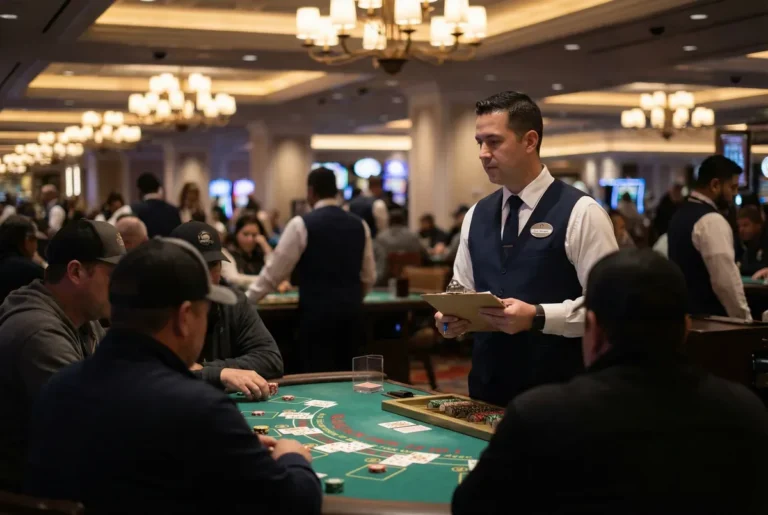
What Actually Happens When a Casino Catches You Counting Cards
A casino backoff is not a legal event it is a private business decision. Here is exactly what happens at…
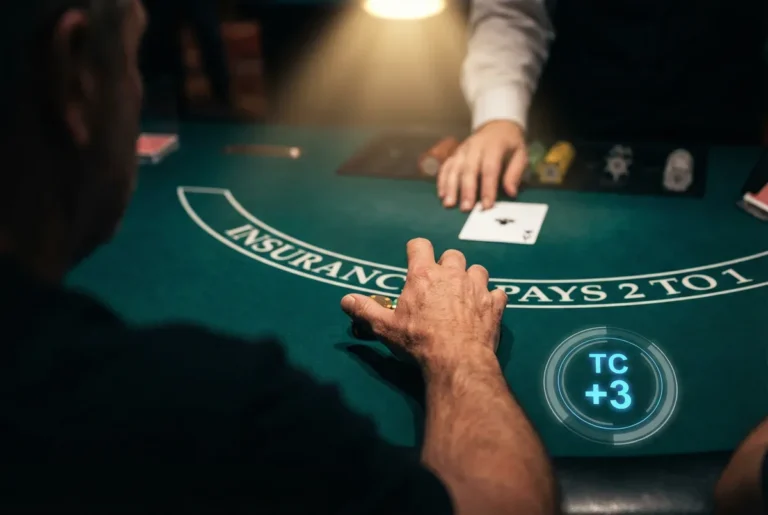
Why Smart Card Counters Never Take Blackjack Insurance Side Bets
Insurance is a losing bet for basic strategy players but becomes profitable for card counters at exactly true count +3…

How Counting Affects the House Edge Mathematically
Card counting shifts the house edge by approximately +0.5% per true count point. Learn the math behind counting advantage, what…