

The Hi-Lo System Is the Most Powerful and Widely Used Card Count
The Hi-Lo system, introduced by Harvey Dubner in 1963 and refined by Stanford Wong, divides every card in the deck into three groups. Cards 2 through 6 are assigned a value of +1. Cards 7, 8, and 9 are assigned 0 they are neutral and do not change the count. Cards 10, Jack, Queen, King, and Ace are assigned -1. Every card dealt receives one of those three values, and the counter adds it to their running total.
How the Hi-Lo Count Assigns Values to Every Card
The logic behind the assignments is direct. Low cards (2–6) benefit the dealer. Dealers are forced to hit stiff hands totals of 12 through 16 and low cards help them reach a standing total without busting. When low cards leave the shoe, the remaining deck becomes more favorable to the player. The count rises. High cards (10-value and Aces) benefit the player through naturals, favorable doubles, and dealer bust pressure. When they leave the shoe, the count falls.
A complete deck of 52 cards contains exactly 20 low cards (2–6), 12 neutral cards (7–9), and 20 high cards (10-value plus 4 Aces). Because there are equal numbers of low and high cards, a balanced system like Hi-Lo sums to zero across the full deck. This is the built-in accuracy check: if you count through an entire deck and don’t land on zero, you made an error. Use this zero-sum property to verify your practice sessions.
- 2, 3, 4, 5, 6 → Count +1 (low cards good for dealer)
- 7, 8, 9 → Count 0 (neutral ignore)
- 10, J, Q, K, A → Count -1 (high cards good for player)
- Starting count0 at fresh shoe
- Positive countdeck rich in 10s and Aces → increase bet
- Negative countdeck rich in small cards → minimum bet
- At reshufflereset count to 0
How to Keep a Running Count Through a Full Shoe?
The running count begins at zero when the shoe is freshly shuffled. As each card is exposed your cards, the dealer’s card, other players’ cards you apply its Hi-Lo tag and adjust the running count in real time. Every card visible on the table is yours to count. At a full table with seven players, you may count 10–15 cards in a single deal. The count changes continuously throughout the hand, not just when your own cards are revealed.
The critical habit is counting cards in pairs when possible. A 5 and a King dealt simultaneously cancel each other: +1 and -1 sum to zero. You can ignore the pair and save cognitive effort. When two low cards appear together, you add 2. When two high cards appear, you subtract 2. Training yourself to see pairs before applying individual tags dramatically reduces the mental load at a busy table.
The running count is the raw number. It tells you the net composition shift since the last shuffle, but it does not yet account for how many cards remain in the shoe. A running count of +8 with five decks left is a much weaker signal than a running count of +8 with one deck left. To make betting decisions, you convert the running count to a true count by dividing by the approximate number of decks remaining but the running count is always the foundation that the true count is built from.
Dealer Shows
Your Hand
You're counting. A 10 and a Jack are dealt to you. What happens to the running count?
Each 10-value card dealt (including J, Q, K) reduces the running count by 1. Two 10-value cards dealt means the count decreases by 2. This is the Hi-Lo mechanic: 10+ and Ace = -1 each; 2-6 = +1 each; 7-9 = 0. The running count tracks the net composition shift after every card. In this case: count decreases by 2. The question asks about the count change, not a strategy play but 'hit' is selected as the closest proxy for 'count decreases.' explanation: Two high cards dealt → running count -2.
Why Hi-Lo Achieves Near-Optimal Counting Efficiency?
Counting systems are evaluated on two primary metrics: betting correlation and playing efficiency. Betting correlation measures how well the count predicts when the player has a betting advantage. Hi-Lo’s betting correlation is 0.97 close to the theoretical maximum of 1.0. This means that when Hi-Lo says bet big, you are almost always in the mathematically correct situation to do so. The system’s accuracy at identifying betting opportunities is nearly optimal.
Playing efficiency measures how well the count informs strategy deviations the index plays where blackjack basic strategy is overridden based on the count. Hi-Lo’s playing efficiency is 0.51, which is moderate. More complex systems achieve higher playing efficiency by tracking specific card denominations separately, but they require significantly more cognitive effort. For most players, the efficiency gain from a more complex system does not justify the increased error rate in execution.
The reason Hi-Lo dominates practical blackjack card counting is this tradeoff: near-perfect betting correlation at beginner-accessible complexity. The system generates approximately 85–90% of the theoretical maximum advantage available to a card counter, while remaining simple enough to execute reliably under real casino conditions. More powerful systems exist, but the edge difference rarely exceeds 0.1–0.2% far less than the edge lost to execution errors under pressure.
Hi-Lo Betting Correlation
near-perfect
Playing Efficiency
moderate
Insurance Correlation
good
Why Do the Most Common Hi-Lo Mistake and How to Fix Them?
The most frequent error new counters make is forgetting the dealer’s hole card when it is revealed at the end of the hand. The dealer’s down card is a real card that changes the count it must be tagged and added to the running total when exposed. Counters who ignore it after the hand is settled are systematically running a biased count. Every exposed card counts, including the dealer’s hole card when it is turned over.
The second major error is losing the count after a split or double-down situation. A split creates two hands, potentially drawing two additional cards on top of the original card separated. Doubles draw one card. Each of these cards must be tagged. When attention shifts to managing the split hands, the count is frequently dropped. The fix is to practice split scenarios specifically deal yourself split hands and practice counting through the resolution of both hands before continuing.
Resetting the count at the wrong time is a less obvious but damaging error. The count resets to zero at a full reshuffle of the shoe but not at a shuffle of a small portion of cards, and not between hands. A counter who resets unnecessarily will mistime bets repeatedly. Confirm the casino’s penetration point where the dealer places the cut card and only reset when a full reshuffle occurs.
Practicing Hi-Lo Before Your First Live Counting Session
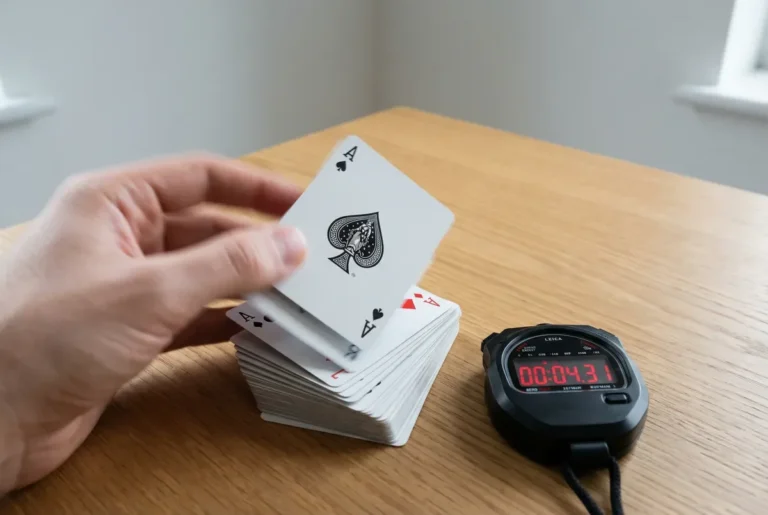
A functional Hi-Lo counter can run through a single deck in under 30 seconds with zero errors before they are ready for a live session. This benchmark exists because real casino dealing pace requires approximately that speed to count all cards as they are exposed in a multi-player hand. Practice at home with a physical deck: flip one card per second, adjust the count, aim for zero at the end. Log your time and error rate. When you sustain sub-30-second clean runs for three consecutive days, move to multi-deck practice.
The second phase of preparation is counting while executing blackjack basic strategy decisions simultaneously. Deal a hand to yourself and a simulated dealer, make the correct blackjack basic strategy play, and maintain the count through the entire sequence. This dual-task practice is the hardest and most important preparation step the moment strategy decision and count maintenance compete for attention is where most beginner counters lose accuracy in both.
When you are ready to test your Hi-Lo count under real conditions without the full exposure of a casino floor, a live-dealer online session removes some friction. At https://blackjackacademy.online/blackjack-live you face a human dealer working from a genuine shoe real cards, real pace, real money at stake. A session there will reveal whether your count holds under live conditions faster than any home drill can, and the financial stakes serve as a meaningful readiness check.
Hi-Lo accuracy degrades under speed and distraction the only fix is live reps. The live dealer tables here run at full casino pace against a real multi-deck shoe, with real stakes attached to every count error. Run your Hi-Lo count at a live table and find out where it breaks before a pit boss does.
Frequently Asked Questions
With correct basic strategy, perfect Hi-Lo counting, and a 1-to-12 bet spread in a favorable 6-deck game, a counter can achieve approximately +0.5% to +1% player advantage. The exact edge depends on game rules, deck penetration, and the size of the bet spread employed.
Every visible card must be counted your cards, other players' cards, the dealer's up card, and the dealer's hole card when it is revealed. Counting only your own cards produces an inaccurate count and unreliable betting signals. The running total reflects all exposed cards since the last shuffle.
Hi-Lo uses three tag values (+1, 0, -1) for simplicity. Advanced systems like Hi-Opt II or Omega II assign multiple different values to individual card denominations for greater playing efficiency. The tradeoff is increased complexity and higher error risk under live conditions. Most professionals consider Hi-Lo's 0.97 betting correlation sufficient for strong advantage play.
Before you test these plays at a real table, run them through our free blackjack simulator practice unlimited hands at zero cost until every move becomes automatic.
Use our free blackjack calculator to model the exact expected value for any rule combination or hand situation before you sit down.
Card Counting Edge Is Real So Is Variance
Hi-Lo generates a genuine long-run mathematical advantage, but no session outcome is guaranteed. Losing sessions are normal even for skilled counters. Never bring money to the table that you cannot afford to lose. Bankroll management is as important as counting accuracy.
Blackjack Academy provides educational content only. A counting edge does not guarantee winning outcomes. Gambling carries financial risk. Play within your means.
Learn More
Continue your education with these related lessons.

How to Use Counting Software and Simulators to Sharpen Your
Counting software and simulators are the fastest path from theory to casino-ready accuracy. Learn how to configure tools like Casino…
Speed Drills for Card Counting That Build Automatic Recognition Fast
Speed is the real bottleneck in card counting not accuracy. This guide walks through single-card flash drills, pair-cancellation technique, and…
Why Index Numbers Are the Most Critical Tool in Every Counting Strategy
Index numbers are the true-count thresholds that tell you when to deviate from basic strategy. The Illustrious 18 capture the…