
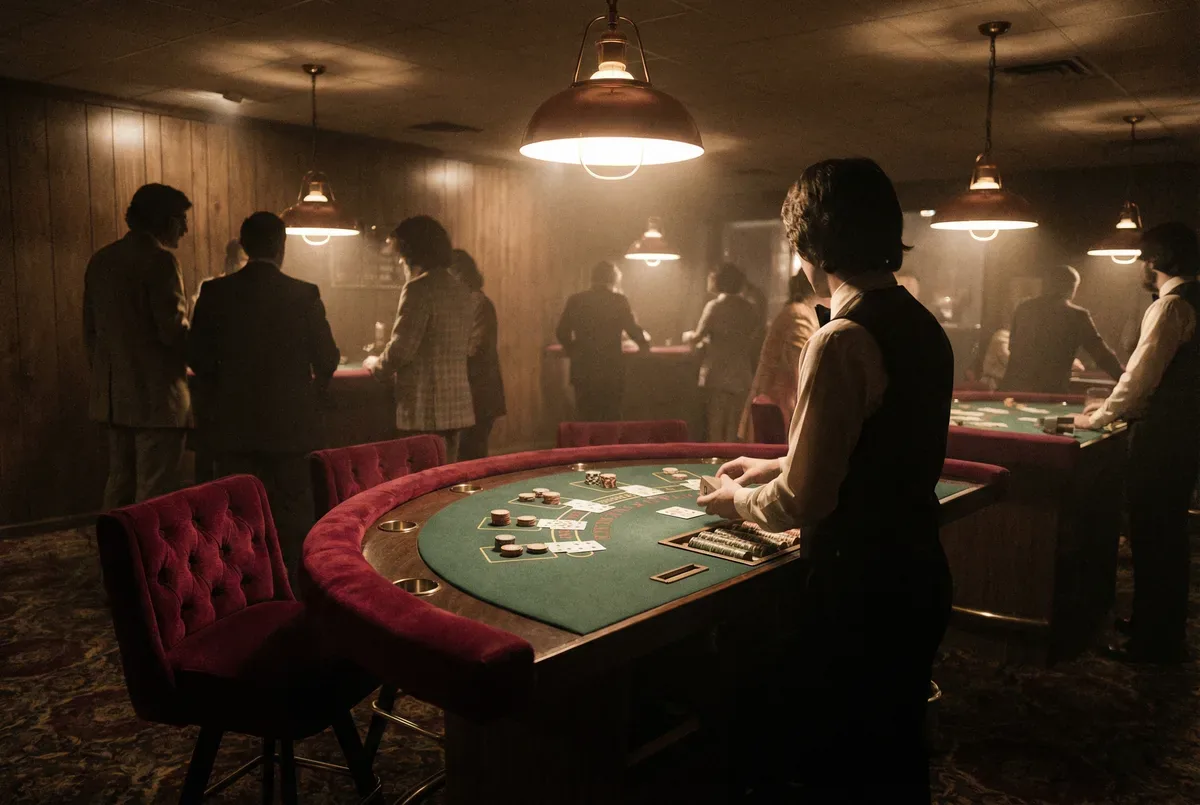
The Golden Age of Card Counting and the Legends Who Beat Las Vegas
Beat the Dealer, published by Edward O. Thorp in 1962, is the most consequential book in the history of gambling. Thorp, a mathematics professor at MIT and later UC Irvine, used an IBM 704 mainframe to simulate millions of blackjack hands and demonstrated for the first time that blackjack card counting produced a provable, exploitable player edge. The book presented his Ten-Count system in enough detail for any motivated reader to learn it. The first edition sold out immediately. Casinos which had been operating blackjack as a high-edge game since the early 20th century were caught off guard by a mathematical proof that their most popular table game could be beaten. The initial casino response was panic: Las Vegas properties changed rules overnight, reducing favorable conditions in ways that alienated recreational players. The negative backlash from recreational players was so immediate that casinos reversed most rule changes within weeks, inadvertently restoring the favorable conditions that counters needed.
How Ed Thorp’s 1962 Book Changed Blackjack Forever
Timeline
1962
Ed Thorp publishes Beat the Dealer first proof of blackjack counting EV
1962
Las Vegas casinos change rules in panic players boycott rules reversed within weeks
1963-1966
Second wave of counters trained by Thorp's book flood Las Vegas
1966
Beat the Dealer revised with more powerful Hi-Lo system (Lawrence Revere contribution)
1970s
Harvey Dubner introduces Hi-Lo simpler count gains widespread adoption
1977
Ken Uston publishes The Big Player team play strategy enters public domain
1979-1982
MIT Blackjack Team forms team play reaches industrial scale
1982
Uston v. Resorts International New Jersey courts restrict casino exclusions
1993
Griffin Book database reaches critical mass individual counter longevity drops sharply
1999
Multiple shuffling machine patents filed CSM deployment begins in earnest
What Is the 1960s and 1970s?
The years immediately following Beat the Dealer represented the most favorable conditions card counters have ever faced. Casino surveillance was limited to human observation by pit bosses and floor supervisors. There was no centralized player database, no photographic tracking, and no understanding of the statistical signatures that counting produces. A counter with Thorp’s Ten-Count system could walk into any Las Vegas casino, employ a 1-to-10 bet spread without triggering attention, and play for hours without incident. The games themselves were extremely favorable by modern standards: single-deck was universal, dealt nearly to the last card (95%+ penetration), and many casinos offered rules like early surrender that have since been eliminated. The blackjack house edge for a blackjack basic strategy player in a 1960s single-deck Las Vegas game was approximately 0.0% essentially a fair coin flip and a proficient counter held a player edge of 0.5%–2.0% depending on count and bet spread.
The 1970s saw the first systematic casino countermeasures. Pit bosses began receiving training on counting indicators particularly the bet spread signature. Properties in Nevada started requiring dealers to shuffle earlier when a suspected counter was at the table. The Griffin Investigations database was established, creating the first cross-property information sharing network. Despite these developments, conditions remained remarkably favorable compared to modern play. Single-deck games with 80%–85% penetration were still widely available. Counters who had not yet entered the Griffin database could play multiple properties without being identified. The bet spreads required to generate meaningful EV were smaller than modern multi-deck games require, reducing the surveillance signal.
1960s-1980s
Modern (2020s)
- Single deck universal
- 6-8 deck shoe dominant
What Is the 1980s?
The proliferation of multi-deck shoes through the 1980s was the casino industry’s most effective structural response to blackjack card counting. A six-deck shoe with 75% penetration requires a bet spread of 1-to-12 or more to generate the same EV that a single-deck game with 85% penetration produced at 1-to-4. The six-deck format also made the dealer’s shuffling task faster and required less dealer downtime, improving casino productivity. The shift was framed to players as offering better odds (fewer mistakes, faster pace) but the actual effect was to dilute the counter’s information advantage by burying the deck composition signal deeper in statistical noise. Counters adapted by developing stronger count systems (Omega II, Hi-Opt II), learning shuffle tracking to extend counting effectiveness across shuffles, and organizing into teams to deploy the Big Player model. The 1980s were still profitable for skilled counters just dramatically harder than the 1960s.
Every major casino rule change from 1963 to today has been a direct response to the mathematics documented in Beat the Dealer. The modern game is a product of 60 years of counter-casino arms race.
The Thorp Causality
What Is the 1990s?
Three developments converged in the 1990s to effectively end the golden age. The Griffin Investigations network reached sufficient density that known counters were identified across properties within days rather than months. Surveillance camera technology improved to the point where continuous video review was feasible, and pit bosses were replaced by a new generation of gaming protection specialists with explicit training in advantage play identification. Atlantic City casinos, following the Uston ruling’s regulatory mandate, began deploying more aggressive shuffle-behind protocols that effectively reduced penetration to 50%–60% in many properties. By the mid-1990s, the average professional counter’s viable casino lifetime had shrunk from years to months. The MIT team, operating from 1984 to approximately 1998, represented both the apex and the end of the golden age a massively scaled team operation that required industrial sophistication to overcome the countermeasures that individual counters could no longer defeat.
What the Golden Age Teaches Modern Players
The golden age documents a mathematical truth: blackjack card counting works. The 30-year window from 1962 to the early 1990s represents the largest sustained demonstration of verifiable player advantage in gambling history. Modern conditions are harder but not hopeless the edge still exists in well-penetrated games, and the mathematics have not changed. If you want to feel what counting under real-money pressure was like in that era stripped of its historical context a live blackjack session carries genuine financial stakes that make the lessons concrete, though every real-money hand played today carries risks that should never exceed what you can afford to lose entirely. The tools and knowledge from the golden era remain valid apply them today in a real-money session at validate this count at a real table tonight this week, funded strictly from your entertainment budget.
Frequently Asked Questions
Thorp's original Ten-Count, which tracked tens separately from all other cards, is accurate but harder to use than Hi-Lo because it requires maintaining two simultaneous counts. Hi-Lo, which was introduced in the revised 1966 edition of Beat the Dealer and popularized independently by Harvey Dubner, is both easier and nearly as powerful. Modern counters use Hi-Lo or its variants almost universally.
Some individual casinos lost significant amounts to sophisticated players during the early golden age, particularly before countermeasures were established. Casino industry records from the period are not publicly available, but accounts from early counters suggest that prepared players could generate sustained wins across multiple visits to the same property. The industry-wide impact was never so severe that casinos faced financial distress the recreational player base was large enough to sustain profits even with counter losses.
Casinos faced a prisoner's dilemma: any property that changed rules aggressively would lose recreational players to competitors offering better rules. When multiple Las Vegas casinos simultaneously changed rules in 1962, the immediate player boycott proved that recreational players were more sensitive to rule quality than most casino operators expected. The industry settled on incremental countermeasures more decks, more shuffling, less penetration that were less visible to recreational players while degrading counter conditions.
Before you test these plays at a real table, run them through our free blackjack simulator practice unlimited hands at zero cost until every move becomes automatic.
Mathematical Risk Warning
Even in the most favorable historical conditions, card counters experienced losing months and losing years. The golden age was profitable in aggregate but devastating in individual sessions. No era has eliminated blackjack variance, and none ever will.
Blackjack Academy is an educational resource. All strategy is based on mathematical expectation. Always play within your means.
Learn More
Continue your education with these related lessons.

How Your Counting Advantage Changes in Single Deck vs Multi Deck
Single-deck games offer higher count volatility and better counting conditions in theory, but practical challenges often make 6-deck shoes the…
Why Counting Side Bets in Blackjack Is Almost Never Worth the Effort
Some blackjack side bets are vulnerable to card counting. Learn which side bets are countable, the exact count thresholds for…
Why Index Numbers Are the Most Critical Tool in Every Counting Strategy
Index numbers are the true-count thresholds that tell you when to deviate from basic strategy. The Illustrious 18 capture the…