
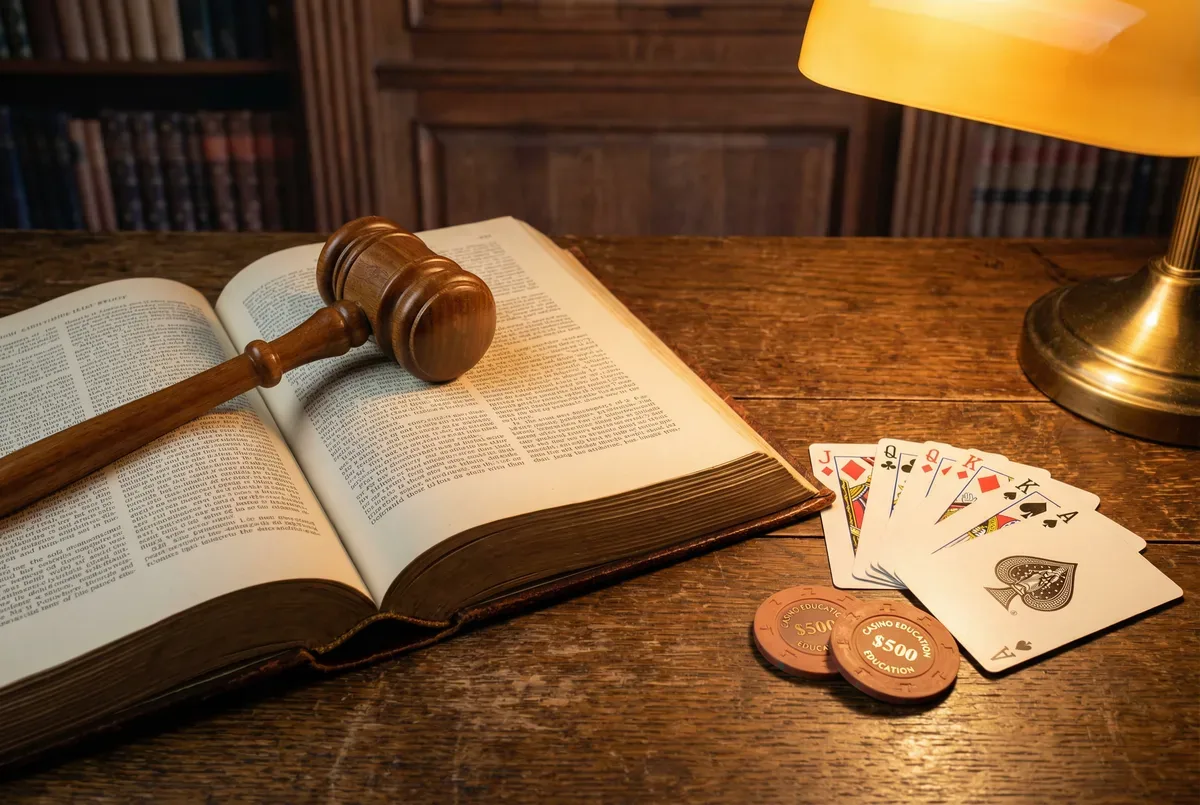
The Complete Legal History of Card Counting in American Casinos
Card counting is legal under the laws of every US state and virtually every international jurisdiction. It is not fraud, it is not cheating, and it does not involve any device or external assistance it is a cognitive skill applied to publicly available information. The cards dealt face up are visible to everyone at the table. A counter simply tracks that information more systematically than other players. US courts have affirmed this position repeatedly. Federal law defines cheating as using deception or devices to alter game outcomes counting cards in your head does neither. The confusion arises because legality of the act and a casino’s right to exclude you are entirely separate legal questions, and casinos are private property with broad rights to refuse service to anyone they choose, provided they do not violate anti-discrimination statutes.

Is Card Counting Illegal? The Direct Legal Answer
Card counting is legal everywhere in the US. It is not cheating under any gaming statute. The casino's right to ban you is a property right, not a legal judgment about your conduct.
The Legal Baseline
What Is the New Jersey Supreme Court Case?
The most significant legal ruling in the history of blackjack card counting is Uston v. Resorts International Hotel, Inc., decided by the New Jersey Supreme Court in 1982. Ken Uston, a professional blackjack player and prominent public advocate for card counters, sued Resorts International after being physically ejected from the casino for counting cards. The New Jersey Supreme Court ruled unanimously in Uston’s favor, holding that casinos licensed by the state did not have the common law right to exclude patrons for conduct that was not cheating. The court reasoned that because New Jersey had created a comprehensive regulatory framework for casino gambling, the state’s interest in regulating casino conduct, including patron exclusion, and superseded the common law property right that normally allows businesses to refuse service. The ruling was narrow and applied only to licensed New Jersey casinos, but its implications were significant. Resorts International and Atlantic City casinos were prohibited from barring skilled players.
The New Jersey Casino Control Commission responded to Uston by exercising its regulatory authority in a different direction: it ordered casinos to implement rule changes that reduced counters’ advantages without excluding them. The primary measure was mandating more frequent shuffling effectively imposing maximum penetration limits that reduced the depth of penetrable shoes. This regulatory response illustrated the legal paradox clearly: New Jersey protected counters’ right to play but allowed the industry to degrade the game conditions that made counting profitable. The net effect was that New Jersey blackjack became significantly less favorable for counters than Nevada games for most of the 1980s and 1990s. Nevada, which has no comparable consumer protection framework, retained broad property-right-based exclusion authority throughout.
- CourtNew Jersey Supreme Court, decided 1982
- PlaintiffKen Uston, professional card counter and author
- RulingCasinos cannot exclude patrons for legal skilled play
- Casino responseNJ Gaming Control Board mandated shuffle rule changes
- ScopeApplied only to NJ licensed casinos Nevada unaffected
Why Casinos Can Still Bar You: Property Rights vs. Anti-Discrimination Law?
Outside New Jersey, and arguably even within New Jersey for unlicensed private gaming, casinos retain broad authority to exclude players under property rights. A casino is a private business. Like a retail store, it can refuse entry to individuals for almost any reason that does not constitute illegal discrimination race, religion, national origin, disability, and other protected characteristics under civil rights statutes. Card counting skill is not a protected characteristic anywhere in the US. Casinos can bar a counter not because the counter is doing anything illegal but because the casino chooses not to do business with that individual. The legal framework treats this exactly like a restaurant refusing service to a patron who is too skilled at negotiating discounts the patron did nothing wrong, but the business is under no obligation to continue serving them. In Nevada, the exclusion right is explicit: Gaming Control Board regulations allow licensed casinos to refuse service to anyone not on a legally mandated exclusion list for cause, providing the exclusion does not violate civil rights statutes.
Advantages
- Counting is fully legal no criminal liability for the act itself
- Courts have consistently rejected fraud characterizations of counting
- New Jersey provides statutory protection against exclusion at licensed casinos
- No federal law restricts use of mental skills in gambling
Disadvantages
- Casinos in most states can exclude you without legal remedy
- Being trespassed and returning exposes you to criminal trespass charges
- No legal right to play blackjack at any specific venue
- Being identified as a counter can follow you across casino networks
What Is State-by-State Variations?
New Jersey remains the only US state where licensed casino exclusions specifically for blackjack card counting have been legally challenged and restricted. Nevada gaming law explicitly gives casinos the right to exclude any player whose skill level makes continued play not in the casino’s interest. Mississippi, Indiana, Illinois, and other major gaming states follow the Nevada model. Some tribal gaming compacts contain specific provisions about player exclusion, and the tribal sovereign immunity framework means that legal remedies against tribal casinos for exclusion are extremely limited. International jurisdictions vary widely: some European casinos have no legal basis for excluding skilled players, others operate under private membership frameworks that give them broader exclusion authority. A counter operating across multiple jurisdictions should understand that the legal landscape is not uniform and that assumptions based on US law do not necessarily apply abroad.
Legal Reality at the Live Table
The legal protection that counting is not cheating does not mean you can count indefinitely at any venue. The practical legal risk for most counters is not prosecution it is trespass. Being asked to leave and refusing is the only way a counter typically creates a criminal exposure. Before applying any counting skill at a real-money live table including any live platform that processes actual financial transactions understand the house rules and jurisdiction. Any live blackjack session carries genuine financial risk regardless of skill level. To understand how counting decisions feel under live dealer pressure, try a real-stakes session at stress-test this count at a live dealer table in your next session budget it as entertainment spending, not investment.
Frequently Asked Questions
In most US states, no. The legal basis for a lawsuit would require proving the casino violated a statute, which most exclusions of counters do not. Private businesses have broad discretion to refuse service outside anti-discrimination law. You could theoretically file a civil claim, but courts have consistently held that casinos have a property right to exclude gamblers they identify as advantage players outside New Jersey.
Leave voluntarily and immediately. Arguing extends the interaction, creates risk of formal trespass proceedings, and provides surveillance more footage of your behavior. There is no legal mechanism to compel the casino to let you continue playing. Refusing to leave after being asked constitutes criminal trespass in most jurisdictions this is the one area where a legal counter can face criminal charges.
The 1982 New Jersey Supreme Court ruling was a legal victory but not a financial damages award it was a ruling on the casino's right to exclude, not a monetary judgment. Uston continued to play professionally after the ruling and wrote extensively about card counting. The lasting impact was the New Jersey regulatory response, which ultimately constrained game conditions more than exclusion had.
Before you test these plays at a real table, run them through our free blackjack simulator practice unlimited hands at zero cost until every move becomes automatic.
Mathematical Risk Warning
Legal protection for card counting does not protect against financial loss. Even with a verified edge, individual sessions can result in complete bankroll loss. Understand both the legal and financial risks before any casino session.
Blackjack Academy is an educational resource. All strategy is based on mathematical expectation. Always play within your means.
Learn More
Continue your education with these related lessons.
The Powerful Big Player Technique for Spreading Bets Without Heat
The Big Player technique lets card counters spread bets dramatically without triggering casino heat by entering tables only at positive…

How Professional Blackjack Counting Teams Work and Beat the Casino
Professional blackjack teams use spotters, big players, and pooled bankrolls to achieve bet spreads no solo counter could sustain. Learn…

How to Bet Spread Without Casino Heat
Bet spreading is how counters extract profit but done wrong, it's what gets you backed off. Learn the cover-bet technique,…