
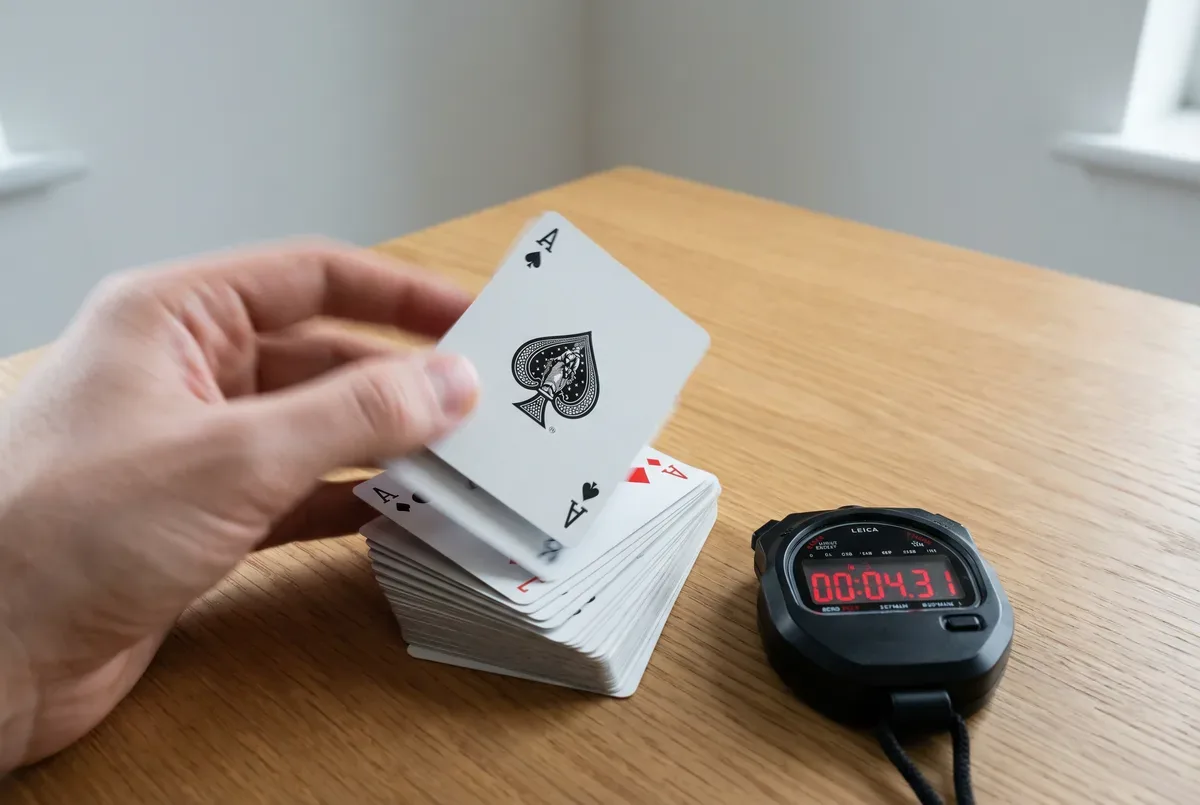
Speed Drills for Card Counting That Build Automatic Recognition Fast
Most beginners can count a deck accurately in three minutes. That is useless at a casino table where cards hit the felt at one or two per second and the dealer expects your decision in under ten. The skill gap between a trained counter and a struggling one is almost never about knowing the tag values it is about processing speed under real-world pressure.
Why Speed Not Accuracy Is the Real Bottleneck
When recognition is slow, everything else breaks down. You hesitate on decisions, lose the running count mid-hand, and visibly focus on the cards in a way that invites pit attention. Fluency the point where each card’s tag fires instantly without conscious retrieval is what separates a practice-room counter from a working one. Building that fluency is a physical conditioning process, not a knowledge problem.
The good news is that speed is trainable on a precise schedule. There are three distinct drill phases, each with a measurable pass threshold, and moving through them systematically is the fastest path to casino-ready performance. The benchmarks below define each phase so you always know exactly where you stand.
”
Single-card
How Do You Drill Under Real-World Conditions?
Counting a silent deck alone at a kitchen table is not the same cognitive task as counting at a crowded casino table with music, cocktail service, and a dealer asking for your decision. The casino simulation phase bridges that gap deliberately by introducing the distractions before you encounter them under real-money pressure.
Set up a full-deck timed run with the television on and someone nearby talking to you. You must maintain your running count, respond to verbal questions with brief answers, and finish the deck under your target time. The first few sessions will feel impossible that is the point. You are training the mental filtering system to treat the count as a background process that survives interruption.
Advanced casino simulation adds a secondary task: convert the running count to a true count at random intervals by dividing by a simulated decks-remaining number. Call it out loud. Then continue counting. This two-layer drill directly mirrors the actual table environment where you must run the count, decide true count, and simultaneously act on a hand decision all within a few seconds.
The Casino-Ready Benchmark and What Comes Next
Five consecutive error-free full-deck runs at under 25 seconds achieved under distraction conditions is the accepted casino-ready benchmark for Hi-Lo blackjack card counting. At that speed, a single-deck dealt at normal casino pace gives you enough processing headroom to count, calculate true count, and make all decisions without cognitive overload. Below 25 seconds with errors, or above 25 seconds without them, you are not yet ready for a live session with real money on the line.
Once you have cleared the benchmark, the next skill layer is true-count conversion accuracy and speed a separate drill cycle from raw card recognition. At that point, your recognition reflexes are a solved problem you can trust while your conscious attention handles bet spreading, cover play decisions, and table observation. If your speed ever degrades during a break from practice, a one-week re-conditioning cycle using Week 1 and Week 2 drills will restore it quickly. If you want to test your trained count against a live dealer before committing to a casino floor session, see this edge in live counted play immediately runs in real time with an actual dealer but treat it as real money is at stake, because it is.
Frequently Asked Questions
Most dedicated practitioners reach the 25-second error-free benchmark in four to six weeks of daily 20-minute practice sessions. Progress is rarely linear speed tends to plateau and then jump. Skipping the pair-cancellation phase and going straight to full-deck runs typically doubles the time to benchmark.
Start with a single deck until you clear the single-card and pair-cancellation phases. Once you reach the full-deck benchmark, add multi-deck practice shuffle two or three decks together and run them straight through. Multi-deck drills build the stamina and true-count conversion speed required for 6-deck and 8-deck shoe games.
Inconsistent error detection during practice. Many counters time themselves but do not verify the final count against the expected zero. If you allow small errors to go uncorrected in practice, your count will drift in the casino where there is no error check. Always verify the end count against deck composition after every drill run.
Before you test these plays at a real table, run them through our free blackjack simulator practice unlimited hands at zero cost until every move becomes automatic.
Mathematical Risk Warning
Card counting requires extensive practice and carries financial risk.
Blackjack Academy is an educational resource. All strategy is based on mathematical expectation. Always play within your means.
Learn More
Continue your education with these related lessons.
The 5 Most Common Mistakes That Get Card Counters Caught Fast
Most card counters aren't caught because casinos are brilliant they're caught because of predictable, avoidable mistakes. Here are the seven…

How to Back-Count Tables and Wong Into Positive Shoe Counts
Wonging standing behind a blackjack table, counting cards without betting, and jumping in only at positive counts is the highest…

Why Card Counting in Blackjack Tournaments Requires a Completely Different Approach
Tournament blackjack has different math than regular play. Chip accumulation, elimination rounds, and bet-sizing relative to opponents change every decision…