
How to Practice Card Counting at Home
Card counting is not a talent you discover at the table. It is a reflex you build through structured repetition away from the casino. Every counter who performs reliably under live pressure has followed some version of the same progression: isolated card recognition, speed drilling, distraction training, and live simulation. Skipping stages produces a counter who counts accurately at home and falls apart the first time a dealer makes small talk.
The Four Stages of Card Counting Skill Development
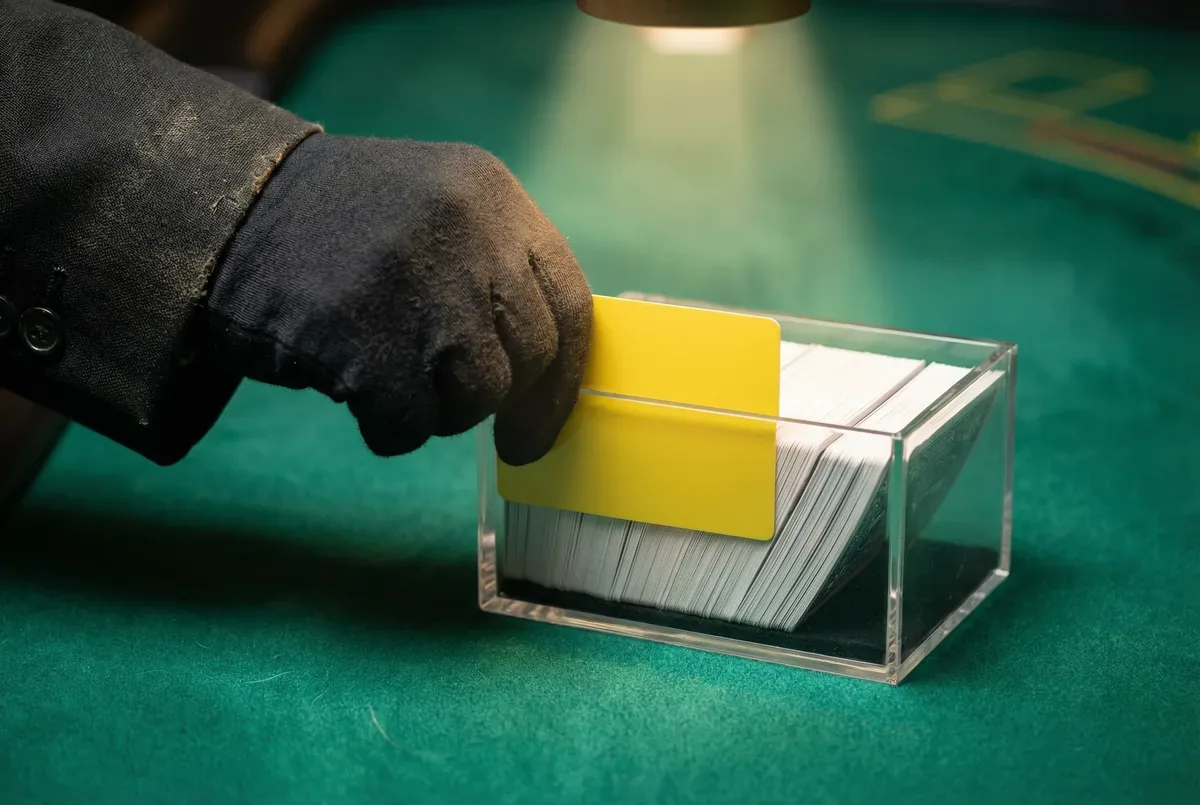
The four-stage framework organizes this progression deliberately. Stage 1 establishes card-value recognition as an automatic response no hesitation on any card. Stage 2 builds speed until counting a full deck takes under thirty seconds. Stage 3 introduces the noise and simultaneity of a real table by adding distractions and multi-hand counting. Stage 4 is a dress rehearsal simulated live conditions before real money enters the equation.
Each stage has a measurable exit criterion. You do not advance by feeling ready you advance by hitting the time or accuracy target. This objectivity removes the wishful thinking that leads players to a casino before their counting reflex is actually reliable. The targets in this guide are conservative. Meeting them means you are genuinely prepared.
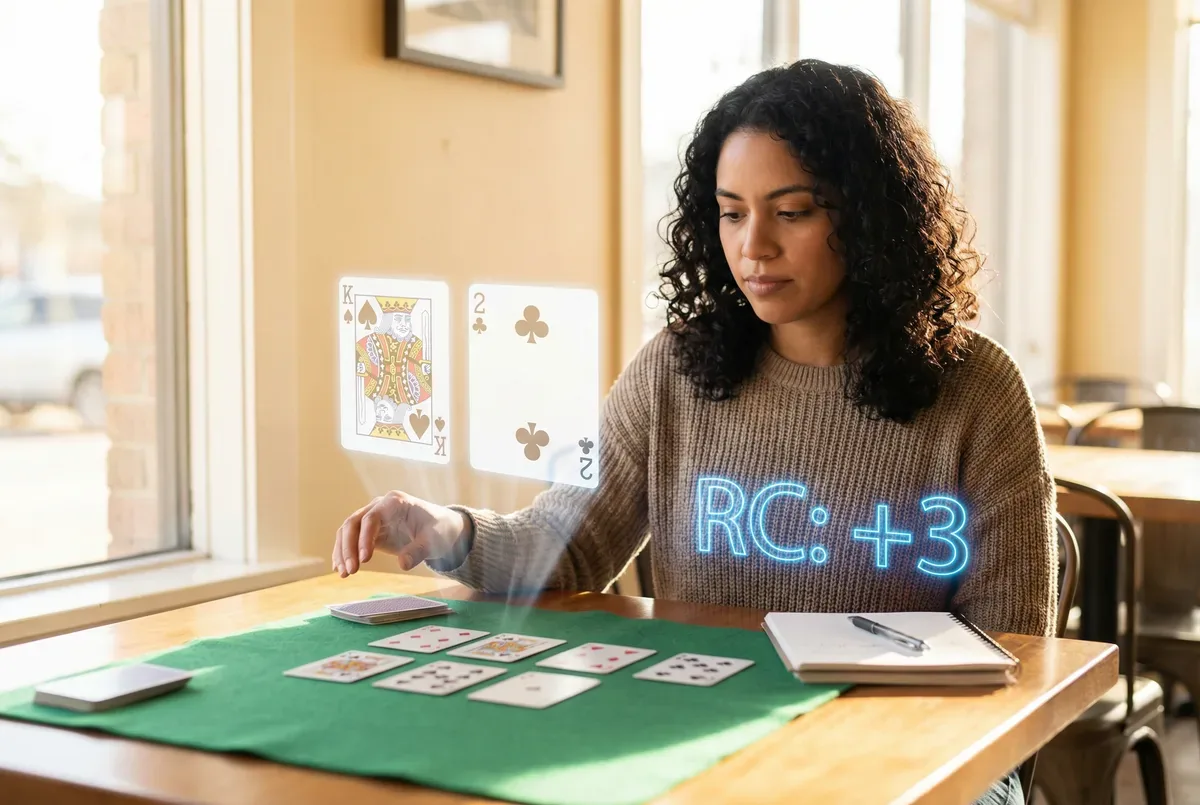
Take a single deck. Flip cards one at a time. Assign: 2–6 = +1, 7–9 = 0, 10/J/Q/K/A = −1. Running count: start at 0. Target: complete 52 cards in under 30 seconds. Verification: final count should be exactly 0 (balanced deck). Repeat 3× per session. 5–7 days to reach target speed.
What Are Stage 1 and 2 Single-Card Counting and Speed Drills?
Stage 1 is about accuracy before speed. When you flip the eight of spades, your brain should register zero before you consciously think about it. When you flip the king of clubs, it should register −1 immediately. This automatic recognition is the foundation that every subsequent stage builds on. If you have to think about any card’s value, you are not ready for Stage 2.
The balanced-deck verification is essential. Hi-Lo assigns +1 to low cards (2–6) and −1 to high cards (10–A), with neutral cards in between. A standard 52-card deck contains exactly 20 low cards, 20 high cards, and 12 neutral cards. A perfect count through all 52 cards returns to exactly zero. If your ending count is not zero, you made at least one error. Identify the error and restart do not advance until you complete three consecutive zero-ending counts.
Stage 2 increases speed and introduces pair counting. Instead of flipping cards one at a time, flip two cards simultaneously and call their combined value as a single number. A 3 and a king cancel to zero call it immediately, do not add +1 then subtract 1. A 5 and a 7 produce +1. Two aces produce −2. Training your brain to resolve pairs without internal arithmetic dramatically increases your counting speed under real table conditions, where several cards are often exposed at once.
The Stage 2 speed target is a full 52-card deck in under twenty seconds using two-card flips. This is roughly two cards per second, which comfortably covers the pace of a live multi-player blackjack round where cards are dealt quickly. Once you reach twenty seconds with zero count errors, you are ready to progress.
What Are the Stage 3 Counting Full Hands With Distractions?
A live blackjack table is not a quiet room. There are conversations at adjacent seats, dealer announcements, music overhead, the clatter of chips, and occasional questions directed at you. Stage 3 replicates this environment deliberately. You are not training to count in silence you are training to count while everything around you is competing for your attention.
Set up a phone playing a sports broadcast or podcast. Count two hands (4–6 cards) simultaneously dealer and player. Maintain running count while tracking both hands. Aim: zero hesitation on any card. Test: flip a challenge card mid-count and state the count immediately. This simulates table noise, dealer conversation, and adjacent player hands.
The multi-hand element of Stage 3 replicates what you will encounter at a full table. At a seven-player game, you have up to fifteen cards exposed per round two per player plus the dealer upcard. You do not need to count them sequentially. You scan the table left to right, updating the running count as each card registers. The target is that no card requires deliberate attention. Every card you see simply modifies the running total without pausing your other cognitive processes.
If you notice your count slipping when the podcast hosts argue or a commercial plays loudly, that is exactly the friction Stage 3 is designed to expose. The solution is not to turn off the distraction it is to practice until the distraction no longer matters. Your count should survive anything that happens in the room. When it does, Stage 3 is complete.
What Is the Stage 4 Live Simulation Before a Real Casino?
Stage 4 is the dress rehearsal. You set up a simulated blackjack game deal multiple hands from a six-deck shoe, manage chips, make bet-sizing decisions based on your true count, and execute cover behavior as if floor supervisors are watching. The goal is to discover every failure mode that will appear at a real table, in an environment where it costs nothing but time.
In Stage 4 simulation, you practice the full sequence: start count, running count through each round, deck estimation, true count conversion, bet sizing, blackjack basic strategy decision, and cover behavior. The last element behaving like a casual player while counting precisely is something many home practitioners skip entirely. Do not skip it. The moment you sit at a live table, you will discover that appearing relaxed while doing mental arithmetic under observation is a separate skill that requires deliberate rehearsal.
Exit criteria for Stage 4: complete a full simulated six-deck shoe with zero count errors, correct bet sizing at each true count level, and correct blackjack basic strategy on every hand. Time yourself. If this takes more than about two hours for a six-deck simulation at realistic dealing speed, you are not ready. Build speed before moving to a live environment.
Stage 1 target
per deck
Stage 2 target
per deck at 2 cards/flip
Stage 3 target
across full shoe
When You’re Ready to Count in a Live Game
The benchmark for readiness is not how counting feels at home it is whether you can count without counting. When the reflex is fully built, you will not experience blackjack card counting as a task. Cards will update your running total passively, the way you absorb the score of a football game without consciously calculating it. If counting still feels like work, more practice is the answer.
Your first live sessions should use a minimal bet spread perhaps two or three units maximum until you have confirmed that the counting reflex holds under live pressure. The difference between home and a real table is not the cards or the rules. It is the social environment, the ambient noise, the pace of play set by someone else, and the genuine financial consequence of every decision. These factors affect performance in ways that are impossible to fully anticipate until you experience them.
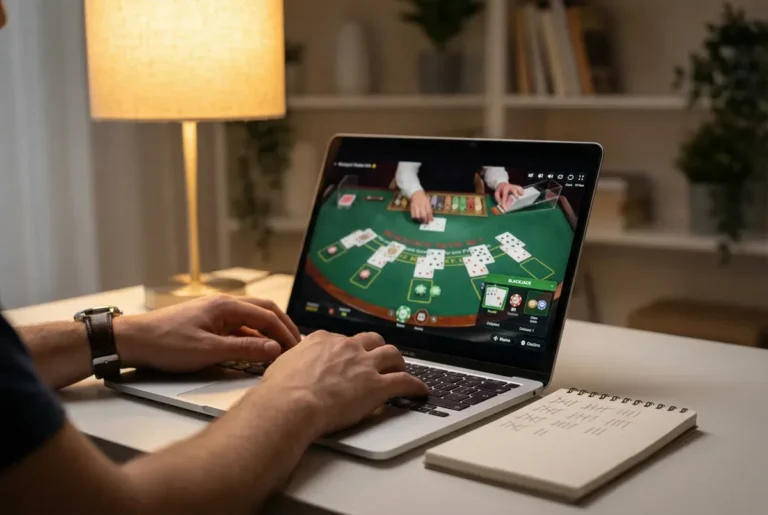
The bridge between Stage 4 simulation and a full live casino floor is a live dealer online environment. If you want to test your count against a genuine multi-deck shoe dealt by a human at real money stakes, the live blackjack tables at apply the count with real money down in your next session provide exactly that exposure with the important understanding that real money is on the line and losses are real. It is a genuine test, not a free trial. Use it as one session of calibration before moving to higher-stakes floor play.
Frequently Asked Questions
Most dedicated learners complete the four-stage framework and reach reliable live performance in four to eight weeks of fifteen to thirty minutes of daily practice. Stage 1 and 2 typically take one to two weeks each. Stage 3 takes one to two weeks. Stage 4 simulation takes another week of full-shoe practice before the skill is stable enough for live play.
One or more standard 52-card decks and a timer. Six decks are ideal for simulating real casino shoe conditions. No software or apps are required, though some counters use training software to simulate multi-hand play. Physical cards are preferable for developing the tactile and visual pattern recognition that a live table demands.
You are ready when you can complete a full six-deck shoe simulation with zero count errors, correct bet sizing at every true count level, and correct basic strategy on every hand all while maintaining natural-looking behavior. If counting feels automatic rather than effortful, and Stage 4 simulation produces no errors across multiple full shoes, you are genuinely prepared for a live environment.
Before you test these plays at a real table, run them through our free blackjack simulator practice unlimited hands at zero cost until every move becomes automatic.
Use our free blackjack calculator to model the exact expected value for any rule combination or hand situation before you sit down.
Practicing at Home Does Not Eliminate Casino Risk
Even a well-trained counter faces real financial risk at a live table. Variance can produce losing sessions regardless of counting accuracy. Casino surveillance may identify and restrict you. Never play with money you cannot afford to lose, and treat your first live sessions as skill calibration rather than profit generation.
Card counting provides a long-run statistical advantage. Individual sessions involve significant variance and can result in losses even with a positive true count.
Learn More
Continue your education with these related lessons.
Card Counting for Online Blackjack That Actually Works
RNG blackjack reshuffles after every hand counting is impossible. Live dealer blackjack is different. Here is exactly what works, what…

Complete Card Counting Comparison of Multi-Deck vs Single-Deck Games
Single-deck counting is fundamentally different from six-deck work. Learn how deck count changes every variable that matters TC impact, penetration,…
Why Continuous Shuffling Machines Completely Destroy the Counter’s Edge
Continuous shuffling machines eliminate card counting advantage entirely. Learn exactly how CSMs work, why the running count resets constantly, and…