
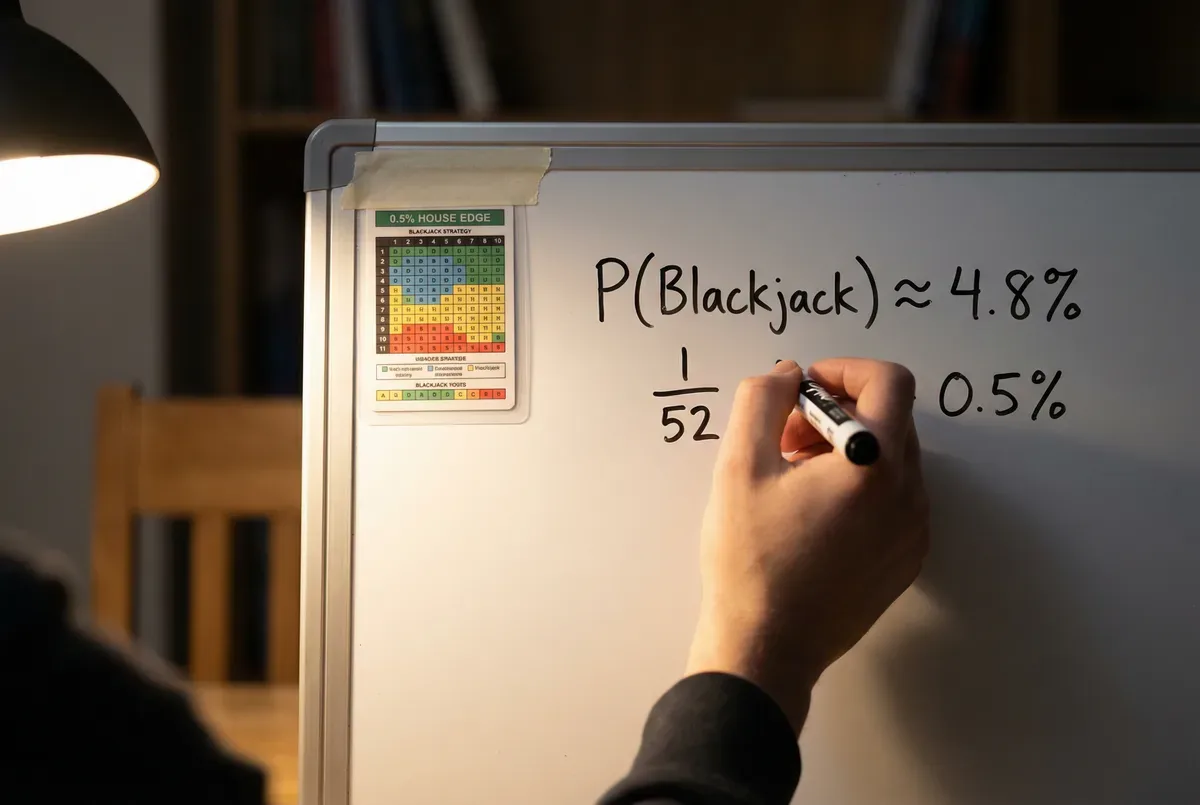
How the Casino Calculates the House Edge and Profits from Blackjack
The blackjack house edge is the long-run percentage of every dollar wagered that the casino expects to keep, expressed as the mathematical expectation calculated across every possible hand outcome weighted by its probability.
What the House Edge Actually Is
It is not the percentage of sessions you lose, not the ratio of wins to losses, and not a number that fluctuates with your personal luck. It is a fixed mathematical property of the game under a specific set of rules, as deterministic as the formula used to compute it. A blackjack house edge of 0.5% on a blackjack game means that for every $100 in total action wagered over millions of hands, the casino retains $0.50 in expectation. Short-run variance can produce any result. The edge is a long-run statement, not a session guarantee.
Understanding this distinction matters because most recreational players treat the blackjack house edge as an abstraction a warning label they acknowledge and ignore. Card counters understand it as a precise number that can be shifted, reduced, and in favorable conditions, reversed. The calculation is the starting point for all of that work.
House Edge = Σ (Probability of outcome × Net payoff per unit wagered) across all possible hand outcomes
House Edge Formula
How the Calculation Is Actually Built?
The blackjack house edge calculation is built by enumerating every possible initial two-card combination against every possible dealer upcard, computing the optimal expected value for each combination under the given rule set, and summing those values weighted by their frequency of occurrence.
For a single hand, the calculation must account for: the probability of being dealt each two-card total, the probability of each dealer upcard, the decision tree branching from each player action (hit, stand, double, split), the dealer’s draw probabilities given their upcard and the remaining composition of the deck, and the payoff structure including blackjack at 3:2, push at 1:0, loss at 1:-1, and double payoffs at 2:1 or 2:-1.
The complete calculation for a six-deck game requires working through thousands of distinct scenarios. This is why early blackjack house edge estimates were rough approximations the full combinatorial analysis was not practical by hand. Julian Braun’s IBM computer simulations in the 1960s and 1970s were the first accurate computations. Modern programs like CVCX can calculate edge to five decimal places under any rule combination in seconds.
Return to Player (RTP) is simply the complement of blackjack house edge: a game with 0.5% blackjack house edge has 99.5% RTP. The terms are used interchangeably but with different frames casino operators quote blackjack house edge, slot marketing quotes RTP. For blackjack, the relationship is direct and the underlying calculation is identical.
| Rule Set | House Edge | Notes |
|---|---|---|
| S17, DAS, 6D, 75% pen | ||
| 0.44% | ||
| Near-optimal for basic strategy player;H17, DAS, 6D, 75% pen | ||
| 0.62% | ||
| H17 adds ~0.2% to house edge;S17, No DAS, 6D | ||
| 0.57% | ||
| Loss of DAS worth ~0.14%;S17, DAS, 2D, 70% pen | ||
| 0.19% | ||
| Fewer decks favor player significantly;S17, DAS, 8D, 65% pen | ||
| 0.52% | ||
| More decks and shallow pen raise edge;H17, No DAS, No RSA, 6D | ||
| 0.87% | ||
| Worst common rule combination |
How Deck Count and Rules Shift the Edge?
Fewer decks in play reduce the blackjack house edge because a single-deck game has greater card removal effect removing one card from a 52-card deck changes the composition more dramatically than removing that same card from a 416-card eight-deck shoe.
Going from eight decks to six adds approximately 0.02% to the player’s favor. Moving from six to two decks adds roughly 0.19%. A genuine single-deck game dealt to favorable rules can carry a player edge under blackjack basic strategy alone which is precisely why single-deck games are almost extinct in traditional casinos and why the few that remain are typically offset by reduced blackjack payouts (6:5 instead of 3:2 adds 1.39% to the blackjack house edge, completely obliterating the single-deck advantage and then some).
Individual rules shift the edge in measurable increments. The dealer standing on soft 17 versus hitting it is worth approximately 0.20% to the player one of the most significant single-rule differences. Doubling after splitting is worth about 0.14%. Re-splitting aces adds roughly 0.06%. Late surrender is worth approximately 0.07% under optimal usage. These numbers are additive across a rule set, which is why the difference between the best and worst common blackjack games can exceed 1.5% in blackjack house edge a enormous gap when evaluated over thousands of hands.
How Card Counting Flips the Edge and the Compound Effect?
Card counting inverts the blackjack house edge calculation by exploiting a property the static analysis assumes away: the composition of the remaining deck is not fixed it changes with every card dealt, and those changes predictably shift the edge.
When the remaining shoe is rich in tens and aces, both the player and dealer benefit from the card distribution but the player benefits more. Blackjacks pay 3:2 to the player but only 1:1 to the dealer (the dealer never receives a blackjack bonus). The player can double and split at high-count moments; the dealer must follow fixed rules regardless. High counts favor doubling on 10 and 11, splitting more pairs, and standing on borderline totals where the dealer is more likely to bust with a ten underneath. These strategic adjustments are the mechanism by which a positive true count produces a positive player expectation.
The compound effect operates at scale. A counter with a 0.5% edge over a six-deck game playing 100 hands per hour at an average bet of $50 generates approximately $25 per hour in expectation. That number is small session to session and easily swamped by variance. Over 10,000 hands, roughly 100 sessions, and the edge resolves statistically and the counter’s results converge toward their theoretical EV. This is why professional blackjack card counting requires a bankroll large enough to survive the variance interval between starting and reaching the N0 convergence point.
Common Myth
“The house always wins long-term no player can beat the casino over thousands of hands.”
It is true for fixed negative-EV games: slots, roulette, craps all carry edges that never move regardless of play history. Blackjack is misclassified alongside these games.
The Reality
Card counters with a genuine positive edge do beat the casino long-term. The mathematical conditions that make this possible card removal effect, betting correlation with remaining composition are real and exploitable. Multiple documented counters and teams have shown positive long-run results over careers spanning hundreds of thousands of hands.
A skilled counter playing optimal basic strategy plus index plays with a 1–12 bet spread achieves approximately +0.5% to +1.2% player edge depending on game conditions a genuine long-run advantage.
Using the House Edge Calculation to Choose Your Game
Basic strategy reduces the blackjack house edge to its lowest possible value without counting approximately 0.4% to 0.6% depending on the rule set but it does not eliminate it, because blackjack basic strategy is derived from fixed infinite-deck probabilities that do not account for shoe composition.
A blackjack basic strategy player makes the same decision on every identical hand total regardless of what cards have already been dealt. A counter adjusts those decisions based on remaining composition. The difference between blackjack basic strategy and count-adjusted index plays accounts for approximately 0.15% to 0.25% of total player edge, depending on which index plays are incorporated. This is not the majority of counting’s value bet variation against true count provides roughly 70–80% of counting’s expected value but index plays are the component that pushes edge decisively positive in strong counts.
The practical consequence for serious students is this: blackjack basic strategy is the mandatory prerequisite, not the destination. Mastering blackjack basic strategy eliminates the decision errors that would cost you 1–3% per hand in a typical recreational player. Counting and index plays then add positive expectation on top of that clean baseline. Attempting to count without solid blackjack basic strategy is like building on a cracked foundation the structure above cannot stand. Counters who want to experience real-money table play while applying these skills can practice strategy under genuine casino conditions at see this edge in action at a live table immediately, but be clear that this involves real financial risk and no mathematical edge exists unless you are counting in a game where counting is viable.
Frequently Asked Questions
Approximately 0.44% under perfect basic strategy. This is the long-run percentage of every dollar wagered the casino retains in expectation. Individual sessions will vary widely due to variance, but over hundreds of thousands of hands this number resolves accurately.
Switching from 3:2 to 6:5 blackjack payouts adds approximately 1.39% to the house edge. This single rule change is larger than all other rule variations combined and makes 6:5 games unbeatable for card counters under any realistic bet spread.
No. Card counting requires sufficient penetration (75%+ is the practical floor), hand-dealt cards rather than a continuous shuffle machine, and favorable base rules. Low-penetration games and CSM games effectively eliminate the counting edge regardless of how accurately the player tracks the count.
Before you test these plays at a real table, run them through our free blackjack simulator practice unlimited hands at zero cost until every move becomes automatic.
Mathematical Risk Warning
Casino games always carry financial risk. House edge calculations describe long-run expectations, not short-run outcomes. Never wager more than you can afford to lose entirely.
Blackjack Academy is an educational resource. All strategy is based on mathematical expectation. Always play within your means.
Learn More
Continue your education with these related lessons.
What Actually Happens When a Casino Catches You Counting Cards
A casino backoff is not a legal event it is a private business decision. Here is exactly what happens at…

Online Blackjack vs Live Casino Which Gives You the Better Counting Edge
Learning card counting has a four-stage progression and online live dealer blackjack is the ideal intermediate step before committing real…

Build a Proven Card Counting Training Routine That Delivers Real Results
A card counting training routine is not just flipping through a deck. It is a structured system of drills with…