
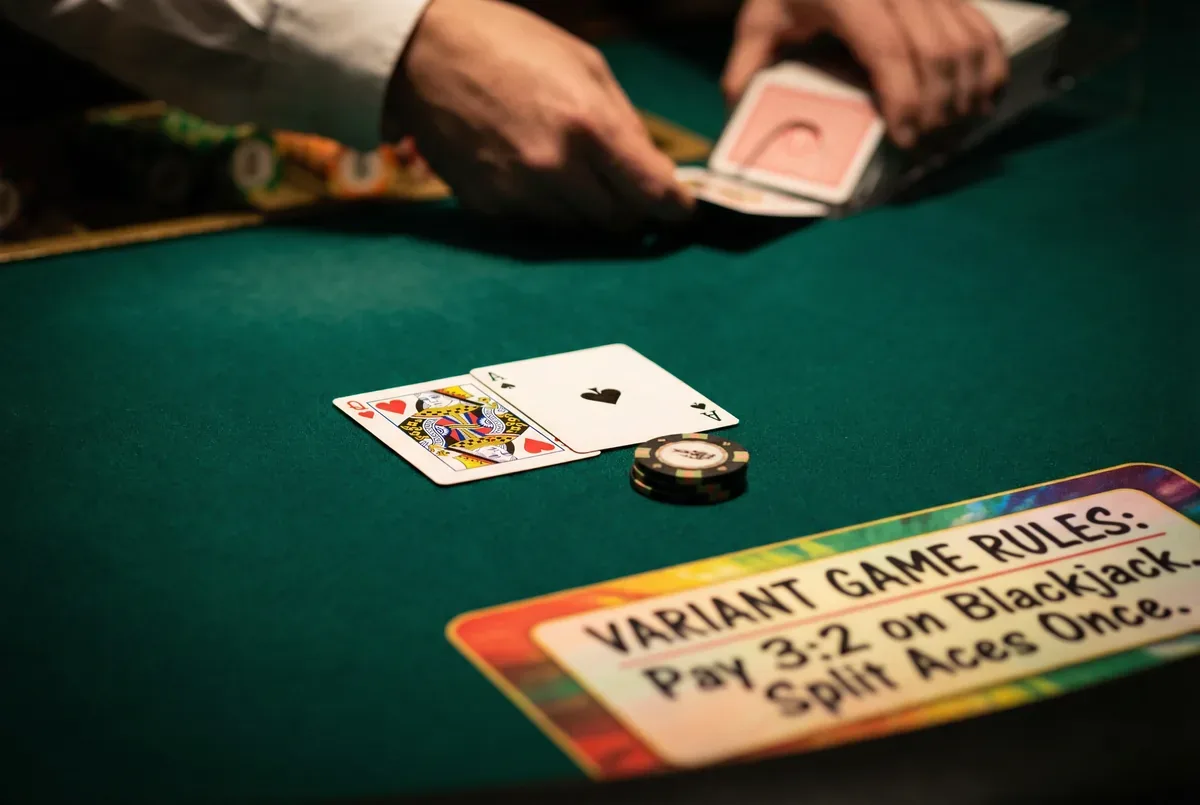
How Card Counting Works in Spanish 21 and Other Blackjack
Spanish 21 uses a 48-card Spanish deck the standard 52-card deck with all four 10-pip cards removed, leaving only jacks, queens, and kings as the high-value 10-point cards. That single structural change, applied to every one of the six or eight decks in the shoe, fundamentally rewrites the composition that blackjack card counting systems are built around. You are not sitting down to a familiar game with a cosmetic rebrand. You are playing a mathematically distinct game that requires a different analytical framework from the ground up.
Spanish 21 Is Not Standard Blackjack
The game compensates for the removed 10s with an extensive set of bonus payouts: a 7-7-7 in suited spades pays $1,000 on a qualifying bet, a 6-7-8 of mixed suits pays 3:2, and any five-card 21 pays 3:2 regardless of how it is composed. The player also gains rules unavailable in standard blackjack doubling down on any number of cards, surrendering after a double, and re-splitting aces. The casino engineers these bonuses to return roughly equivalent value to the removed 10-density advantage, keeping the blackjack house edge near 0.40% under optimal blackjack basic strategy. That is a competitive figure. But competitive blackjack house edge under blackjack basic strategy and a viable counting environment are two separate things entirely.
Removing the 10s is not a neutral design choice from a card counter’s perspective. In Hi-Lo, ten-value cards carry a point value of -1. Their systematic removal from every deck in the shoe means the baseline composition of a Spanish 21 shoe is permanently skewed relative to what Hi-Lo was designed to track. A counter sitting at a Spanish 21 table with a Hi-Lo running count in their head is tracking a signal that was calibrated for a different game. The information is not wrong it is just tuned to the wrong instrument.
Classic Blackjack
Spanish 21
- 52 cards
- 16 (10s + faces)
- 30.8%
- Works as designed
- ~0.50%
- +0.5–1.5%
- Standard
- None
- Late surrender only
- 48 cards (10s removed)
- 12 (faces only)
- 25.0%
- Requires modification
- ~0.40%
- Lower, harder to reach
- Same rules apply
- 7-7-7, 6-7-8, 5-card 21 etc.
- After doubling allowed
Why Removing the 10s Breaks Standard Hi-Lo?
Hi-Lo is a balanced count: for every -1 card removed from the shoe, there is a corresponding +1 card that offsets it across the full deck. The running count starts at zero and the system’s balance ensures that a freshly shuffled shoe always returns to zero if every card is counted through. The indices the specific true count numbers that tell you when to deviate from blackjack basic strategy and when to raise your bet are derived from simulations run against a standard 52-card deck. The fundamental assumption built into every one of those index numbers is that tens are present at approximately 30.8% of all cards.
In Spanish 21, that figure is 25% before the first card is dealt, and it never rises. Four tens per deck are permanently absent. This means the decision points where Hi-Lo tells you to deviate stand on 16 vs 10 at TC +1, double a hard 10 vs ace at TC +4, take insurance at TC +3 are all wrong when applied to a Spanish shoe. Each index was calculated against a different deck composition. Applying them without modification does not make you a slightly less accurate counter. It makes you a counter whose positive-count bet raises and strategic deviations are systematically miscalibrated.
The correct approach is a counting system purpose-built for the 48-card Spanish deck. The Spanish Optimal Count adjusts both the point values assigned to card types and the index numbers for strategy deviations, accounting for the altered high-card density. Some researchers have also published modified Hi-Lo index sets for Spanish 21 essentially a table of corrected thresholds that partially compensates for the 10-removal. Neither approach matches the edge available in a well-penetrated standard shoe, but the modified count is dramatically more accurate than an unmodified Hi-Lo applied to a game it was never designed for.
There is also a knock-on effect on insurance decisions. Insurance in standard blackjack becomes a positive-EV bet when the true count reaches approximately +3 under Hi-Lo, because that count tells you the shoe contains a higher-than-normal proportion of tens. In Spanish 21, the concept of tens-rich does not map cleanly to the same threshold because tens were never at full density to begin with. A counter who takes insurance at TC +3 in a Spanish shoe is making a decision that is calibrated for a composition that does not exist in that game.
Common Myth
“The same Hi-Lo count and indices work across all blackjack variants”
Hi-Lo is marketed as a universal system and most counting guides teach it without variant-specific caveats, leading counters to assume it transfers directly to Spanish 21, Pontoon, and other games.
The Reality
Hi-Lo indices are derived from simulations against a 52-card deck with standard ten-density. Spanish 21 removes all four 10-pip cards per deck, changing the baseline composition so significantly that standard indices produce wrong strategic and betting decisions every time they are applied.
Using unmodified Hi-Lo in Spanish 21 erodes your theoretical edge and converts positive-count situations where you should have an advantage into hands played with the wrong strategy and the wrong bet size.
What Are Pontoon and Other Variants Counting Viability?
Pontoon is the British predecessor of blackjack and shares its 52-card deck, which means it does not suffer the structural composition problem that undermines counting in Spanish 21. Both of the dealer’s cards are face-down, the dealer wins all ties, and a five-card trick any five-card hand that does not bust pays 2:1. A Hi-Lo adaptation is theoretically viable in Pontoon because you are tracking a standard deck. The practical problem is that Pontoon is almost never offered in a live shoe game with meaningful penetration, and the face-down dealer hand removes information that skilled players in standard blackjack rely on for certain decisions.
Penetration is the deeper obstacle across virtually every variant game. Counting requires the accumulation of meaningful information across multiple hands before the deck composition shifts enough to justify raising bets significantly. If the shoe is reshuffled after every hand as in every online RNG version of Pontoon, Blackjack Switch, or Super Fun 21 counting produces no information whatsoever. There is no composition to track because the deck is refreshed before it can shift. The entire mathematical basis for counting dissolves the moment a continuous shuffle or per-hand reshuffle enters the equation.
Super Fun 21, Free Bet Blackjack, and Double Exposure all use standard 52-card decks, making them structurally countable. But each game’s player-favorable rules require the casino to extract value somewhere else almost always through a reduced natural payout. Super Fun 21 pays even money on a blackjack unless it is a diamond suited natural, which pays 2:1. Free Bet Blackjack offers no-cost doubles and splits but pays 6:5 on naturals at many tables. The math is not generous. A perfect count in these games delivers a thinner edge than the same effort applied to a standard 6-deck 3:2 game, often thin enough that the mental overhead exceeds the financial return in any realistic session.
Double Exposure is worth a separate mention because its most dramatic rule both dealer cards are face-up initially sounds like it would obliterate the blackjack house edge. In practice, the rule is offset by the dealer winning all ties except a natural, and naturals paying even money. Counting in Double Exposure is viable in theory, but the game is rarely spread in shoe form with meaningful depth, and the information advantage of seeing both dealer cards operates independently of the count skilled blackjack basic strategy players in Double Exposure play essentially optimally without counting at all, leaving little incremental value for the counter to extract.
How Do You Count Only Works Where Composition Matters?
Card counting works because cards have memory a card dealt from a physical shoe cannot reappear until that shoe is reshuffled. As high cards leave the deck, the proportion of low cards rises. As low cards are consumed, the proportion of high cards increases. That shifting composition is what the count tracks, and it is what creates the information asymmetry between a counter and a player operating on static expected values. The count is only actionable if three conditions are simultaneously met: the game uses a physical shoe, the shoe is dealt to meaningful depth before reshuffling, and the base deck has not been structurally altered in a way that invalidates your count’s calibration.
Spanish 21 meets the first two conditions but fails the third unless you deploy a purpose-built system. Most other variant games either fail on penetration online RNG games, frequent shufflers, single-deck games shuffled every two hands or deliver such thin theoretical edges after rule compensation that the effort required to learn and execute a modified count simply cannot be justified by the expected hourly return. This is not a judgment about whether variant games are enjoyable or strategically interesting. It is a mechanical observation: counting exists to exploit composition shifts in a standard deck, and the more a game departs from that standard, the less your counting system applies.
The strongest environments for blackjack card counting remain the standard 6-deck and 8-deck games offered in most live casinos, dealt to 65–75% penetration, with a 3:2 natural payout. Hi-Lo was designed for these games. The indices were calibrated for these games. The bet-spread calculations assume these games. If you want to maximize the return on the hundreds of hours it takes to become a reliable counter, those games are where your practice belongs.
Variant games are not counting environments they are entertainment products with interesting rule sets. Spanish 21 requires a specialist system that most serious counters have not studied, and the achievable edge even with a correct modified count is lower than in a standard shoe. If a game excites you for the bonus payouts or the rule variations, play it for that reason. But when you sit down to grind a counting edge, standard multi-deck blackjack is the correct table. Your system was designed for it. Your indices are accurate in it. That precision matters.
Applying Variant Knowledge Before You Sit Down
Understanding why Hi-Lo does not transfer cleanly to Spanish 21 gives you a sharper pre-game checklist regardless of whether you count. Every blackjack table you approach can be evaluated with two questions: does this deck have standard composition, and will this shoe be dealt with genuine penetration? If the answer to either question is no, the conditions for advantage play are absent or severely compromised. Walking past a Spanish 21 table or an online variant game is not discipline it is just knowing what your system needs to work.
The same habit applies when researching casinos before a trip or evaluating an online platform. A Spanish 21 table may advertise a blackjack house edge below 0.50% and that number is real and accurate under optimal blackjack basic strategy. But it is computed against a different game, with different blackjack strategy charts, and it creates a different counting environment. Knowing that distinction prevents a common mistake: sitting at a game that looks favorable because the headline edge is low, then applying strategy and counting tools calibrated for standard blackjack and wondering why the results do not match expectations.
If you want to put this framework to the test in a live environment with real dealer decisions and real money on the line, the standard multi-deck tables at practice this count in live conditions this week offer exactly the game your counting practice was built for keep in mind that every chip there represents real money, the blackjack house edge is never zero even with a positive count, and bankroll management is not optional.
Frequently Asked Questions
Not without modification. Spanish 21 removes all four 10-pip cards from each deck in the shoe, permanently reducing ten-density from 30.8% to 25.0%. Hi-Lo indices are calibrated for standard ten-density applying them to a Spanish shoe produces systematically wrong betting and strategy decisions. A purpose-built counting system such as the Spanish Optimal Count is required to maintain any theoretical edge in this game.
Pontoon uses a standard 52-card deck, so the composition issue that affects Spanish 21 does not apply. The practical problem is penetration: Pontoon is almost never offered as a live shoe game with meaningful depth, and online versions typically reshuffle every hand using a random number generator. Without penetration, no counting system produces actionable information regardless of how it is constructed.
Standard 6-deck and 8-deck blackjack games with 65–75% shoe penetration and 3:2 natural payouts remain the strongest environment for card counting. Variant games like Spanish 21, Pontoon, Super Fun 21, and Free Bet Blackjack either require specialist counting systems, offer thin post-adjustment edges, or lack the penetration that makes counting viable making the effort-to-return ratio far worse than in standard multi-deck games.
Before you test these plays at a real table, run them through our free blackjack simulator practice unlimited hands at zero cost until every move becomes automatic.
Mathematical Risk Warning
Card counting knowledge belongs in carefully selected games. All live blackjack involves real financial risk never bet money you cannot afford to lose, and understand that even a theoretical edge does not guarantee short-term results.
Blackjack Academy is an educational resource. All strategy is based on mathematical expectation. Always play within your means.
Learn More
Continue your education with these related lessons.
The Real Mathematics of Blackjack Every Serious Player Must Master
Understanding blackjack's probability tables transforms card counting from rule-following into genuine mathematical reasoning. Learn bust probabilities by hand total, dealer…

How to Back-Count Tables and Wong Into Positive Shoe Counts
Wonging standing behind a blackjack table, counting cards without betting, and jumping in only at positive counts is the highest…
The Full Spectrum from Solid Basic Strategy to Professional Card Counting
There is a complete skill spectrum between playing basic strategy and counting cards professionally. This guide maps every stage with…