
Complete Reference for All 18 Illustrious Card Counting Deviations
Index plays are deviations from blackjack basic strategy that become correct at specific true count thresholds. Basic strategy is mathematically optimal when no deck composition information is available it assumes a neutral shoe. When a card counter tracks the true count, deck composition is no longer unknown. High positive true counts mean the remaining shoe is rich in tens and aces. High negative counts mean it is depleted of tens. These shifts in composition change the correct play for specific hands, and the true count value at which the deviation becomes correct is called the index number.
What Are Index Plays and Why They Exist
The Illustrious 18 is the list of the 18 index plays that produce the highest combined EV gain for a Hi-Lo counter. The term comes from Stanford Wong’s research, later refined by Don Schlesinger in Blackjack Attack, which ranked all known deviations by their contribution to total counting edge. The key finding is that the top 18 deviations capture approximately 80% of the total EV available from all possible index plays combined. Learning every deviation that exists produces minimal additional gain over learning just these 18, which makes the Illustrious 18 the practical memorization target for all serious counters.
Before committing these to memory, understand what they are not. Index plays are not intuitions or reads they are precise mathematical thresholds. Playing a deviation at TC +2 when the index is TC +3 produces negative EV. Accuracy at index plays requires the same discipline as accuracy at blackjack basic strategy: the number is fixed and the decision is binary. Either the true count has crossed the threshold or it has not.
| Hand | Deviation Action | TC Threshold |
|---|---|---|
| Insurance | ||
| Take insurance | ||
| +3;16 vs 10 | ||
| Stand (instead of hit) | ||
| +0;15 vs 10 | ||
| Stand (instead of hit) | ||
| +4;10 vs 10 | ||
| Double (instead of hit) | ||
| +4;12 vs 3 | ||
| Stand (instead of hit) | ||
| +2;12 vs 2 | ||
| Stand (instead of hit) | ||
| +3;11 vs A | ||
| Double (instead of hit) | ||
| +1;9 vs 2 | ||
| Double (instead of hit) | ||
| +1;10 vs A | ||
| Double (instead of hit) | ||
| +4;9 vs 7 | ||
| Double (instead of hit) | ||
| +3;16 vs 9 | ||
| Stand (instead of hit) | ||
| +5;13 vs 2 | ||
| Stand (instead of hit) | ||
| −1;12 vs 4 | ||
| Stand (instead of hit) | ||
| 0;12 vs 5 | ||
| Stand (instead of hit) | ||
| −2;12 vs 6 | ||
| Stand (instead of hit) | ||
| −1;13 vs 3 | ||
| Stand (instead of hit) | ||
| −2;A8 vs 6 | ||
| Double soft 19 vs 6 | ||
| +1;A8 vs 5 | ||
| Double soft 19 vs 5 | ||
| +2 |
What Is Deviations Grouped by Type?
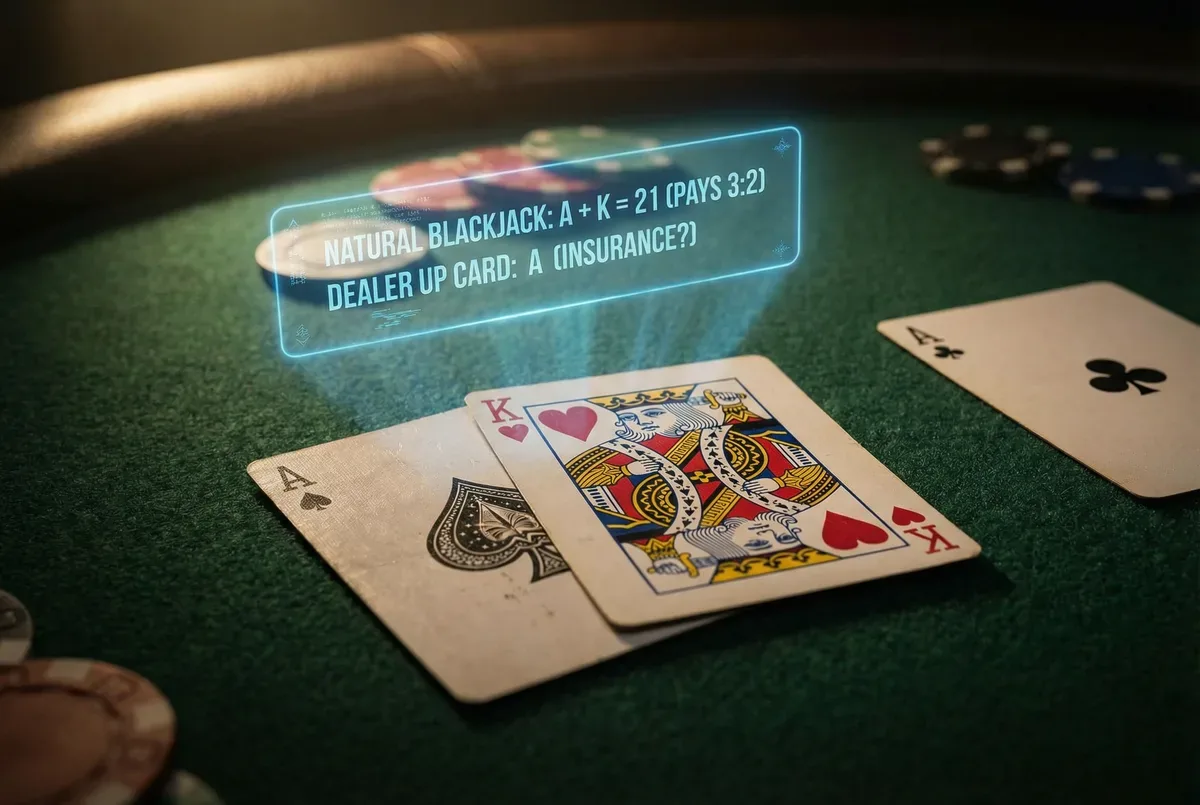
Insurance is the single most valuable deviation by EV contribution. At TC +3 or higher, taking insurance becomes a positive-expectation bet because the probability that the dealer’s hole card is a ten exceeds the break-even threshold. Insurance at a neutral or negative count is a losing side bet, which is why blackjack basic strategy never takes it. For a Hi-Lo counter, insurance at TC +3 and above converts a negative play into a positive one. This single deviation accounts for a disproportionate share of total index-play EV, which is why it appears at the top of every deviation ranking.
The standing deviations are the largest group. These involve standing on hands that blackjack basic strategy hits when the count is high enough to make standing correct. The most commonly encountered is 16 versus 10, which has an index of 0 meaning stand whenever the true count is at zero or positive. This is practically significant because 16 versus 10 is one of the most frequent close decisions at the table. A counter who only learns this single deviation captures meaningful EV simply from the frequency with which this hand appears. The other standing deviations 15 versus 10 at TC +4, 12 versus 2 and 3, 13 versus 2 and 3 follow the same logic but appear less frequently or require a more extreme count.
The doubling deviations add EV by identifying hands where a high count makes doubling correct even against blackjack basic strategy. Soft 19 doubled against dealer 5 and 6 are among the most surprising to new students blackjack basic strategy never doubles A-8, but a ten-rich shoe makes the double profitable against weak dealer upcards. The hard doubling additions 9 versus 2 at TC +1, 11 versus Ace at TC +1, 10 versus 10 at TC +4 are similarly non-intuitive and require a separate memorization effort from the standing group.
What Are the Fab 4 Surrender Deviations?
The Fab 4 is a companion set to the Illustrious 18 four surrender index plays that apply only when late surrender is available. These four deviations capture the majority of EV available from count-adjusted surrender decisions. They require the casino to offer late surrender, which is not universal, but when surrender is on the table these four plays are worth adding to the deviation repertoire immediately after the Illustrious 18 are solid.
The four deviations are: 14 versus 10 at TC +3 (surrender), 15 versus 10 at TC +0 (surrender which overrides the standing deviation at that index), 15 versus 9 at TC +2 (surrender), and 15 versus Ace at TC +1 (surrender). The logic in each case is that at sufficiently high counts, the dealer is likely to make a strong hand and the expected loss from playing the hand exceeds the guaranteed 50% loss from surrendering. These are negative hands made worse by a ten-rich deck, and surrender at the right index converts a bad play into a controlled loss.
The combined EV of the Fab 4 varies by game conditions, but in typical 6-deck games with surrender available, they add approximately 0.07% to 0.10% to total edge when executed accurately. This is not negligible it represents real money over a large sample of hands and it is available simply by adding four memorized thresholds to an existing deviation set.
Learning all 18 Illustrious Deviations adds approximately 0.15% to total counting edge. The top 6 deviations alone capture roughly 0.10% two-thirds of the available gain. Prioritise the top 6 until they are automatic, then add the remaining 12 as a second memory layer.
Edge Impact
What Are Memorization Method and Practice Sequence?
Index plays must be stored in a separate memory layer from blackjack basic strategy. Players who attempt to learn both simultaneously typically corrupt both. The correct sequence is: complete blackjack basic strategy until it is completely automatic zero errors at casino speed with zero hesitation and only then begin adding index plays. Mixing them during the learning phase creates false anchors where the deviation interferes with the base play and vice versa.
The clusters method is the most effective approach to organizing the deviations. Group them by true count value rather than by hand. At TC +3: take insurance, stand 16 versus 10 (already done at 0), double 9 versus 7. At TC +2: stand 12 versus 3, double A-8 versus 5, surrender 15 versus 9. At TC +1: double 9 versus 2, double 11 versus Ace, double A-8 versus 6, surrender 15 versus Ace. Organizing by true count lets you scan the table once at each count level and recall all applicable deviations simultaneously, rather than recalling each hand-situation independently. This is how the plays integrate with active counting rather than competing with it.
Practice sequence matters. Start with the top three by EV: insurance at TC +3, 16 versus 10 at TC 0, and 15 versus 10 at TC +4. Drill those three in isolation with flashcards or a deviation drill tool until the responses are immediate. Add the next three 10 versus 10, 12 versus 3, 11 versus Ace as a second stage. Proceed in EV-priority order, adding groups of three to four until the full set is solid. Running the full 18 in random-order flashcard drills before each study session reinforces retention without allowing pattern-based shortcuts that fail under casino randomness.
The fastest path to index play fluency is the clusters method: group deviations by true count level, not by hand. At TC +3, you need to know: take insurance, stand 16v10 (and 12v2 if not already doing so). At TC +2: stand 12v3. Practice by count level and you will recall all applicable deviations the moment the count hits a threshold instead of cycling through 18 individual hand memories during a live hand with a dealer waiting.
Putting Index Plays Into Live Action Without Blowing Your Cover
Executing deviations at the live table introduces a cover problem that simulation cannot prepare you for. When you stand on 16 versus a dealer 10 at a positive count, it looks deeply wrong to everyone at the table recreational players, dealers, and floor staff alike. Standing on a 16 is the kind of play that draws attention. The counter who executes it correctly but telegraphs the decision by pausing, hesitating, or showing calculation in their face has just flagged their counting to anyone paying attention. Deviations must be executed with the same casual confidence as a blackjack basic strategy hit no apparent deliberation, no visible connection to bet sizing or previous count behavior.
Some deviations are naturally less visible than others. Insurance at a high count is less conspicuous because recreational players take insurance occasionally for superstitious reasons the play itself does not stand out. Standing on 16 versus 10 is more conspicuous and should be executed with behavioral preparation. Doubling soft 19 against a 5 or 6 is very conspicuous and may invite comment. Know which of your deviations are high-visibility actions and practice delivering them without hesitation or the facial expressions that communicate analysis.
A structured live test before committing to full deviation execution is worth the session. If you want to see how live deck composition feels before running deviations in a real money environment, the live tables at Blackjack Academy use a real physical shoe where you can practice count-based decisions against actual dealt cards but understand that every hand at a live table involves real monetary risk, and no counting strategy eliminates the possibility of losing sessions.
Frequently Asked Questions
No. The top six deviations by EV insurance at TC +3, 16 vs 10 at TC 0, 15 vs 10 at TC +4, 10 vs 10 at TC +4, 12 vs 3 at TC +2, and 11 vs Ace at TC +1 capture roughly two-thirds of the total deviation EV. A counter with these six plus the Fab 4 surrender plays has most of the available index-play edge. Learning all 18 adds incremental value but is not a prerequisite for a positive expected return.
Yes. If the index for a deviation is TC +3, the deviation becomes correct at exactly TC +3 and above. Below TC +3, basic strategy is correct. The index number is not a suggestion it is the mathematically precise point where the deviation crosses from negative to positive EV. Playing a deviation one true count unit too early or too late produces negative expected value on that decision.
The Illustrious 18 list and index numbers were developed for Hi-Lo. Other counting systems Omega II, Zen Count, K-O produce different index numbers for the same deviations because the tag values and true count calculations differ. If you use a system other than Hi-Lo, use the index numbers calibrated specifically for that system. Applying Hi-Lo index numbers to a different count system produces incorrect deviation decisions.
Before you test these plays at a real table, run them through our free blackjack simulator practice unlimited hands at zero cost until every move becomes automatic.
Mathematical Risk Warning
Index plays add edge only when executed accurately at precise true count thresholds. Errors in index play execution produce negative EV and can exceed the gain of learning the deviations. Real-money blackjack involves significant financial risk regar
Blackjack Academy is an educational resource. All strategy is based on mathematical expectation. Always play within your means.
Learn More
Continue your education with these related lessons.

The Complete Guide to Back-Counting (Wonging)
Wonging back-counting a shoe and entering only at positive counts is theoretically the most efficient use of counting skill. Here…

What Research Reveals About Real Card Counting Win Rates and Data
Academic simulations and real-world data from Don Schlesinger's Blackjack Attack put hard numbers on what counters actually earn. The results…

How to Count Cards Without Getting Caught Using Proven Cover Plays
Cover plays are deliberate actions that disguise card counting from casino surveillance. Learn what they cost, when to use them,…