
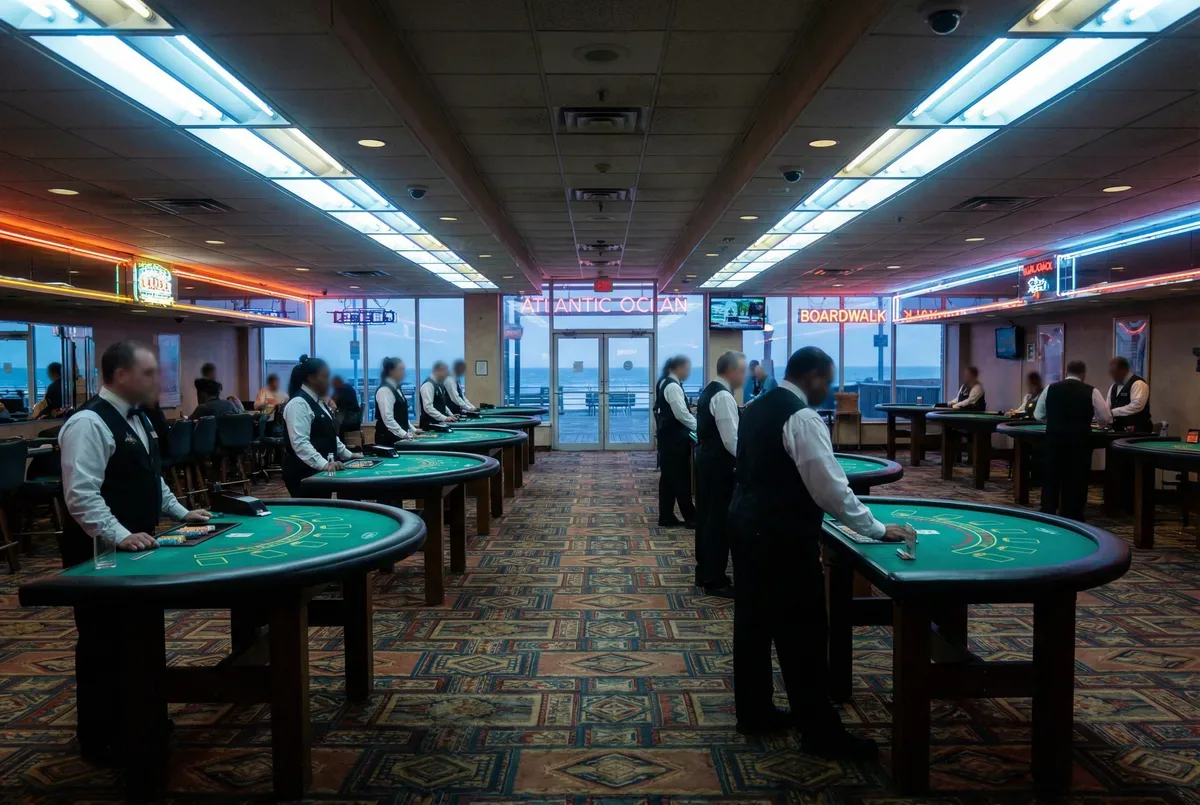
7 Key Differences in Card Counting Between Atlantic City and Las Vegas
The Uston v. Resorts International ruling by the New Jersey Supreme Court in 1982 established that Atlantic City casinos cannot bar a card counter from playing but the legal protection it created paradoxically produced some of the worst blackjack conditions in the country.
The 1982 Uston Ruling and What It Actually Means
Ken Uston, the professional card counter who brought the case, argued that the New Jersey Casino Control Act implicitly gave all qualified players the right to play in licensed casinos. The court agreed: because New Jersey had established a comprehensive regulatory framework for casinos, the state’s regulatory body not individual casinos held the authority to set rules about who could be excluded. Casinos could not act unilaterally to bar a legal activity like counting.
The ruling looked like a historic win for advantage players. Within months, it became clear it was not. New Jersey’s Casino Control Commission, responding to industry pressure, simply changed the game conditions to neutralize counting. The protection against barring turned into permission to destroy the games worth protecting.
Timeline
1979
Uston v. Resorts International Filed: Ken Uston sues Resorts International after being banned from blackjack. Case goes to NJ Supreme Court.
1982
NJ Supreme Court Rules: Court holds that Atlantic City casinos cannot bar card counters. Industry responds immediately.
1982–1983
Casino Control Commission Response: NJ regulators mandate rule changes including mandatory shuffle-on-demand and multiple-deck requirement. Penetration drops to near-useless levels.
1990s–2000s
CSM Proliferation: Continuous shuffle machines introduced across AC properties. Running count becomes impossible at CSM tables.
Present Day
AC properties offer some hand-dealt games, but conditions remain far inferior to comparable Las Vegas offerings.
How AC Casinos Responded: Conditions That Kill Counting?
Atlantic City casinos responded to the Uston ruling by mandating game conditions that make profitable blackjack card counting practically impossible a legal workaround that the Casino Control Commission permitted because it did not involve barring individual players.
The immediate response was shuffle-on-demand: dealers at AC properties were authorized to shuffle the shoe at their discretion when a player suspected of counting increased their bets significantly. This single rule change gutted the penetration that counting depends on. A counter who bets large at TC +3 and triggers an immediate reshuffle gains nothing the high-count shoe they built their bet on no longer exists after the shuffle.
The longer-term response was continuous shuffle machines. CSMs return discarded cards to the shoe after every hand, maintaining a constant near-infinite deck state. A running count against a CSM is statistically meaningless because the deck composition never depletes there is nothing to track. Today, a significant portion of blackjack tables at AC properties run on CSMs. The tables that remain hand-dealt tend to carry inferior rules, higher minimums, or aggressive reshuffle policies that limit effective penetration to levels where counting produces negligible edge.
The rules differences compound the penetration problem. AC games typically run with 8 decks (versus 6-deck standard in Vegas), stricter doubling restrictions, and lower overall flexibility in game rules. The theoretical blackjack house edge on an 8-deck AC game with standard AC rules is higher than a comparable 6-deck Vegas game with good rules meaning a counter at AC needs to overcome a larger baseline deficit before their edge contributes net positive EV.
Common Myth
“Atlantic City is better for card counters because the casinos can't bar you.”
The Uston ruling sounds like a definitive advantage. If you can't be removed, you can play indefinitely and extract unlimited EV from a positive count.
The Reality
The no-barring rule is legally real but operationally irrelevant. AC casinos responded with shuffle-on-demand policies and CSMs that eliminate the conditions counting requires. You can't be barred from a game that has been made unbeatable by design.
A counter at a CSM table extracts zero edge regardless of their skill level. A counter at an 8-deck hand-dealt AC table with shuffle-on-demand earns a fraction of the EV available at a comparable Vegas game, where barring risk is real but conditions are genuinely countable.
What Is the Legal Framework?
The legal right of casinos to exclude card counters varies by jurisdiction, but the variation has less practical significance for counters than the underlying game conditions at each location.
Nevada treats casinos as private businesses with broad exclusion rights. A Nevada casino can ask any patron to leave for any reason or no reason and is not required to explain itself. This authority is exercised routinely against suspected advantage players, though formal lifetime bans are rare. Most exclusions in Nevada take the form of a backoff: the player is asked to stop playing blackjack but may continue at other games or remain on the property.
New Jersey’s framework, established by the Uston ruling, sits at the opposite pole legally. The Casino Control Commission’s comprehensive oversight was interpreted by the court as displacing individual casino discretion over patron exclusions making NJ the only US jurisdiction where a skilled counter is legally protected from being barred specifically for counting. The Casino Control Act does permit exclusion for cheating, disruptive behavior, and other specific causes just not for playing the game skillfully.
Tribal casino jurisdiction depends on individual compact agreements between each tribe and its host state. Most tribal compacts follow Nevada norms and permit exclusion at the casino’s discretion. A small number of tribal properties in states with progressive gaming regulations have adopted more restricted exclusion policies, but these are exceptions rather than the rule. Counters evaluating tribal properties should treat exclusion risk as equivalent to Nevada until they have specific information about a particular property’s policies.
What Is Las Vegas vs Atlantic City?
When evaluated across the specific dimensions that determine counting profitability, Las Vegas outperforms Atlantic City on nearly every metric despite carrying genuine backoff and ban risk that AC legally cannot impose.
The backoff risk in Vegas is real and should not be minimized. A skilled counter playing correctly at a Strip property will eventually attract attention, and the casino retains full legal authority to ask them to leave or to stop playing blackjack. This happens. Advantage players accumulate backoffs over careers and manage them by rotating properties and managing session length. But the games being managed are genuinely countable good penetration, 6-deck shoes, favorable rules at many properties meaning the edge extracted before a backoff occurs is substantial.
At AC, there is no backoff but there is also often no game worth counting. The legal protection is preserved; the opportunity it was meant to protect has been engineered away.
Atlantic City
Las Vegas
- No (Uston ruling)
- Common at most properties
- High many tables
- 8 decks
- 50–65%
- Below Vegas average
- None (legally)
- Low to negative (many tables)
- Yes full legal authority
- Rare outside high-stakes pits
- Present but avoidable
- 6 decks (common)
- 70–85% (good games)
- Better at competitive properties
- Real accumulates over sessions
- Positive with proper game selection
Choosing Your Market and Playing to Its Rules
The Uston ruling applies only in New Jersey and no other major US gaming jurisdiction has adopted similar protections for card counters.
Nevada casinos retain full private property rights to exclude any patron they choose. Mississippi and Mississippi riverboat casinos follow Nevada-style rules backoffs are legal and practiced. Tribal casinos operate under compact agreements with their respective states and typically follow Nevada norms regarding exclusion, though tribal sovereignty creates some legal complexity that varies by property. In practice, most tribal casinos exercise the same backoff rights as commercial Nevada casinos.
For a counter evaluating jurisdiction, the practical question is not where barring is legally prohibited but where the games are worth playing. That answer remains Las Vegas for most serious advantage players specifically properties off the main Strip where game conditions are better and surveillance is somewhat less sophisticated. Downtown Vegas, the Boulder Strip, and North Las Vegas properties often offer 6-deck games with 80 percent or better penetration at lower minimums, representing the best combination of countable conditions and manageable heat in the country.
Before committing to any jurisdiction for real-money play, see this edge in live counted play lets you practice count-based decision-making in a live-dealer environment though every session there involves genuine financial risk, and the skill required to play with a real edge takes far longer to build than most players expect.
Frequently Asked Questions
Yes, legally AC casinos cannot bar a counter. But the ruling has been practically neutralized by shuffle-on-demand policies and continuous shuffle machines, which destroy the penetration and deck composition that counting requires. Legal protection does not create profitable conditions.
Las Vegas offers genuinely countable games 6-deck shoes with 75–85% penetration at the best properties, better rules, and lower baseline house edge. A counter in Vegas extracts real edge before eventually facing a backoff. In AC, the games have been engineered to prevent profitable counting in the first place, making the no-barring protection largely irrelevant.
Yes. Mississippi casinos and most tribal casinos follow Nevada-style rules that give the property full authority to exclude any patron. The Uston ruling is specific to New Jersey's regulatory framework and has not been adopted elsewhere in the US.
Before you test these plays at a real table, run them through our free blackjack simulator practice unlimited hands at zero cost until every move becomes automatic.
Mathematical Risk Warning
Card counting involves real financial exposure in every jurisdiction. No legal protection or advantage technique eliminates the risk of loss. Always play within your bankroll and understand the rules at your specific casino before wagering.
Blackjack Academy is an educational resource. All strategy is based on mathematical expectation. Always play within your means.
Learn More
Continue your education with these related lessons.

How the Red Seven Count Compares to Hi-Lo for Beginners
Arnold Snyder's Red Seven count eliminates true count conversion by using an unbalanced design. Here is how it compares to…

Complete Reference for All 18 Illustrious Card Counting Deviations
The Illustrious 18 deviations are the highest-value index plays in blackjack. This complete reference lists all 18 with TC thresholds,…
Why Index Numbers Are the Most Critical Tool in Every Counting Strategy
Index numbers are the true-count thresholds that tell you when to deviate from basic strategy. The Illustrious 18 capture the…