
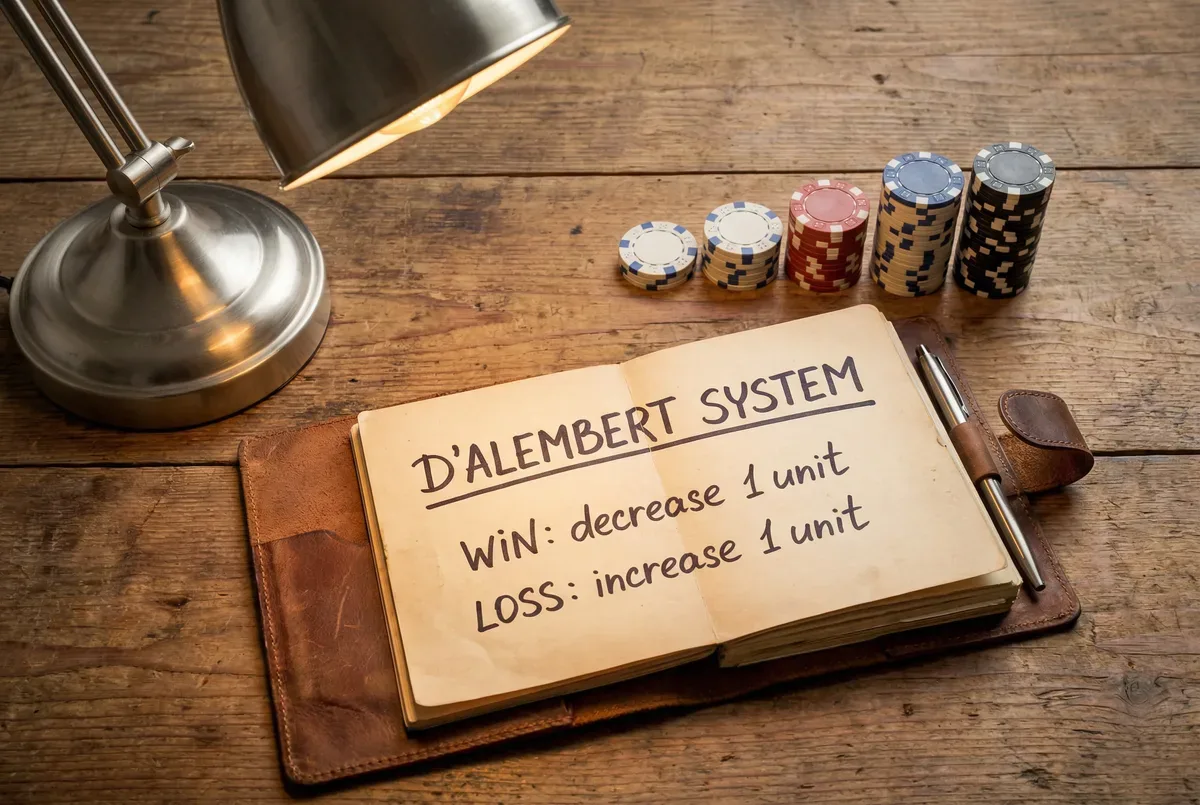
Why the D’Alembert Betting System Fails Most Blackjack Players Long-Term
The D’Alembert system is a negative-progression betting strategy where you add one unit to your bet after every loss and subtract one unit after every win. Named after the 18th-century French mathematician Jean le Rond d’Alembert, the system rests on the intuition that wins and losses must eventually balance out that after a string of losses, a win becomes more likely. At a $10 base unit, a loss sequence of four hands means your fifth bet is $50. A win brings you back to $40. The logic feels like a safety net. In practice, it is a slow leak dressed up as discipline.
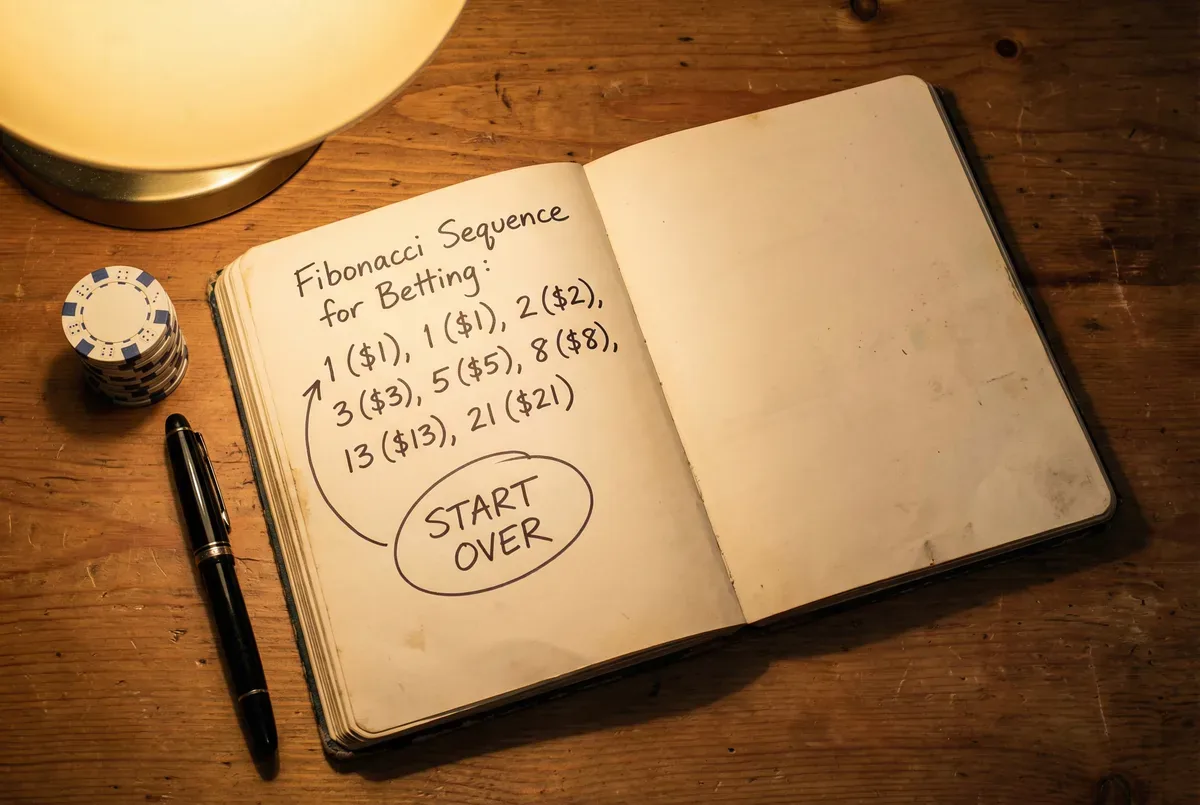
D’Alembert System Explained
Base unit
unit added per loss
Bet after 5 losses
units
Profit per win-loss pair
unit
How the Progression Actually Works?
Start at 1 unit. Lose: move to 2. Lose again: 3. Win at 3: drop to 2. Win again: drop to 1. In a perfectly alternating win-loss sequence you profit exactly 1 unit per win-loss pair. That sounds appealing. The problem is that blackjack hands do not alternate neatly. Runs of three, four, or five consecutive losses are statistically normal with a blackjack house edge around 0.5%, you lose roughly 49.75% of decisions. A six-hand losing streak, which happens to nearly every player in a two-hour session, pushes your bet to 7 units. Recovery from that level requires seven consecutive net wins at successively shrinking bet sizes.
The key structural difference from Martingale is growth rate. Martingale doubles after each loss exponential. D’Alembert adds one unit linear. After ten straight losses your Martingale bet is 1,024 units. Your D’Alembert bet is 11 units. This is why players describe D’Alembert as “gentler.” Gentler is not the same as safe. A ten-loss streak at 11 units still means you have wagered 65 units to recover a 10-unit deficit. Every one of those hands carries the same blackjack house edge.
D'Alembert
Martingale
- 7 units
- 28 units
- 6 wins
- Low
- 64 units
- 127 units
- 1 win
- Extreme
What Is the Gambler’s Fallacy Buried Inside D’Alembert?
D’Alembert’s original formulation contained a mathematical error: he believed the probability of heads increased after a run of tails in a coin flip. It does not. Each hand of blackjack is statistically independent of the last. The shoe has no memory of your previous results. The system’s entire logical foundation that losses should be “corrected” by subsequent wins is the gambler’s fallacy given a respectable name and a French accent.
What D’Alembert does accomplish is smoothing the variance profile relative to Martingale. You will rarely face table-limit problems. Bankroll drawdowns are more gradual. For players who find flat betting psychologically difficult who need the feeling of responding to results D’Alembert channels that impulse into a less destructive pattern. That is the honest case for it. It does not turn a losing game into a winning one. It makes losing at the mathematically expected rate feel more structured.
Common Myth
“D'Alembert guarantees recovery because wins and losses balance out”
Feels logical if you've lost more than you've won, the gap must close
The Reality
Each hand is independent. Past losses have zero influence on future outcomes. The system cannot alter expected value.
EV per hand = -0.5% × bet size, regardless of sequence
When D’Alembert Feels Like It’s Working and When It Breaks?
Short sessions with wins distributed evenly across the progression will show the system in its best light. You win a few at elevated bets and drop back down. The net result looks better than flat betting would have produced in that same sequence. Players remember these sessions. They do not remember the sessions where a losing streak pushed the line to 8 or 10 units and a brief winning patch only half-recovered the deficit before a new losing run began. Survivorship bias runs deep in how we evaluate betting systems.
The system breaks most visibly during extended losing streaks combined with interrupted recovery. You climb to 8 units, win twice and drop to 6, then lose four more and sit at 10. Now you need ten net wins to return to your starting bet. Meanwhile every hand at those elevated levels is amplifying the blackjack house edge in dollar terms. A 0.5% edge on a $10 bet costs $0.05 expected value. A 0.5% edge on a $100 bet costs $0.50. The system has not changed your probability of winning. It has changed the dollar magnitude of each expected loss.
Practice D’Alembert in a Zero-Consequence Environment First
Before you commit real money to any progression system, run it through live hands where the feedback is immediate and the stakes are not. At see this system in action with real money you can track your unit line through full sessions without a dollar changing hands watch how quickly a modest losing streak inflates your required bet, and understand what “recovery” actually looks like in practice before putting real money on the table where those elevated bets carry genuine financial consequence.
Frequently Asked Questions
It cannot produce a long-run profit in a negative-expectation game. It modifies how bets are sized but cannot change the house edge. Over thousands of hands it will return a loss equal to approximately 0.5% of total wagered.
It is less aggressive in terms of bet escalation. After six losses your D'Alembert bet is 7 units versus 64 units for Martingale. The risk of hitting a table limit or exhausting a bankroll is substantially lower but the house edge still applies to every hand.
Your starting unit should be no more than 1–2% of your session bankroll. If you sit down with $500, a $5–$10 unit keeps the progression within manageable range through typical variance without risking ruin on a single bad streak.
Before you test these plays at a real table, run them through our free blackjack simulator practice unlimited hands at zero cost until every move becomes automatic.
Mathematical Risk Warning
No betting system can overcome a negative expected value. The D'Alembert system modifies bet sizing only it cannot change the house edge of 0.5% (with basic strategy). Over a long enough sample, total losses will converge to house edge × total amount wagered.
Blackjack Academy is an educational resource. All strategy is based on mathematical expectation. Always play within your means.
Learn More
Continue your education with these related lessons.
Why Winning Streaks are Just Short Term Statistical Variance
Winning streaks feel like momentum, but the mathematics say otherwise. Every hot run in blackjack is a cluster of positive…

Why Side Bets Like Perfect Pairs Drain Your Bankroll
Perfect Pairs and other blackjack side bets carry house edges of 4–10%, far above the main game's 0.5%. This post…

Why Past Hands Have No Effect on Your Future Results
Each blackjack hand is an independent statistical event. Past losses do not make future wins more likely, and winning streaks…