

Why Taking Regular Breaks Keeps You Winning Longer
Every blackjack session demands hundreds of micro-decisions. Hit or stand. Double or flat call. Split or surrender. Each choice draws from a finite pool of cognitive energy, and research on decision fatigue shows that quality deteriorates sharply after sustained mental effort. At the blackjack table, a degraded decision is not just an inconvenience it is a mathematical error with a real dollar cost. A single deviation from blackjack basic strategy on a doubled hand can swing expected value by 1–4%. Multiply that across a tired two-hour stretch and the losses compound far beyond the blackjack house edge itself. Regular, structured breaks interrupt this erosion cycle before it becomes expensive. Professional players treat rest not as downtime but as an active bankroll-protection mechanism built into their session plan.
Decision Fatigue Is the Silent Bankroll Killer
Decision quality drop after 90 min
% avg decline
Strategy error rate when fatigued
× baseline
EV cost per fatigued deviation
% per hand
What Is the Physiology of a Profitable Rest Period?
A break does not mean wandering the casino floor for an indeterminate stretch. Effective rest is deliberate. Leave the table, move to a quiet area, and avoid stimulus that mimics play flashing screens, other games, or strategy discussion. The goal is cortical recovery: allow the prefrontal cortex, which governs rule-based reasoning and impulse control, to reset. Fifteen minutes away from the table environment is enough to substantially restore baseline decision accuracy according to cognitive load studies applied in high-stakes trading environments.
Hydration and posture matter more than most players acknowledge. Sitting hunched over a felt table for two hours reduces circulation and accelerates fatigue. Standing up, stretching, and drinking water during a break are not trivial self-care rituals they are tools for maintaining the mental sharpness that separates profitable strategy execution from expensive guesswork. Eating a light snack with slow-release carbohydrates before a long session also stabilizes blood glucose and delays the cognitive slump that typically arrives ninety minutes in.
Schedule breaks every 45–60 minutes regardless of run. If you are on a hot streak, the break still matters cognitive fatigue accumulates silently even when you are winning.
How Do You Structur Your Session Around Rest Windows?
Professional players do not wait until they feel tired to take a break. By the time fatigue registers consciously, strategy integrity has already been compromised for thirty minutes or more. The correct approach is a pre-committed break schedule: play for forty-five minutes, rest for fifteen, return. This 3:1 ratio mirrors performance protocols used in competitive chess and professional sports. Some counters use shoe boundaries as natural break triggers after every third or fourth shoe, step away and reassess.
Break scheduling also creates natural checkpoints for bankroll review. Each time you step away, note your session profit or loss, compare it to your stop-loss and stop-win targets, and make a clear-headed decision about whether to continue. This is far more reliable than making that same assessment mid-session when the sunk-cost fallacy and emotional momentum are actively distorting judgment.
- 000–0:45 Play Block 1 (table minimum warm-up)
- 045–1:00 Break: hydrate, stand, reset mentally
- 100–1:45 Play Block 2 (full strategy execution)
- 145–2:00 Break: review bankroll vs stop targets
- 200–2:45 Play Block 3 (execute or walk away)
- 245–3:00 Final review and session close
How Does Emotional Resets Are Work as Important as Cognitive Ones?
Tilt is the emotional counterpart to cognitive fatigue, and it is at least as damaging. A cold streak over twenty hands generates frustration that compromises strategy in predictable ways: players hit when they should stand on stiff hands, skip doubles on favorable counts, or start chasing losses with oversized bets. A break interrupts tilt at the source. Stepping away from a losing streak for fifteen minutes replaces emotional reactivity with the analytical distance required to execute strategy correctly.
Many experienced players keep a brief written log during breaks three lines noting session balance, any strategy deviations made, and emotional state. This ritual forces honest self-assessment and creates accountability that is impossible to maintain mid-session. If the log shows two or more deviations in the previous block, that is a signal to either extend the break or end the session entirely rather than reinforcing poor execution habits.
Test Your Break Discipline at the Live Table
The most revealing stress test for a break schedule is real play under real conditions. Visit take a timed break mid-shoe at a live dealer table to practise structured session management in a live-dealer environment. Remember that real money is at stake set your session blocks before you sit down and commit to the break schedule exactly as planned, regardless of how the cards are running. Discipline exercised against real financial pressure is the only discipline that transfers to a physical casino floor.
Frequently Asked Questions
Research on cognitive recovery suggests fifteen minutes of genuine rest away from game stimuli is sufficient to substantially restore prefrontal decision accuracy. Breaks shorter than ten minutes provide limited benefit.
Yes. Cognitive fatigue accumulates regardless of outcomes. A winning streak can mask deteriorating decision quality because variance temporarily rewards poor choices, reinforcing bad habits that will cost money long-term.
No. A break schedule is a cognitive tool, not a bankroll protection rule. You still need a hard stop-loss limit. Breaks improve decision quality during play; the stop-loss prevents catastrophic session losses regardless of how you feel.
Before you test these plays at a real table, run them through our free blackjack simulator practice unlimited hands at zero cost until every move becomes automatic.
Mathematical Risk Warning
Blackjack carries inherent variance. Even with perfect strategy and disciplined breaks, you can lose any session. Breaks reduce strategic error but do not eliminate house edge or variance risk.
Blackjack Academy is an educational resource. All strategy is based on mathematical expectation. Always play within your means.
Learn More
Continue your education with these related lessons.
Why Setting a Stop Win is a Critical Professional Skill
A stop-win rule is not pessimism about your ability to keep winning. It is the mathematical recognition that every hand…
The Real Difference Between Replenishable and Static Gambling Funds
Not all gambling money is the same. Replenishable funds sourced from ongoing income behave differently from static capital in both…
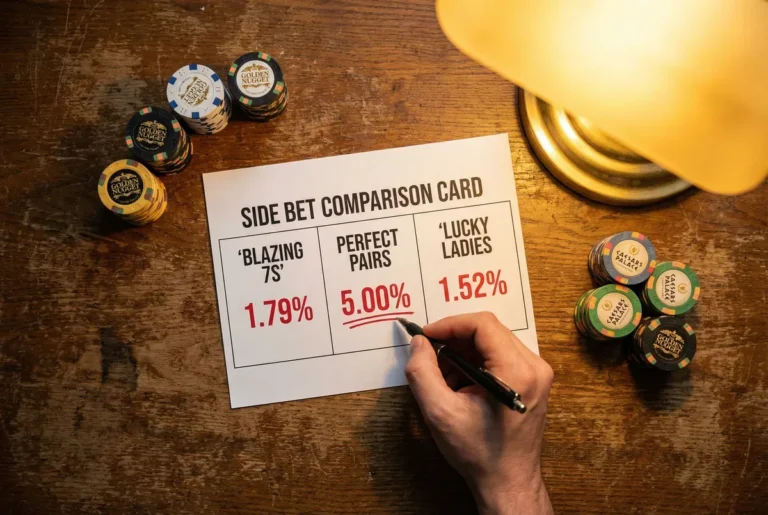
House Edge of Popular Side Bets Like Blazing 7s
Blazing 7s, Lucky Lucky, and Royal Match all carry house edges far above the main game. This post gives you…